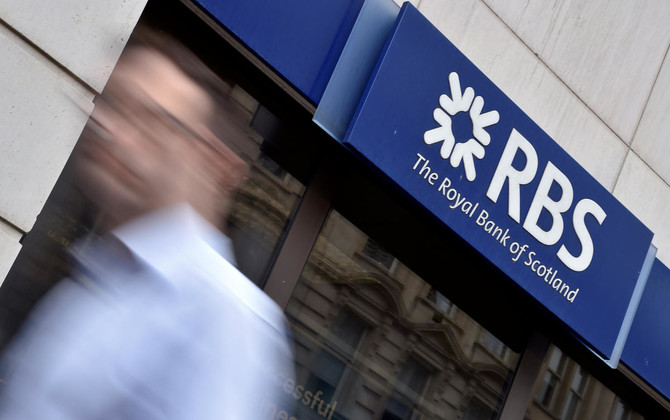
LONDON: British state-owned Royal Bank of Scotland (RBS) said on Friday it will close 259 branches and cut 680 jobs as it reduces costs and encourages customers to use online and mobile services.
The latest round of closures at the Edinburgh-based bank follow 180 announced in March, putting 1,000 jobs at risk, and a similar move by Lloyds Banking Group which said on Wednesday it would close 49 branches.
British banks are set to close a record 762 branches this year, Reuters reported in August, drawing criticism for depriving customers of access to in-person services, particularly in poorer parts of the country.
Jane Howard, RBS’s managing director of branch banking, said that customers are increasingly using mobile and online channels rather than bricks-and-mortar branches, and RBS had to react to that.
“There will be some customers that will be really disappointed we are closing branches … and I understand why. But it’s important that we do respond.”
RBS is investing in its remaining branches and its digital offering, Howard said, adding: “Given what we know, we’ve got the right shape of network.”
Unite, a labor union that represents staff at RBS, said the bank was “decimating” its branch network.
“This announcement will forever change the face of banking in this country resulting in over a thousand staff losing their jobs and hundreds of high streets without any banking facilities,” Rob MacGregor, Unite national officer, said.
The latest closures will affect the bank’s RBS and Natwest brands in England, Wales and Scotland, leaving it with around 744 branches.
Low interest rates and increasing competition from startup banks have eaten into profits for many of Britain’s banks, prompting them to cut costs and RBS CEO Ross McEwan has cut thousands of jobs.
The bank reported a stronger-than-expected operating profit for the third quarter of this year after keeping expenses under control and avoiding any misconduct charges, which, along with restructuring costs, have dogged the bank’s return to profitability since the financial crisis.
RBS hopes to post its first profit since 2007 in 2018, but that depends on when it reaches a multi-billion pound settlement with the US Department of Justice over the mis-selling of toxic mortgage backed securities in the US.
It finalized the closure of its ‘bad bank’, set up to sell unwanted assets nearly a decade after it was rescued in a £45-billion bailout, on Thursday and this month the British government said it plans to start selling £15 billion of shares in RBS next year.

RBS axes further 259 British branches as it expands e-banking
PIF-backed AviLease achieves revenue of $664m and 19% growth in 2025
RIYADH: Saudi Arabia’s Public Investment Fund-backed AviLease achieved exceptional performance and sustainable business growth during 2025, supported by the strategic expansion of its global platform.
According to its financial results for 2025, AviLease recorded total revenues of $664 million, an annual increase of 19 percent, driven by disciplined growth in its asset portfolio and strong performance in aircraft remarketing amid sustained global demand for modern, fuel-efficient aircraft, the Saudi Press Agency reported.
Profit before tax doubled compared to the previous year, reaching $122 million. The year witnessed an expansion in AviLease’s portfolio, reaching 202 owned and managed aircraft, leased to over 50 airline companies in more than 30 countries.
The total value of the company’s assets stabilized at $9.3 billion. AviLease maintained a 100 percent fleet utilization rate, reflecting the resilience of its business model, the efficiency of its asset management, and the strength of its strategic relationships with airlines around the world.
AviLease concluded purchase agreements for aircraft from Airbus, including the A320neo family and A350F, and Boeing 737 aircraft, aiming to enhance its future asset portfolio with modern, fuel-efficient aircraft. This step will contribute to supporting future growth and meeting increasing customer demand for the latest aircraft, aligning with the Kingdom’s ambitions to become a leading global aviation hub.
AviLease strengthened its prestigious credit standing by obtaining a strong Baa2 credit ratings from Moody’s and BBB from Fitch, reflecting its financial solidity, managerial discipline, and efficiency in managing leverage. The company also successfully issued senior unsecured bonds worth $850 million last November under Regulation 144A/RegS. This issuance contributed to diversifying its funding sources and enhancing its financial flexibility.
Commenting on the results, AviLease CEO Edward O’Byrne said: “This exceptional performance reflects the quality of the company’s investment portfolio, the strength of its partnerships with airlines, and its strategic focus on responsibly deploying capital into highly sought-after, efficient, modern aircraft assets.”
He added: “As aviation markets continue to grow, AviLease is strategically positioned to continue its expansion plans and deliver sustainable long-term value for shareholders, contributing to the Kingdom’s ambitions.”
Throughout 2025, AviLease continued to play a pivotal role in the Kingdom’s growing aviation sector and contributed directly to the launch and scaling of the new national carrier, Riyadh Air, by completing a sale and leaseback transaction for a Boeing 787-9 aircraft, which thereby became the first aircraft to join the airline’s fleet.
AviLease also established a strategic partnership with Hassana Investment Co. This partnership aims to provide an opportunity for local and international investors to enter the aircraft financing asset class and benefit from AviLease’s technical expertise and operational capabilities to support partnership growth and enhance performance.
Hassana Investment Co. has agreed to acquire an initial portfolio of 10 modern aircraft from AviLease.