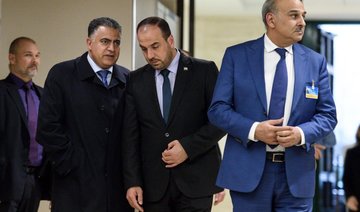
GENEVA/ANKARA: Syria’s opposition wants Russia and other states to put pressure on President Bashar Assad to engage in peace talks in Geneva to produce a political solution within six months, the chief of its delegation said at the start of negotiations on Wednesday.
“We want more pressure on the regime to engage in the negotiation and continue in the negotiation to reach a political solution in six months, as (UN Security Council Resolution) 2254 says,” Nasr Hariri told Reuters.
“Just speaking about a political transition without any advancement, we will lose our trust in the process and our people will lose their trust in us and in the process itself.”
The talks were originally planned to last 4-5 days, but UN mediator Staffan de Mistura now planned to extend them until Dec. 15, Hariri said, adding that his team had come hoping for direct talks with the regime delegation for the first time.
Meanwhile, Turkey’s top security body, the National Security Council (MGK), on Tuesday recommended that the government deploy forces around Syria’s Kurdish-held Afrin canton and in western Aleppo.
The MGK emphasized Turkey’s determination to secure its borders against terrorist groups. Afrin is controlled by the US-backed Kurdish People’s Protection Units (YPG), which Ankara views as the Syrian affiliate of the outlawed Kurdistan Workers’ Party (PKK).
On Monday, Turkish Defense Minister Nurettin Canikli hinted at a possible operation in Afrin, saying such an operation “may be tomorrow or... sooner than tomorrow.”
Last week, he said the PKK/YPG presence in Afrin poses a “serious danger and threat that should be removed in line with Turkey’s rights arising from international law.”
The Turkish military recently completed the formation of its third observation post in Syria’s northwest Idlib province, as part of a cease-fire co-guaranteed with Russia and Iran.
Earlier this month, Turkish President Recep Tayyip Erdogan said his country needed to clear Afrin of the YPG after accomplishing its military operation in Idlib.
But Serhat Erkmen, a Middle East expert at the Ankara-based 21st Century Turkey Institute, told Arab News: “Following the agreement reached in Sochi last week between Moscow, Tehran and Ankara, a comprehensive military operation that would escalate regional tension is unlikely.”
He added: “Even if it took place, it wouldn’t be a military operation that changes the balance power fundamentally, at a time when the Syrian conflict is evolving toward a political settlement.”
Turkey’s Operation Euphrates Shield in northern Syria last year was conducted after getting the green light from Moscow.
Any move on Afrin, where Russian military observers were deployed this summer, would also need its approval.
“Ankara should reach an agreement with Moscow over who will control Afrin if the PKK/YPG are removed from the region: The Syrian regime or the Free Syrian Army (FSA), which is backed by Turkey? It’s the key question,” Erkmen said. “Turkey won’t feel secure so long as the PKK is in Afrin.”
But the risks of such an operation may be prohibitively high, he added. “First of all, there’s a military risk. The PKK has been preparing for a possible Turkish operation for a while.”
Erkmen said: “One shouldn’t forget the political risks as well. We don’t know how the Syrian government will react.”
He added: “If the perceived security threat is bigger than the current risk, decision-makers will take into consideration the dynamics not only of Syria but the whole region.”
Bora Bayraktar, a Middle East expert from Istanbul Kultur University, told Arab News: “The operation will be mostly a continuation of Turkey’s military engagement in the Idlib de-escalation zone.”
“The region will be contained by moving as close as possible to Aleppo and the town of Tal Rifat,” he said.
“Fifty-five percent of Afrin’s population are Arabs, Kurds make up 30-35 percent, and the rest are Turkmen. With the stability that would be brought by a possible Turkish operation, the return of displaced populations may restore the original demography and neutralize the PKK/YPG presence.”
If Syrian-Kurdish forces resist the Turkish operation, Ankara may use aerial attacks and shelling without launching a ground operation with its troops, Bayraktar said.


![]()

Opposition wants Russian pressure for Syria deal within six months
Opposition wants Russian pressure for Syria deal within six months


Latest updates


© 2026 SAUDI RESEARCH & PUBLISHING COMPANY, All Rights Reserved And subject to Terms of Use Agreement.