Pope meets Myanmar’s Suu Kyi as Rohingya crisis looms large

1 / 6
Pope Francis, left, speaks with Myanmar’s civilian leader Aung San Suu Kyi during their meeting in Naypyidaw on November 28, 2017. (AFP)
2 / 6
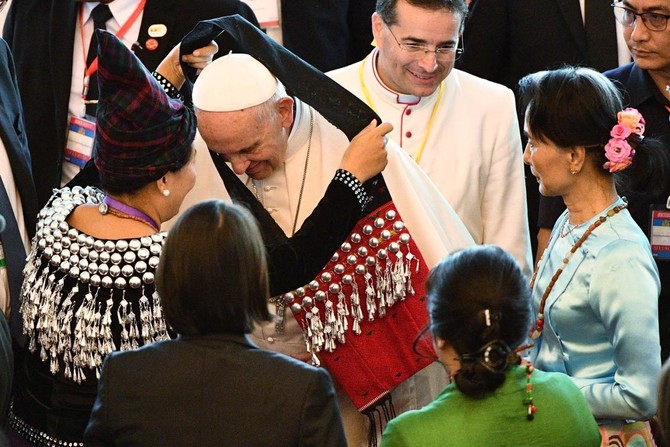
Pope Francis, center, is presented with a gift, as Myanmar’s civilian leader Aung San Suu Kyi, right, looks on, in Naypyidaw on November 28, 2017. (AFP)
3 / 6
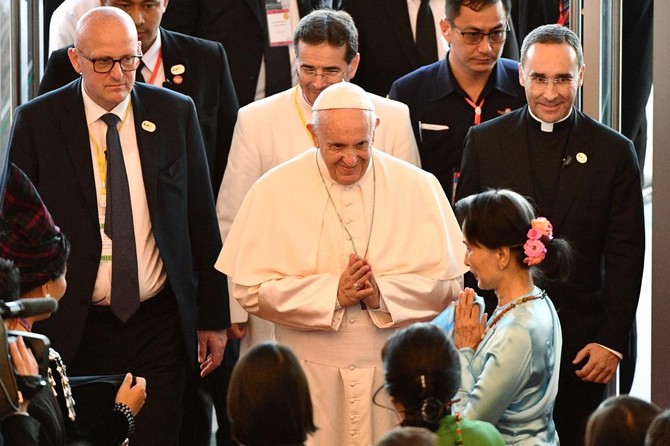
Pope Francis, center, is greeted by Myanmar’s civilian leader Aung San Suu Kyi, front right, in Naypyidaw on November 28, 2017. (AFP)
4 / 6
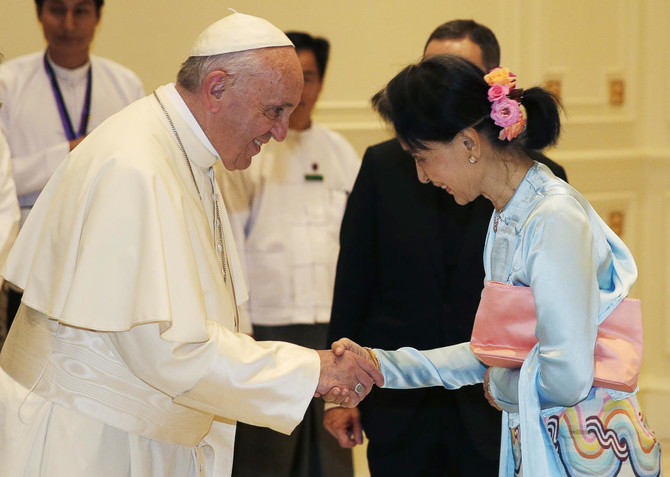
Pope Francis shakes hands with Myanmar’s leader Aung San Suu Kyi in Naypyitaw, Myanmar, Tuesday on November 28, 2017. (Pool Photo via AP)
5 / 6
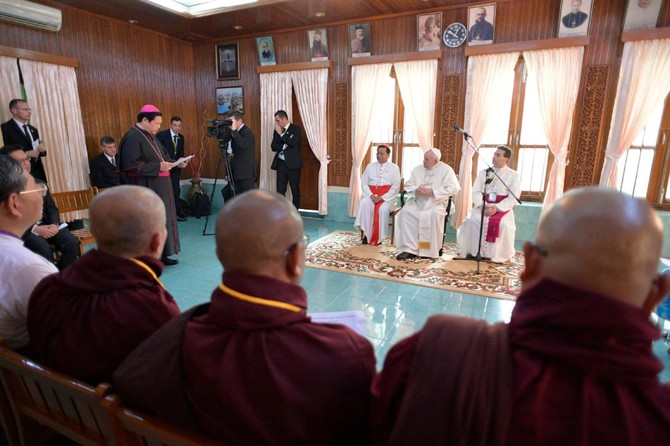
This handout picture taken and released by the Vatican press office (Osservatore Romano) shows Pope Francis (back 2nd R) attending a meeting with religious leaders from various faiths in Yangon on November 28, 2017. (OSSERVATORE ROMANO via AFP)
6 / 6
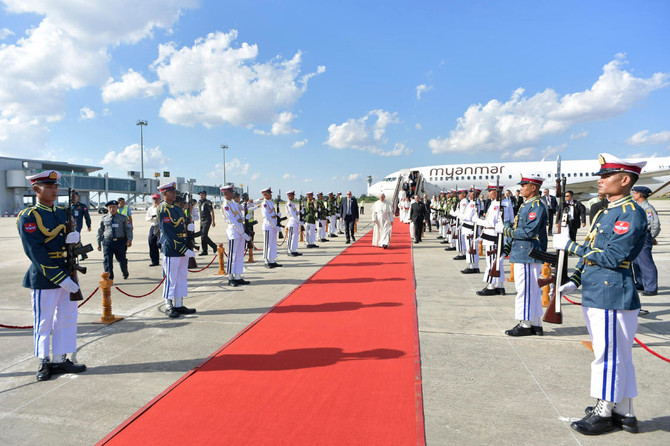
This handout picture taken and released by the Vatican press office (Osservatore Romano) shows Pope Francis, center, walking past an honor guard as he arrives at the airport in Naypyidaw on November 28, 2017. (OSSERVATORE ROMANO via AFP)
Updated 28 November 2017
Follow

Pope meets Myanmar’s Suu Kyi as Rohingya crisis looms large

NAYPYIDAW, Myanmar: Pope Francis held talks with Myanmar’s leader Aung San Suu Kyi on Tuesday, a pivotal moment in a visit aimed at alleviating religious and ethnic hatreds that have driven huge numbers of Muslim Rohingya from the country.
After meeting Suu Kyi in the capital Naypyidaw, the pontiff will deliver a keenly-awaited address — his first opportunity to speak publicly about a refugee crisis that hangs heavy over his four-day trip.
His words will be scrutinized for references to the “Rohingya,” an incendiary term in a mainly Buddhist country where the Muslim minority are denied citizenship and branded illegal “Bengali” immigrants.
Francis has repeatedly defended the group, some 620,000 of whom have fled to Bangladesh since August.
Suu Kyi, a Nobel Peace Prize winner, has been ostracized by a global rights community that once adored her but is now outraged at her tepid reaction to the plight of the Rohingya.
She is due to deliver remarks after the pope, who signed a guestbook at the presidential palace on Tuesday afternoon delivering “the divine blessings of justice, peace and unity” to Myanmar’s people.
The pope’s peace mission is studded with pitfalls in Myanmar, where a monk-led Buddhist nationalist movement has fostered widespread loathing for the Rohingya.
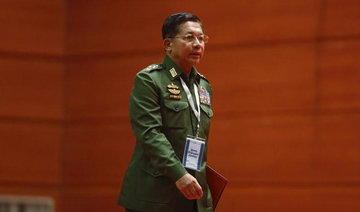
Late on Monday the 80-year-old pontiff received a “courtesy visit” from Myanmar’s powerful army chief — whose troops, according to the UN and US, have waged a campaign of ethnic cleansing against the Rohingya from Rakhine state.
Senior General Min Aung Hlaing has firmly denied allegations of widespread brutality by his forces, despite the flight of Rohingya who have recounted widespread cases of rape, murder and arson.
His office said he told the pope there was “no discrimination” in Myanmar, and feted his military for maintaining “the peace and stability of the country.”
Early Tuesday — day two of his visit — the pontiff met leaders from Buddhist, Muslim, Baptist and Jewish faiths in Yangon.
The conversation centered around themes of unity and diversity, with the pope sharing a prayer and giving a “very, very beautiful speech,” according to Sammy Samuels, a representative from the small Jewish community.
The Lady, as she is fondly known in Myanmar, finally came to power after elections in 2015 but has fallen from grace internationally for not doing more to stand up to the army in defense of the Rohingya — whose name she will not publicly utter.

Rights groups have clamored for Suu Kyi to be stripped of her peace prize. Oxford, the English city she once called home, on Monday removed her Freedom of the City award for her “inaction” in the face of oppression of the Rohingya.
Just days before the papal visit, Myanmar and Bangladesh signed a deal to start repatriating Rohingya refugees within two months.
But details of the agreement — including the use of temporary shelters for returnees, many of whose homes have been burned to the ground — raise questions for Rohingya fearful of returning without guarantees of basic rights.
Francis will travel on to Bangladesh on Thursday.
So far, the pontiff has received a warm welcome in Myanmar, whose Catholic community numbers just over one percent of the country’s 51 million people.
But some 200,000 Catholics are pouring into the commercial capital Yangon from all corners of the country ahead of a huge, open-air mass on Wednesday morning.
Zaw Sai, 52, from Kachin state, found space for himself and his family to camp out in a churchyard.
“We feel very pleased because we are from different ethnicities but are one in our religion,” he told AFP.
Backlash as Australia kills dingoes after backpacker death

Updated 58 min 43 sec ago
Follow

Backlash as Australia kills dingoes after backpacker death

  • The euthanization program has stirred debate about how to manage the local population of dingoes
  • Wildlife experts said killing the animals was the wrong response and may threaten the island’s dingo population

SYDNEY: Australian authorities have sparked a backlash by killing a group of dingoes linked to the death of a young Canadian woman on an island in the country’s east.
The Queensland government said six animals were put down after 19-year-old backpacker Piper James’s body was found on January 19 at a beach on the World Heritage-listed island of K’gari.
The euthanization program has stirred debate about how to manage the local population of dingoes, a sandy-colored canine believed to have first arrived in Australia 4,000 to 5,000 years ago.
An autopsy conducted on James’ body found evidence “consistent with drowning” but also detected injuries corresponding to dingo bites.
“Pre-mortem dingo bite marks are not likely to have caused immediate death,” said a spokesperson for the Coroners Court of Queensland.
The coroner’s investigation into the cause of death was expected to take several weeks.
In response, the Queensland government said a pack of 10 dingoes involved would be euthanized after rangers had observed some “aggressive behavior.”
Six of the dingoes had already been euthanized, the state’s environment minister, Andrew Powell, told reporters Sunday.
“Obviously, the operation will continue,” he said.
The traditional owners of K’gari, the Butchulla people, said the state’s failure to consult with them before euthanizing the dingoes — or wongari in their language — was “unexpected and disappointing.”
“Once again, it feels as though economic priorities are being placed above the voices of the people and traditional owners, which is frustrating and difficult to accept,” the Butchulla Aboriginal Corporation said in a statement to Australian media this week.
‘You are food’
Wildlife experts said killing the animals was the wrong response and may threaten the island’s dingo population, estimated at just 70-200 animals.
Given their small numbers, killing a pack of 10 animals would harm the population’s genetic diversity, said Mathew Crowther, professor of quantitative conservation biology at the University of Sydney.
“There’s no moral from the dingoes’ point of view. They’re just being wild animals, doing wild things,” Crowther said.
Dingoes tend to lose their fear of people as they interact with tourists, some of whom defy advice against feeding the animals.
“That’s the worst thing you can do to a wild animal,” Crowther said.
“They just relate humans to food, and if you don’t give them food, well, you are food — that’s basically how it is.”
Dingoes are wild, predatory animals and need to be treated with respect, said Bill Bateman, associate professor in the school of molecular and life sciences at Curtin University.
The canines are more likely to attack children or people who are alone, and may be triggered when people turn their backs or run, he said.
“These are important animals, and therefore we need to change the way we deal with them, otherwise we’re just going to keep reacting to these attacks and driving the population of dingoes down,” Bateman said.
Wildlife managers, rangers, Indigenous people and tourism operators need to work together so that humans and dingoes can coexist on the island, he said.
Todd James, the father of Piper, has described on social media how his family’s hearts were “shattered” by her death.
News of the dingoes’ euthanization was “heart-wrenching,” he told Australian media, adding however that he recognized it may be necessary for safety because of the pack’s behavior.