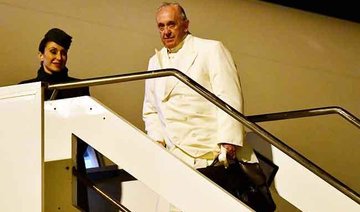
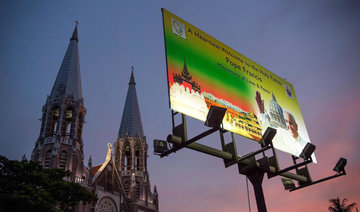
YANGON: Pope Francis arrived in mainly Buddhist Myanmar Monday on a highly sensitive visit to a country facing sharp global criticism for the alleged ethnic cleansing of its Rohingya Muslim minority.
The 80-year-old pontiff, the first to travel to Myanmar, was welcomed by children from different minority groups in bright, bejewelled clothes, who gave him flowers and received a papal embrace in return.
Nuns in white habits were among the devotees to have traveled from across the country in his honor, waving flags as his motorcade swept by the golden Shwedagon Pagoda to the archbishop’s residence in downtown Yangon, where the pope will stay on Monday night.
“I saw the pope, he was sitting in the front of the car. I was so pleased, I cried!” Christina Aye Aye Sein, 48, told AFP after the pope’s convoy passed.
“His face looked very lovely and sweet... He is coming here for peace.”
But the joyful scenes stood in stark contrast to the gravity of the main issue that frames his trip.
Myanmar’s military stands accused of waging a campaign of ethnic cleansing against the Rohingya Muslims.
More than 620,000 have fled a crackdown in northern Rakhine state for neighboring Bangladesh over the past three months.
The pope’s four-day visit intensifies pressure on Myanmar over its treatment of the stateless minority, a group he has called his “brothers and sisters” in repeated entreaties to ease their plight.
His speeches will be scrutinized by Buddhist hard-liners for any mention of the word “Rohingya,” an incendiary term in a country where the Muslim group are reviled and labelled “Bengalis” — alleged illegal immigrants from Bangladesh.
Francis will meet civilian leader Aung San Suu Kyi, a Nobel Peace Prize winner whose lustre has faded because of her failure to speak up publicly for the Rohingya.
He will also hold talks with army chief Min Aung Hlaing — a meeting between a religious leader, who has championed the rights of refugees, and the man accused of overseeing the brutal campaign to drive out the Rohingya.
Speaking to a crowd of 30,000 people in St. Peter’s Square, shortly before he left Rome, the pontiff said: “I ask you to be with me in prayer so that, for these peoples, my presence is a sign of affinity and hope.”
His visit is a historic chance for Myanmar’s flock to get close to the head of their church.
Myanmar’s estimated 700,000 Catholics make up just over one percent of the country’s 51 million people and are scattered in far-flung corners of the nation, many of them roiled by conflict.
Around 200,000 Catholics are pouring into Yangon, Myanmar’s commercial capital, by plane, train and car ahead of a huge open-air mass on Wednesday.
“People came from all corners of the country, even if we could only see him for a few seconds,” Sister Genevieve Mu, an ethnic Karen nun told AFP.
“I feel very good and proud of our Catholic people and our government for opening the country for his visit.”
The Rohingya crisis looms large over the pope’s visit.
The army, which ran the country with an iron fist for nearly half a century, insists its Rakhine operation was a proportionate response to Rohingya “terrorists” who raided police posts in late August, killing at least a dozen officers.
But rights groups, the UN and the US have accused the army of using its operation as cover to drive out a minority it has oppressed for decades.
The deluge of desperate refugees arriving in Bangladesh have carried with them accounts of murder, rape and arson, at the hands of troops and hard-line Buddhist mobs.
Inside the country a different opinion dominates.
“The vast majority of people in Myanmar do not believe the international narrative of abuse against the Rohingya and the refugee numbers that we’re seeing in Bangladesh,” said Myanmar-based political analyst Richard Horsey.
“If the pope did come and weigh in heavily on this issue, it would inflame tensions and it would inflame public sentiment,” he added.
Days before the pope’s visit, Myanmar and Bangladesh inked a deal vowing to begin repatriating Rohingya refugees in two months.
But details of the agreement — including the use of temporary shelters for returnees, many of whose homes have been burned to the ground — raise questions for Rohingya fearful of coming back without guarantees of basic rights.
Pope Francis will travel on to Bangladesh on Thursday, where he will meet a group of Rohingya Muslims in the capital Dhaka.
Nur Mohammad, a 45-year-old Rohingya imam at the Nayapara refugee camp in Cox’s Bazar in Bangladesh, said he hoped the pope would tell the Myanmar government to accept Rohingya, “give citizenship to them and end all discriminations against them.”