

Thousands stranded as Bali airport closes

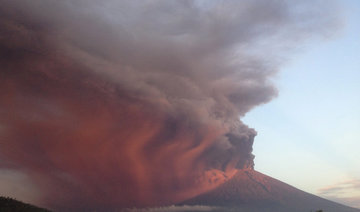
Mount Agung volcano is seen spewing smoke and ash in Bali, Indonesia, on Sunday in this photo obtained from social media. (REUTERS)
Updated 27 November 2017
Follow

Thousands stranded as Bali airport closes

JAKARTA, Indonesia: Thousands of travelers are stranded in Bali after ash from the Mount Agung volcano on the tourist island forced the international airport to close early Monday.
Flight information boards showed rows of cancelations as tourists arrived at the busy Bali airport expecting to catch flights home.
Hundreds of flights are canceled and authorities say seven flights were diverted to airports in Jakarta, Surabaya and Singapore when the closure was announced at about 6 a.m.
Mount Agung has been hurling ash thousands of meters into the atmosphere, which forced the small international airport on the neighboring island of Lombok to close Sunday as the plumes drifted east. It has since reopened.
Airport authorities say the decision to close Bali’s I Gusti Ngurah Rai airport was made after tests showed ash had reached its airspace.

Indonesian authorities raised the alert for a menacing volcano on the tourist island of Bali to the highest level Monday and ordered people within 10 kilometers (6 miles) to evacuate.
The National Disaster Mitigation Agency said Bali’s international airport had closed for 24 hours and authorities would consider reopening it Tuesday after evaluating the situation.
Mount Agung has been hurling ash thousands of meters into the atmosphere, which forced the small international airport on the neighboring island of Lombok to close Sunday as the plumes drifted east.
Geological agency head, Kasbani, who goes by one name, said the alert level was raised at 6 a.m. on Monday because the volcano has shifted from steam-based eruptions to magmatic eruptions. However he says he’s still not expecting a major eruption.
“We don’t expect a big eruption but we have to stay alert and anticipate,” he says.
Previously the exclusion zone around the volcano ranged between 6 and 7.5 kilometers.
The volcano’s last major eruption in 1963 killed about 1,100 people.
Cuba launches mass demonstration to decry US attack on Venezuela and demand Maduro’s release

Updated 12 sec ago
Follow

Cuba launches mass demonstration to decry US attack on Venezuela and demand Maduro’s release

  • “The entire Nation rises up!” wrote Cuba’s Foreign Ministry on X
  • “It is a resounding response to those who dare to threaten the peace and sovereignty for which we have fought so hard”

HAVANA: Tens of thousands of Cubans crowded Friday into an open-air plaza known as the “Anti-Imperialist Tribune” across from the US Embassy in Havana to decry the killing of 32 Cuban officers in Venezuela and demand that the US government release former president Nicolás Maduro.
The crowd clutched Cuban and Venezuelan flags as part of a demonstration organized by the government as tensions between Cuba and the US remain heightened after the US struck Caracas on Jan. 3 and arrested Maduro.
“The entire Nation rises up!” wrote Cuba’s Foreign Ministry on X. “It is a resounding response to those who dare to threaten the peace and sovereignty for which we have fought so hard.”
The 32 Cuban officers were part of Maduro’s security detail killed during the Jan. 3 raid on his residence to seize the former leader and bring him to the US to face drug trafficking charges.
Cuba’s national hymn rang out at Friday’s demonstration as large Cuban flags waved in the chilly wind and big waves broke nearby along Havana’s famed pier. President Miguel Díaz-Canel shook hands with the crowd clad in jackets and scarves.
The demonstration was a show of popular strength after US President Donald Trump recently demanded that Cuba make a deal with him before it is “too late.” He did not explain what kind of deal.
Trump also has said that Cuba will no longer live off Venezuela’s oil and money. Experts say the move could have catastrophic consequences since Cuba is already struggling with severe blackouts.
Friday’s demonstration was expected to become a parade that Cubans call a “combatant march,” a custom that originated during the time of the late leader Fidel Castro.
Washington has maintained a policy of sanctions against Cuba since the 1960s, but during Trump’s presidency, the sanctions were further tightened, suffocating the island’s economy, an objective explicitly acknowledged by the White House.
On Thursday, tens of thousands of Cubans gathered at the headquarters of the Ministry of the Armed Forces to pay their respects to the 32 officers killed.
Their remains arrived home on Thursday morning, and they are scheduled to be laid to rest on Friday afternoon in various cemeteries following memorial ceremonies in all of Cuba’s provincial capitals.