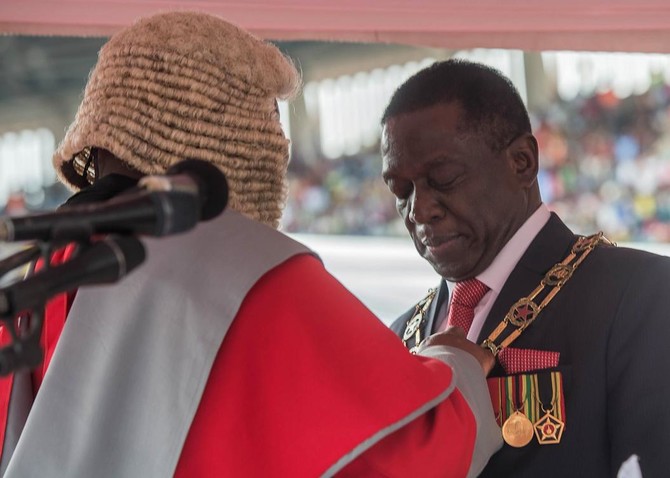
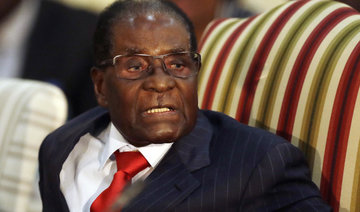
HARARE: A Zimbabwean High Court judge has ruled that the military action leading to Robert Mugabe’s resignation was legal.
High Court Judge George Chiweshe on Friday ruled that the military’s actions “in intervening to stop the takeover” of Mugabe’s constitutional functions “by those around him are constitutionally and lawful.”
The military stepped in almost two weeks ago after Mugabe’s firing of deputy Emmerson Mnangagwa amid fears that Mugabe’s wife was positioning herself to take power.
Zimbabwe’s military has sought to show its actions were not a coup.
The judge said the military’s actions ensured that non-elected individuals do not exercise executive functions.
Separately, the judge said Mugabe’s firing of Mnangagwa as vice president was illegal. Mnangagwa was sworn in as president on Friday in a whirlwind reversal of fortunes.

Zimbabwe judge says military action against Mugabe was legal
Israel to seek new security deal with the US, FT reports
Israel is preparing for talks with the Trump administration on a new 10-year security deal, seeking to extend US military support even as Israeli leaders signal they are planning for a future with reduced American cash grants, the Financial Times reported on Tuesday.
Gil Pinchas, speaking to the FT before stepping down as chief financial adviser to Israel’s military and defense ministry, said Israel would seek to prioritize joint military and defense projects over cash handouts in talks that he expected to take place in the coming weeks.
The US State Department did not immediately respond to a Reuters request for comment outside regular business hours.
“The partnership is more important than just the net financial issue in this context ... there are a lot of things that are equal to money,” Pinchas told the FT. “The view of this needs to be wider.”
Pinchas said pure financial support — or “free money” — worth $3.3 billion a year, which Israel can use to purchase US weapons, was “one component of the MOU (that) could decrease gradually.”
In 2016, the US and Israeli governments signed a memorandum of understanding for the 10 years through September 2028 that provides $38 billion in military aid, $33 billion in grants to buy military equipment and $5 billion for missile defense systems.
Earlier this month, Israeli Prime Minister Benjamin Netanyahu
said he hoped to “taper off” Israeli dependence on US military aid in the next decade.
Gil Pinchas, speaking to the FT before stepping down as chief financial adviser to Israel’s military and defense ministry, said Israel would seek to prioritize joint military and defense projects over cash handouts in talks that he expected to take place in the coming weeks.
The US State Department did not immediately respond to a Reuters request for comment outside regular business hours.
“The partnership is more important than just the net financial issue in this context ... there are a lot of things that are equal to money,” Pinchas told the FT. “The view of this needs to be wider.”
Pinchas said pure financial support — or “free money” — worth $3.3 billion a year, which Israel can use to purchase US weapons, was “one component of the MOU (that) could decrease gradually.”
In 2016, the US and Israeli governments signed a memorandum of understanding for the 10 years through September 2028 that provides $38 billion in military aid, $33 billion in grants to buy military equipment and $5 billion for missile defense systems.
Earlier this month, Israeli Prime Minister Benjamin Netanyahu
said he hoped to “taper off” Israeli dependence on US military aid in the next decade.
© 2026 SAUDI RESEARCH & PUBLISHING COMPANY, All Rights Reserved And subject to Terms of Use Agreement.