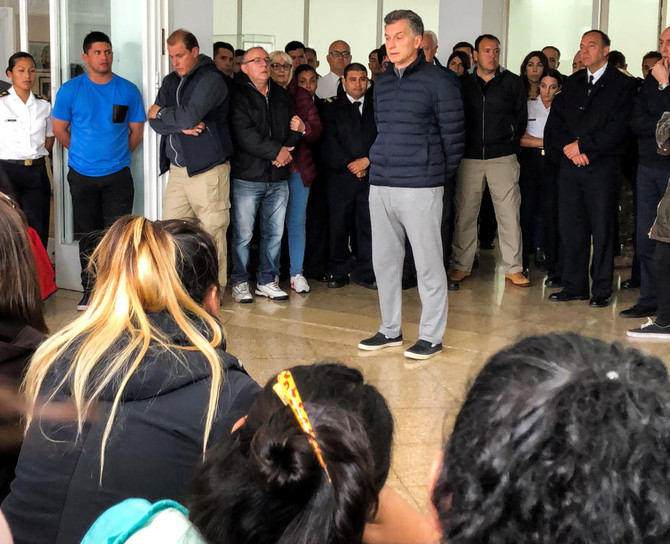
MAR DEL PLATA: President Mauricio Macri on Friday ordered an inquiry to “know the truth” about what happened to Argentina’s missing submarine, the San Juan, which disappeared with the loss of its 44 crew.
The 34-year-old submarine had gone through a refit and was “in perfect condition,” Macri told reporters at the Argentine navy headquarters.
“My commitment is with the truth,” he said, adding the tragedy “will require a serious, in-depth investigation that will yield certainty about what has happened.”
Argentina’s navy has been fiercely criticized for its handling of the operation since first reporting the submarine overdue at its Mar del Plata base on November 16.
The navy took several days to say that the San Juan had reported a problem with its batteries in its final communication on November 15.
Only on Thursday did the navy confirm there had been an explosion on board, which experts said was likely linked to the battery problem.
“Until we have the complete information, we do not have to look for the guilty, to look for those responsible. First we have to have certainty of what happened and why it happened,” said Macri.
The center-right leader spoke as the search for the San Juan shifted from rescue to recovery on Friday, after navy officials lost hope of finding alive any of the crew, which included the country’s first female submarine officer.
“We have to find the submarine at the bottom of the sea, the area is large, the environment hostile, and the search very difficult,” said Argentine navy spokesman Enrique Balbi.
Magistrate Marta Yanez has already begun preliminary investigations into the disaster.
She told reporters that unlike a plane, “the submarine does not have a black box. The black box is the submarine,” and it would have to be recovered before the causes of the explosion could be known.
Officially the navy has not declared the loss of the crew, but marine experts believe an explosion would have been catastrophic.
Brenda Salva, a friend of crew member Damian Tagliapietra, said she had been told by the commander of the Mar del Plata naval base: “They are all dead.”
The navy said one sailor escaped the tragedy because he disembarked the submarine at Ushuaia for another mission — and was replaced by someone else.
A second sailor, aged 26, had been ready to join the ill-fated sub but was exempted because he was finalizing the purchase of a house, the Clarin newspaper reported.
For the relatives of the crew, grief turned to anger by Friday.
“I want to tell Admiral Marcelo Srur that he is not in a position to be in charge of a force, and to the president (Mauricio Macri), to bring order,” said Maria Rosa Belcastro, mother of 38-year-old Lt. Fernando Villarreal.
Relatives have focused their anger on the condition of the three-decade-old sub, which had undergone a seven-year refit to extend its service, and the navy’s guardedness since the start of the search operation.
In his comments at the navy headquarters, Macri paid tribute to the “patriotism, heroism and bravery” of the San Juan’s crew.
“For all of them and their families, my greatest affection,” he said.
To the relatives of the missing submariners he said: “The pain is great but we are together, and we are going to travel this road all the way together.”
Argentine press reports on Friday said Macri’s center-right government was preparing to sack navy chief Srur as part of a purge of top brass in a country where the military is distrusted.
“The government is considering changing the leadership of the navy. They believe there was negligence in the disappearance of the ARA San Juan and criticize the handling of the situation,” the influential Clarin daily said.
Memories are still fresh in Argentina of the 1976-83 military dictatorship responsible for the disappearance of an estimated 30,000 people.
Sociologist Ricardo Rouvier said the submarine drama “encompasses the question of the role of the armed forces” in a country where they are now on the margins of power.
There is also the issue of possible negligence or disinterest by political forces toward investment in the military, Rouvier said.
Macri, however, chose Friday to pay tribute to the navy and the armed forces as a whole. “Because they are the ones who have a central responsibility in the life of this country, which is to take care of our country, to take care of all of us,” he said.
Depths plummet from 200 meters to more than 3,000 meters on the edge of the Argentine shelf, where the sound of the explosion was picked up by hydro-acoustic sensors used by the Nuclear Test-Ban Treaty Organization.
Experts say the sub would begin to break-up once below depths of around 600 meters.


Argentine President Macri orders probe for ‘truth’ about missing submarine
Argentine President Macri orders probe for ‘truth’ about missing submarine


Homeless Muslims in southern Philippines observe Ramadan as month of trial
- Thousands lost their homes when parts of Bongao in Tawi-Tawi were burnt to ashes
- Many trying to fully observe the fasting month say they are grateful to be alive
Manila: As Annalexis Abdulla Dabbang was looking forward to observing the month of Ramadan with her family, just days before it began they lost everything when an enormous fire tore through whole neighborhoods of their city in the southernmost province of the Philippines.
Bongao is the capital of Tawi-Tawi, an island province, forming part of the country’s Muslim minority heartland in the Bangsamoro region. The city experienced its worst fire in years in early February, when flames swept through the coastal community, leaving more than 5,000 people homeless.
“We were swimming for our lives. We had to swim to escape from the fire ... We swam in darkness, and (even) the sea was already hot because of the fire,” Dabbang, a 27-year-old teacher, told Arab News.
“Everything we owned was gone in just a few hours — our home, our memories, the things we worked hard for, everything turned to ashes.”
Trying to save their 2-year-old daughter and themselves, she and her husband left everything behind — as did hundreds of other families that together with them have since taken shelter at the Mindanao State University gymnasium — one of the evacuation centers.
Unable to secure a tent, Dabbang’s family has been sleeping on the bleachers, sharing a single mat as their bed. When Ramadan arrived a few days after they moved to the makeshift shelter, they welcomed it in a different, more solemn way. There is no family privacy for suhoor, no room or means to welcome guests for iftar.
“Ramadan feels different now. It’s painful but at the same time more real. When we lost our home, we began to understand what sacrifice really means. When you sleep in an evacuation center, you understand hunger, discomfort in a deeper way,” Dabbang said.
“We don’t prepare special dishes. We prepare our hearts.”
While she and thousands of others have lost everything they have ever owned, she has not lost her faith.
“Our dreams may have turned to ashes, but our prayers are still alive,” she said.
“This Ramadan my prayers are more emotional than ever. I pray for strength, not just for myself, but for my family and for every neighbor who also lost their family home. I pray for healing from the trauma of fire. I pray that Allah will replace what we lost with something better. I pray for the chance to rebuild not just our house, but our sense of security.”
Juraij Dayan Hussin, a volunteer helping the Bongao fire victims, observed that many of them were traumatized and the need to cleanse the heart and mind during Ramadan was what kept many of them going, because they are “thankful that even though they lost their property, they are still alive.”
But the religious observance related to the fasting month is not easy in a cramped shelter.
“It’s hard for Muslims to perform their prayers when they do not have their proper attire because they usually have specific clothes for prayer,” he said. “Sanitation in the area is also an issue ... when you fast and when you pray, cleanliness is essential.”
For Abdulkail Jani, who is staying at a basketball court with his brother and more than 70 other families, this Ramadan will be spent apart from their parents, whom they managed to move to relatives.
“The month of Ramadan this year is a month of trial ... there will be a huge change from how we observed Ramadan in the past, but we will adjust to it and try to comfort ourselves and our family. The most important thing is that we can perform the fasting,” he told Arab News.
“Despite our situation now, despite everything, as long as we’re alive, we will observe Ramadan. We’ll try to observe it well, without missing anything.”


