

Philippine president's war of drugs has popular support, analyst tells Arab News

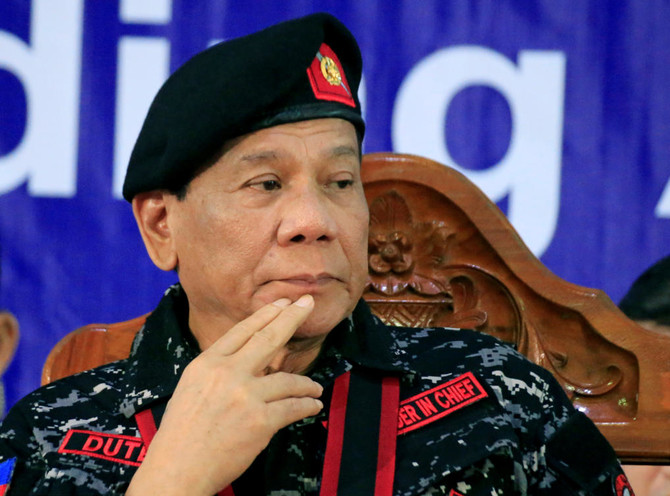
Philippine President Rodrigo Duterte. (Reuters)
Updated 25 November 2017
Follow

Philippine president's war of drugs has popular support, analyst tells Arab News

MANILA: As Philippine President Rodrigo Duterte continues his war on drugs in the face of heavy criticism from the international community, Arab News spoke with political analyst Ramon Casiple to get some insight into Duterte’s motives, and find out how successful his campaign has been.

Duterte promised on the campaign trail that he would eradicate the Philippines’ drug problems if he was elected — “I’ll kill you,” he told drug dealers and users in May 2016 — just as he managed to clean up Davao City when he was mayor there.

But, just as in Davao, reports of unlawful extrajudicial killings have attracted significant criticism of Duterte’s methods.

Casiple said the president is convinced that the cause of most crimes is illegal drugs. “In fact, there are statistics that show that 68 percent of crimes in the country are drug-related,” he said.

Another report suggests that, because of the Duterte administration's relentless campaign against drugs, there has been a significant decrease in crime across the board, especially crimes against property.

“Ironically, there was an increase in murders, but, of course, he is denying that these are extrajudicial killings,” Casiple added.

The president “feels encouraged,” too, by the interest shown by several countries, including Indonesia and the US, in his program’s progress, Casiple suggested.

“They are now seeing that the Philippine government's war on drugs is bearing positive results,” he said. “Even (US President Donald) Trump admitted during their recent talks that he is taking some cues from the Philippines (on dealing with the drug problem).”

Casiple also claimed that Duterte’s campaign “remains popular in general” with the citizens of the Philippines.

And although Duterte has realized his campaign promise to eradicate the Philippines’ drug problem may be impossible, now that he has full access to intelligence reports on the matter, Casiple said, the president remains focused on trying to deliver that promise.

“There is political will on the part of the president. He wants to do his best to address the issue on drugs but he has also realized that he can't completely lick the problem,” said Casiple. “Further, he is bent on fulfilling his campaign promise to bring change to the country. But we first have to achieve peace and order before economic development can set in. That way we can attract investments which will produce jobs, which, in turn,will address the poverty question on a long term basis.”

Casiple said that extrajudicial killings are a violation of human rights and those directly involved can be charged in court, but suggested the president could not be held responsible for the conduct of law enforcement personnel.

“The question is: Does the president have a direct hand on these killings? Or did he create the situation? So far I am not aware of any direct order from the president for our law enforcers to loosen the terms of engagement in the conduct of police operations,” said Casiple.

On the president's recent decision to hand control of the drug war back to the Philippine National Police (PNP), having initially transferred responsibility from the PNP to the Philippine Drug Enforcement Agency (PDEA), Casiple said it poses questions about whether there have been qualitative changes to the policy.

“Remember, it was (originally) removed from the PNP and transferred to the PDEA because of some issues. The first was the killing of a Korean businessman in which the suspects were anti-drug operatives and the second was the killings of three teens in Caloocan City,” he said.

“I dont think there has been a qualitative improvement on the behavior of the police," he continued. “Nothing was changed as far as the anti-drug policy is concerned.”

Casiple did have some advice for the president if he really wants to show the public that he does not condone extrajudicial killings.

“He has to stop giving borderline instructions such as that it's OK for the police to kill and that he will provide them with a lawyer,” Casiple said — although he added that “obviously” what the president meant by such statements is that he will fully support the police’s actions in the line of duty.
 

Israel says Netanyahu will meet with Trump on Wednesday about Iran talks

Updated 2 sec ago
Follow

Israel says Netanyahu will meet with Trump on Wednesday about Iran talks

  • Israeli Prime Minister Benjamin Netanyahu will meet with US President Donald Trump in Washington on Wednesday about the US talks with Iran
JERUSALEM: Israeli Prime Minister Benjamin Netanyahu will meet with US President Donald Trump in Washington on Wednesday about American talks with Iran, his office said Saturday, while Iran’s foreign minister threatened US military bases in the region a day after the discussions.
“The prime minister believes that all negotiations must include limiting the ballistic missiles, and ending support for the Iranian axis,” Netanyahu’s office said in a brief statement, referring to Tehran’s support for militant groups, including Hezbollah in Lebanon and Hamas in the Palestinian territories. Trump and Netanyahu last met in December.
There was no immediate White House comment.
The US and the Islamic Republic of Iran held indirect talks on Friday in Oman that appeared to return to the starting point on how to approach discussions over Tehran’s nuclear program.
Trump called the talks “very good” and said more were planned for early next week. Washington was represented by Middle East special envoy Steve Witkoff and Jared Kushner, Trump’s son-in-law.
Trump has repeatedly threatened to use force to compel Iran to reach a deal on its nuclear program after sending the aircraft carrier USS Abraham Lincoln and other warships to the region amid Tehran’s crackdown on nationwide protests that killed thousands.
Gulf Arab nations fear an attack could spark a regional war, with memories fresh of the 12-day Israel-Iran war in June.
For the first time in negotiations with Iran, the US on Friday brought its top military commander in the Middle East to the table. US Navy Adm. Brad Cooper, head of the military’s Central Command, then visited the USS Abraham Lincoln on Saturday with Witkoff and Kushner, the command said in a statement.
Iranian Foreign Minister Abbas Araghchi told journalists Friday that “nuclear talks and the resolution of the main issues must take place in a calm atmosphere, without tension and without threats.” He said that diplomats would return to their capitals, signaling that this round of negotiations was over.
On Saturday, Araghchi told the Al Jazeera satellite news network that if the US attacks Iran, his country doesn’t have the ability to strike the US “and therefore has to attack or retaliate against US bases in the region.”
He said there is “very, very deep distrust” after what happened during the previous talks, when the US bombed Iranian nuclear sites during last year’s Israel-Iran war.
Araghchi also said the “missile issue” and other defense matters are “in no way negotiable, neither now nor at any time in the future.”
Tehran has maintained that these talks will be only on its nuclear program.
However, Al Jazeera reported that diplomats from Egypt, Turkiye and Qatar offered Iran a proposal in which Tehran would halt enrichment for three years, send its highly enriched uranium out of the country and pledge to “not initiate the use of ballistic missiles.”
US Secretary of State Marco Rubio said Wednesday that the talks needed to include all those issues.
Israel, a close US ally, believes Iran is pursuing a nuclear weapon and wants its program scrapped, though Iran has insisted that its atomic plans are for peaceful purposes. Israel also wants a halt to Iran’s ballistic missile program and its support for militant groups in the region.
Araghchi, speaking at a forum in Qatar on Saturday, accused Israel of destabilizing the region, saying that it “breaches sovereignties, it assassinates official dignitaries, it conducts terrorist operations, it expands its reach in multiple theaters.” He criticized Israel’s treatment of Palestinians and called for “comprehensive and targeted sanctions against Israel, including an immediate arms embargo.”