MAR DEL PLATA, Argentina: Argentina’s navy announced Thursday that a sound detected during the search for a missing submarine apparently came from an explosion — an ominous development that prompted relatives of the 44 crew members to burst into tears.
Navy spokesman Enrique Balbi said the search will continue until there is full certainty about the fate of the ARA San Juan. He said evidence showed “an anomalous event that was singular, short, violent and non-nuclear that was consistent with an explosion.”
“According to this report, there was an explosion,” Balbi told reporters. “We don’t know what caused an explosion of these characteristics at this site on this date.”
US and specialist agencies said the “hydro-acoustic anomaly” was produced just hours after the navy lost contact with the submarine on Nov. 15.
The sub was originally scheduled to arrive Monday at the Mar del Plata Navy Base, about 250 miles (400 kilometers) southeast of Buenos Aires. Relatives of the crew who have gathered at the base to receive psychological counseling broke into tears and hugged each other after they received the news. Some clung to a fence crowded with blue-and-white Argentine flags, rosary beads and messages of support. Some declined to speak, while others lashed out in anger at the navy’s response.
“They sent a piece of crap to sail,” said Itati Leguizamon, wife of submarine crew member German Suarez. “They inaugurated a submarine with a coat of paint and a flag in 2014, but without any equipment inside. The navy is to blame for its 15 years of abandonment.”
The German-built diesel-electric TR-1700 class submarine was commissioned in 1985 and was most recently refit in 2014.
During the $12 million retrofitting, the vessel was cut in half and had its engines and batteries replaced. Experts say that refits can be difficult because they involve integrating systems produced by different manufacturers and even the smallest mistake during the cutting phase of the operation can put the safety of the ship and the crew at risk.
The Argentine navy and outside experts have said that even if the ARA San Juan is intact, its crew might have only enough oxygen to be submerged seven to 10 days.
Authorities said late Wednesday that Argentine navy ships as well a US P-8 Poseidon aircraft and a Brazilian air force plane would return to the area to check out the abnormal sound, which originated about 30 miles north of the submarine’s last registered position.
The search location straddles the edge of the continental shelf, with widely varying ocean depths, some as great as 10,000 feet (3,000 meters). Experts say the submarine could not have supported pressures that far down.
“If a submarine goes below its crush-depth, it would implode, it would just collapse,” said James H. Patton Jr. a retired navy captain.
“It would sound like a very, very big explosion to any listening device.”
Whatever it was, US Navy Lt. Lily Hinz said the sound detected “was not a whale, and it is not a regularly occurring sound.”
The San Juan lost contact as it was sailing from the extreme southern port of Ushuaia. The submarine’s captain had reported a battery failure.
More than a dozen airplanes and ships have been participating in the multinational search despite stormy weather that has caused waves of more than 20 feet (6 meters). Search teams are combing an area of some 185,000 square miles (480,000 square kilometers), which is roughly the size of Spain.
The US government has sent two P-8 Poseidons, a naval research ship, a submarine rescue chamber and sonar-equipped underwater vehicles. US Navy sailors from the San Diego-based Undersea Rescue Command are also helping with the search.
Britain’s Ministry of Defense sent a special airplane with emergency life support pods to join the hunt that includes planes and ships from a dozen nations.
Hopes were buoyed after brief satellite calls were received and when sounds were detected deep in the South Atlantic. But experts later determined that neither was from the missing sub.
“They haven’t come back and they will never come back,” said Jesica Gopar, wife of submarine officer Fernando Santilli, choking back tears. “I had a bad feeling about this and now it has been confirmed.”


Sound heard in Argentine sub search comes from explosion
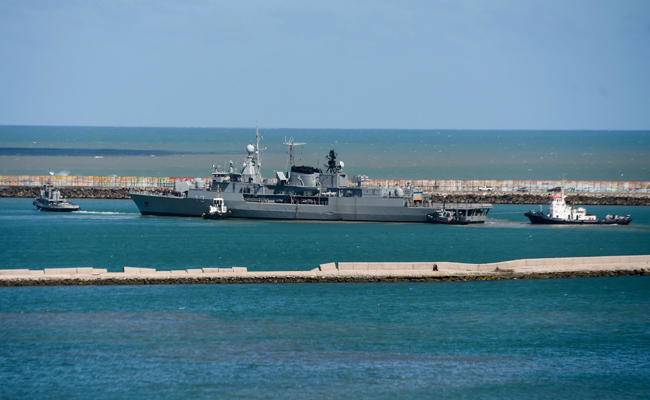
Sound heard in Argentine sub search comes from explosion

US hotels seek World Cup boost after tourism dip under Trump
- At the US hotels that Meade Atkeson manages, a drop in tourism weighs heavily on business — but hoteliers like him hope that World Cup enthusiasm will soon eclipse wariness over President
WASHINGTON: At the US hotels that Meade Atkeson manages, a drop in tourism weighs heavily on business — but hoteliers like him hope that World Cup enthusiasm will soon eclipse wariness over President Donald Trump’s policies.
The US hospitality sector has been reeling from a tourism slump in the world’s biggest economy, which became the only major destination to see a drop in foreign visitors last year.
“Just financially, it’s difficult when international travel is down,” Atkeson told AFP, noting that such visitors tend to stay longer and spend more.
Foreign travelers account for nearly a quarter of business at the three hotels under Sonesta group that he manages — two in Washington and a third in Miami Beach.
Yet, in the first eleven months of 2025, US official data showed that inbound travel dropped by 5.4 percent.
Canadians were noticeably absent, with travel plunging by 21.7 percent from 2024, translating to about four million fewer people. The decline was nearly seven percent for French visitors.
Industry professionals see this as a consequence of Trump’s policies, even if they may not openly say so.
Visitors have chafed at the Republican president’s sweeping tariffs on foreign goods, broadsides against other countries, tightening immigration rules and portrayal of certain Democrat-led cities as ridden with crime.
Canadians “were asked to be the 51st state, right?” Atkeson said.
“If you talk to Canadians, many of them have chosen not to travel out of conscience” or on principle, he added.
Brazilian tourists meanwhile “can go anywhere they want,” he said. “And so they may have gone to Europe, they may have gone to the islands.”
‘Fear’
Thousands of kilometers away, the major resort city of Las Vegas in Nevada — boasting 150,000 hotel rooms — has also had a bad year.
Elsa Rodan, a chambermaid at the Bellagio resort and casino, says her establishment is “blessed” compared with others.
But even so, it has had to lower prices to attract guests, added Rodan, a representative of the Unite Here union who spoke at a Washington press conference.
Unite Here President Gwen Mills urges for a renewed effort to lobby the Trump administration over policies and rhetoric that she believes are jeopardizing the sector employing more than two million people.
According to her, hoteliers are not pushing the government enough.
Employers express “fear, the fear of picking your head up,” she said.
Hopefully ‘better’
Fewer visitors and overnight stays, alongside a drop in revenue, have triggered a $6.7 billion shortfall for Nevada hotels in 2025, according to the American Hotel and Lodging Association (AHLA).
But the organization hopes that 2026 will be a turning point — it is counting on the World Cup, from June 11 to July 19, to attract visitors.
Eleven US cities will be hosting matches.
“It’s being equated to having nearly 80 Super Bowls in just over a month,” AHLA spokesman Ralph Posner told AFP.
“The economic lift won’t be limited to host cities,” he added. “Destinations across the country are hoping to benefit as international visitors extend their trips and travel between markets.”
Las Vegas, for example, hopes to draw fans who might stop there before or after a game in Los Angeles or Kansas City.
Organizers say that besides the seven million spectators in stadiums, the World Cup is set to attract 20-30 million tourists.
The whole event, they believe, can generate $30 billion for the US economy.
“I hope that things will look better,” Atkeson said.
His Miami hotel is under renovations and cannot host much World Cup-related activity.
But his Washington establishments are highlighting their proximity to Philadelphia, where several matches will be held.
Another complication is war in the Middle East following US-Israeli strikes on Iran, which could snarl travel.
“It’s a little too soon to tell how we’re going to do with that, but we’ll see,” he said.


