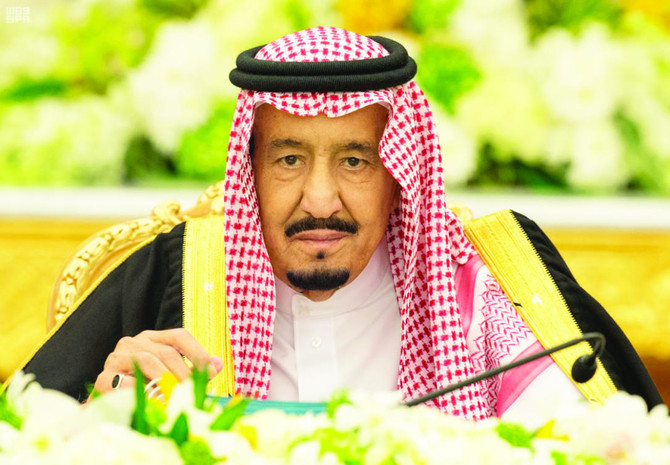
RIYADH: The Cabinet, chaired by King Salman, on Tuesday reaffirmed the statement issued by the emergency meeting of the Arab League foreign ministers in Cairo and their condemnation of all terror acts committed by Iran and its continued interference in the internal affairs of the Arab countries.
The Cabinet meeting, which was held at Al-Yamamah Palace in Riyadh, also stressed that Iran should refrain from supporting groups that fuel sectarian conflicts, notably in the Arab Gulf states, and to stop funding militias and armed parties in the Arab countries.
The Cabinet also stressed the Kingdom’s continued stance at the UN on the Palestinian issue.
The Cabinet said the Kingdom will vote in support of a decision to allow the Palestinian people to keep their permanent sovereignty in the occupied Palestinian lands, including Eastern Al-Quds; to support the Arab population in the occupied Syrian Golan to exploit their natural resources; and to support the Palestinian people to regain their usurped lands and reject Israeli policies, which do not respect international laws and norms.
On other international issues, the Cabinet reaffirmed the Kingdom’s position on the UN framework agreement on climate change in its 23rd session in Bonn in its commitment in taking necessary measures to address climate change to achieve the objectives of sustainable development in line with Saudi Vision 2030.
The Cabinet also strongly condemned the terror attack in Kabul, which resulted in many deaths and injuries, and expressed its support for the Afghan government and people against extremism and terrorism.
The Cabinet appreciated the remarkable progress in the performance of the state general budget for the third quarter of the fiscal year, which showed further improvement in revenues, efficiency in spending and a drop in the deficit, while keeping the required levels of services provided to citizens.
Later, the Cabinet approved a series of decisions:
The Cabinet approved a memorandum of understanding (MoU) signed between the Saudi Ministry of Health and its counterpart in Jordan on health cooperation.
The Cabinet authorized the minister of environment, water and agriculture, or whomever he authorizes, to discuss with the Sudanese side a draft MoU for cooperation in the area of water and irrigation.
The Cabinet approved a MoU signed between the Saudi Ministry of Environment, Water and Agriculture and the Japanese Ministry of Economy, Commerce and Industry for cooperation in the area of water desalination.
The Cabinet also approved the organizational structure of the Saudi Center of International Strategic Partnerships.


Saudi Arabia backs Arab League stance to check Iranian interference
Saudi Arabia backs Arab League stance to check Iranian interference


Economic growth and resilience at heart of 2nd AlUla Emerging Market Economies Conference
- Event on Feb. 8 and 9 will bring together ministers, governors of central banks, policymakers, economic experts and international financial institutions
- Emerging-market economies a ‘pivotal element’ in global economic system due to effect they have on growth and stability, says Saudi Finance Minister Mohammed Al-Jadaan
RIYADH: The second annual AlUla Conference for Emerging Market Economies, which Saudi Arabia will host next week, offers a platform to exchange views on global developments and discuss policies and reforms that support inclusive growth and strengthen economic resilience, the Kingdom’s finance minister said.
The event on Feb. 8 and 9 will bring together finance ministers, governors of central banks and policymakers, alongside economic experts and representatives of international financial institutions.
Organized by the Saudi Ministry of Finance in partnership with the International Monetary Fund, it takes place as emerging-market economies face mounting challenges amid rapid global economic change.
Finance Minister Mohammed Al-Jadaan said the decision to host the conference reflects Saudi Arabia’s ongoing commitment to efforts that support global financial and economic stability, and highlights the growing influence of emerging economies on worldwide growth.
Emerging-market economies represent a “pivotal element” in the global economic system due to the direct impact they have on economic growth and stability, he added.
“The AlUla Conference for Emerging Market Economies provides a unique platform for exchanging views on global economic developments, and discussing policies and reforms that will support inclusive growth and enhance economic resilience, in light of broader international cooperation that contributes to confronting common challenges,” Al-Jadaan said.
Kristalina Georgieva, managing director of the IMF, said the event would help emerging economies deal with growing uncertainty driven by technological change, demographic shifts and geopolitical tensions.
“The AlUla conference provides a vital platform for emerging economies to discuss how they can navigate the risks and embrace the opportunities ahead,” she said.
“In these times of sweeping transformations in the global economy, policymakers face a more challenging and uncertain environment. Countries should work together to strengthen resilience through sound macroeconomic and financial policies.”


