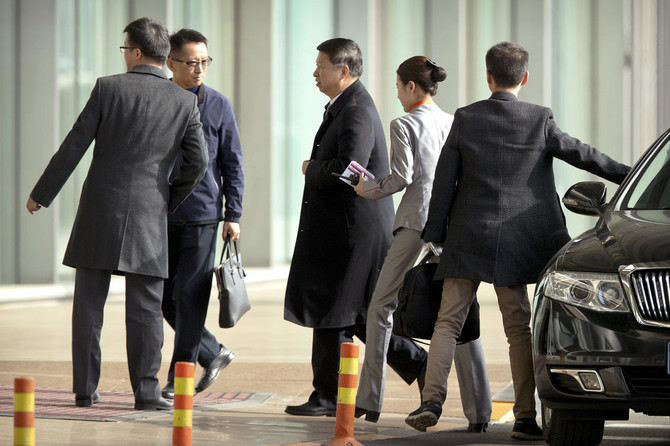
BEIJING: A high-level Chinese envoy wrapped up a four-day trip to North Korea on Monday after meeting with top officials and discussing the tense state of affairs on the Korean Peninsula and other issues.
Song Tao, the most senior Chinese official to visit Pyongyang, North Korea’s capital, in two years, was officially tasked with briefing the government on China’s recent party congress. China’s official Xinhua News Agency said the ruling parties of both countries agreed to strengthen exchanges and “push forward relations.”
Song and North Korean officials discussed “the Korean Peninsula issue and other issues of common concern,” Xinhua said.
Neither side had commented on the tone of the visit as Song wrapped up his official itinerary on Monday. China’s foreign ministry, asked to comment on the visit, repeated a standard line about Song’s official itinerary and added nothing further.
Song’s trip was watched closely because it came on the heels of US President Donald Trump’s Asian tour, in which he urged greater efforts by China and others to push North Korea to abandon its development of nuclear weapons.
Song, head of the Chinese Communist Party’s International Department, met with North Korean ruling party Vice Chairman Choe Ryong Hae and former Foreign Minister Ri Su Yong. He also paid his respects to North Korean “eternal president” Kim Il Sung and “eternal general-secretary” Kim Jong Il, leader Kim Jong Un’s dead grandfather and father.
The visit was seen by some North Korea watchers as an effort by Xi to explore a new approach in relations and a reflection of his desire to head off further pressure from Washington.
China’s relations with North Korea have deteriorated under Kim Jong Un, who has ignored Beijing’s calls to end North Korea’s nuclear weapons and ballistic missile tests and return to disarmament talks.
China has also been busy repairing ties with South Korea that have been strained by the deployment of a US missile defense system. South Korean Foreign Minister Kang Kyung-wha is to visit China from Tuesday through Thursday.
Trump has repeatedly suggested that China could easily solve the North Korea nuclear problem by tightening the screws on trade. While China is North Korea’s largest trading partner, Beijing says its influence with Kim’s government is often exaggerated by the US and others.
Beijing is also opposed to measures that could bring down Kim’s regime and lead to a refugee crisis along its border with North Korea.


![]()
Chinese envoy wraps up North Korea trip after meetings with senior officials
Chinese envoy wraps up North Korea trip after meetings with senior officials
Latest updates



© 2026 SAUDI RESEARCH & PUBLISHING COMPANY, All Rights Reserved And subject to Terms of Use Agreement.