RIYADH: An independent assessment panel on Yemen found airstrikes launched by the Saudi-led coalition fully justified.
The coalition complied with military rules of engagement and international humanitarian laws, the panel said.
The coalition on Sunday renewed its call to international agencies to sit “face to face” to discuss untrue reports of civilian casualties and violations in Yemen.
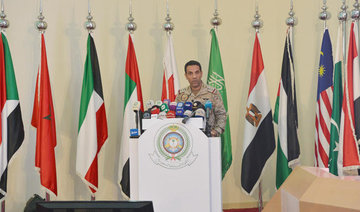
“The Joint Incidents Assessment Team (JIAT) has invited international human rights bodies to discuss all cases, and provide details for assessment before accusing the coalition of reckless attacks,” said JIAT spokesman and legal adviser Mansour Ahmed Al-Mansour.
“We’ve asked them to give full information, including photos and coordinates of targets proving violations… but have received inadequate information,” he added.
“JIAT, representing the member states of the Saudi-led coalition fighting in Yemen, found airstrikes justified and in accordance with international humanitarian laws in five different cases, citing the presence of armed militants at or near those targets.”
On allegations regarding an airstrike on Al-Sabeen Maternity Hospital in Sanaa on Aug. 4, 2016, Al-Mansour said: “JIAT assessed the incident and found military activities by former (Republican Guards) supporting the armed Houthi militia based inside the former special security forces camp in Sanaa.”
He added: “Coalition forces targeted specific buildings inside the camp, which were legitimate military targets, using guided bombs that accurately hit the targets.”
The bombs’ vibration and shockwaves caused “minor collateral damage” to the hospital nearby, Al-Mansour said. JIAT concluded in its probe that the coalition did not target the hospital, he added.
On accusations regarding the bombing of a residential building in Ibb governorate on Sept. 24 last year, Al-Mansour said the coalition targeted a building used by Houthi militants as their military headquarters.
“This was a legitimate target, located at a distance of 1,070 meters from the claimed residential building,” he added.
Regarding the bombing of Al-Senidar Factory complex in Bani Al-Harith in Sanaa on Sept. 13 last year, he said JIAT assessed the incident and found that “six ballistic missiles were launched toward Saudi Arabia from northern Sanaa from Sept. 4-23 last year.”
He added: “Coalition forces carried out aerial surveillance and reconnaissance missions on these areas, and spotted a convoy of three trucks accompanied by an armed military vehicle.”
He said coalition forces tracked the convoy until it entered Al-Senidar Factory complex, located north of Sanaa.
“The forces then targeted the warehouses inside the complex… a legitimate military target,” Al-Mansour added.
Regarding a Human Rights Watch report in December 2016 about a coalition attack on Al-Zaydiyah security building in Hodeida governorate, he said JIAT found the attack justified because Houthi militants and foreign accomplices were using the building for military purposes.
“Thus the building lost its legal protection prescribed as per international conventions,” said Al-Mansour, adding that this led the coalition to target the building using precision-guided bombs.
He also justified the bombing of Salaa Palace Museum in Taiz, saying it was used “as a weapons storage facility and military barracks by the Houthis.”


![]()

Independent body rejects criticism of coalition airstrikes in Yemen
Independent body rejects criticism of coalition airstrikes in Yemen


Latest updates


© 2026 SAUDI RESEARCH & PUBLISHING COMPANY, All Rights Reserved And subject to Terms of Use Agreement.