LONDON: A once-distant future of flying cars, household robots and talking appliances is rapidly approaching and no one is sure what to expect.
Technology companies developing innovative artificial intelligence (AI) applications promise a life made easier as machines take over everyday tasks from making coffee to driving to work. People, they say, will be free to focus on rewarding and creative pursuits while benefiting from more leisure time.
But what about those whose jobs can be managed more efficiently by machines?
Alongside the cab drivers replaced by driverless cars and flying taxis, the list of potential cast-offs includes construction workers, couriers, journalists, paralegals, retail sales people and doctors.
In the UAE, the impending arrival of driverless buses, delivery drones and even robot police officers is an indication of how wide-ranging the advance of AI will be.
Some sectors, including banking — no stranger to technological disruption since automated teller machines (ATMs) replaced traditional clerks 50 years ago — have already started adapting to AI.
Mashreq Bank in the UAE recently announced plans to cut 10 percent of its 4,000-strong workforce within 12 months as it makes way for new AI and robotic technologies.
“AI will provide the competitiveness to the early adopters and in a few years these will become generic features with all banks,” said a spokesperson for Mashreq.
“In the region, the banking sector will see an uplift on service quality and enhanced self-service capabilities with the increased penetration of AI tools.”
Research by McKinsey claimed that 60 percent of all occupations could see 30 percent of their constituent activities automated, and last year the Future of Jobs report published by the World Economic Forum estimated that automation could lead to the net loss of 5 million jobs across 15 developed and emerging economies by 2020.
Speaking to Arab News, Rigas Hadzilacos, global leadership fellow at the World Economic Forum said, “This is a very short timeline and probably a conservative estimate so there is a huge amount of urgency attached to finding ways of exploiting the benefits of AI while mediating the negative impact.”
“In the long run AI will also create new jobs related to the development, maintenance and oversight of artificial intelligent agents — and other completely new jobs we cannot imagine at this stage.
“However in the near future, the rate of job displacement will be much higher than the rate of new jobs created. And this is something that every government needs to prepare for.”
Key to this is bolstering the ability of local workforces to harness the AI and robotic revolution. Santhosh Rao, principal research analyst at Gartner, a technology research and advisory firm with offices in the Middle East, described the skills shortage as a major roadblock for regional governments adopting AI.
“AI engineers are a rare commodity globally because it involves not just programming but advanced mathematics, statistics, electronics and complex algorithm designs,” he said.
Meanwhile, a lot of lower-skilled jobs will become obsolete, Hadzilacos added, pointing to the impact on large numbers of expat workers from the Middle East and Asia employed in Gulf states.
“On the flip side, a new flow of expats needed for the high-skilled labor to support this transformation can be expected,” he said.
David Llorente, CEO of Narrativa, an AI startup with a client base in the UAE, Saudi Arabia and Europe, believes AI will change societies across the region and contribute to a shift away from reliance on oil and gas as Gulf countries cultivate knowledge economies.
Countries such as the UAE and Saudi Arabia are ripe for AI adoption, he said, outlining the potential to reduce dependency on foreign labor.
“Gulf states have two standout qualities: Lots of available cash and a very big deficit in human labor,” Llorente said.
“Increasing automation will enable them to do more with less, helping them to become more productive and competitive.”
He spotlighted Saudi Arabia as the next major growth area for AI in the region.
“Saudis love technology and there’s huge market potential,” Llorente said, adding that AI adoption could help companies in the Kingdom to internationalize and place the country on a par with the region’s biggest AI player — the UAE.
Last month, Dubai Ruler Sheikh Mohammed bin Rashid Al-Maktoum tweeted about the appointment of Omar Bin Sultan Al-Olama as the country’s first minister of state for artificial intelligence.
The move followed the launch of the UAE Strategy for Artificial Intelligence, outlining the country’s aims to enhance performance and productivity by investing in AI.
“We believe that by harnessing the potential of the latest technologies we can offer innovative services to enhance citizen experiences in Dubai,” said Aisha Bin Bishr, director general of the Smart Dubai Office, which is providing AI training to government and private-sector employees.
Saudi Arabia, meanwhile, recently unveiled plans to invest $500 billion in Neom, a fully automated city where citizens will travel in driverless vehicles, enjoy access to free Internet and live in zero-carbon homes.
The project website describes a digital oasis in which “repetitive and arduous tasks will be fully automated and handled by robots, which may exceed the population, likely making Neom’s GDP per capita the highest in the world.”
Speaking at the Saudi Future Investment Initiative summit in Riyadh last month, Peter Thiel, a venture capitalist and partner at Founders Fund, described “hybrid solutions” based on people working in synergy with computers.
“AI will make certain sectors more efficient and then it will free people up to do other things,” he said.
Jacob Crandall, professor in computer sciences at Brigham Young University, who spent 10 years in Abu Dhabi, agreed. “In my opinion, technologies simply alter job prospects rather than eliminating them. AI is not likely to eliminate the need for human creativity, but rather opportunities create new needs for human creativity.”
But according to Thiel, there is a tipping point at which people could become redundant in an increasingly automated world.
“It’s mainly a game of complementarity; it becomes a game of substitution only at the end if you have an AI that can do everything better, smarter and cheaper than any human being, and then that will be very scary.”


![]()
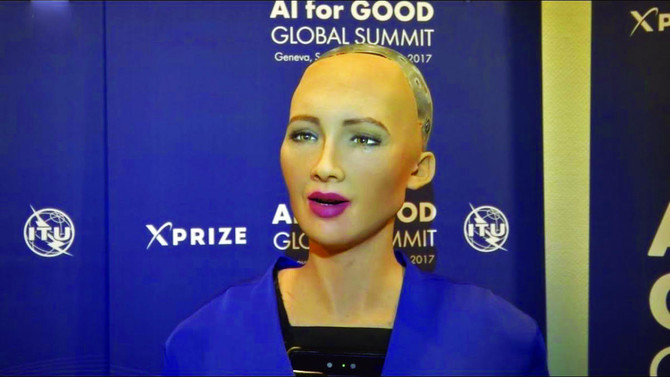
Rise of the machines: Will a robot take your job?
Rise of the machines: Will a robot take your job?
Latest updates


Recommended


© 2026 SAUDI RESEARCH & PUBLISHING COMPANY, All Rights Reserved And subject to Terms of Use Agreement.