LONDON: A driverless, electric car is only a swipe away in the cities of the future, where pollution clampdowns and rapid advances in technology will transform the way we travel, despite lagging infrastructure.
As more and more countries announce a phasing-out of pure petrol and diesel cars, early versions of tomorrow’s models are already on the streets: Hybrid cars, fully electric motors and vehicles that can partially drive themselves.
Attitudes to vehicle ownership in cities are changing as smartphone apps make a ride available in minutes.
David Metz, of the Center for Transport Studies at University College London, believes developed cities have reached “peak car,” with ownership no longer associated with increasing prosperity.
Metz said city planning was changing to temper the vehicle access once thought vital.
“We now see high-density urban areas are more successful with less traffic,” he said, citing London’s car-free Leicester Square entertainment district and the Canary Wharf financial hub.
Cars could be phased out of city centers altogether, as urban planners ditch the 20th-century, car-focused grid-plan model for city streets.
Private cars, sitting idle for 23 hours a day, might be eclipsed by car-pool clubs, journey-sharing apps or one-trip rental cars as seen in cities around the world from Berlin to Istanbul to Vancouver.
Driverless technology also looks set to revolutionize urban road travel, according to industry figures.
Graeme Smith, chief executive of Oxbotica, a British company developing autonomous vehicle software, said new cities being planned in China envision all vehicles being electric, autonomous and publicly-owned.
“In those cities, your life would be fundamentally different,” he told AFP.
“50 years into the future, maybe these things will be driving everywhere by themselves — but there’s a progression to go through.”
Driverless technology faces the challenge, over time, of bringing down the cost of sensors while improving their performance — and there is currently no standard operating methodology.
Some cars with levels two and three autonomy are already on the roads.
Britain’s Transport Secretary Chris Grayling said he expected the first level four self-driving cars to reach the UK market by 2021, bringing the world closer to level five, or total autonomy.
Fully driverless cars could help ease gridlock by driving closer together in convoy and avoid traffic by exchanging real-time information.
The switch to electric vehicles (EVs), meanwhile, is already well underway.
Volvo will no longer sell solely diesel or petrol cars from 2019, while Volkswagen’s Audi brand is gearing up to offer an electric version of every one of its models.
Britain and France intend to ban the sale of fully petrol or diesel cars from 2040, while smog-plagued India wants to sell only electric cars by 2030.
— AFP


Driverless cars just round the corner
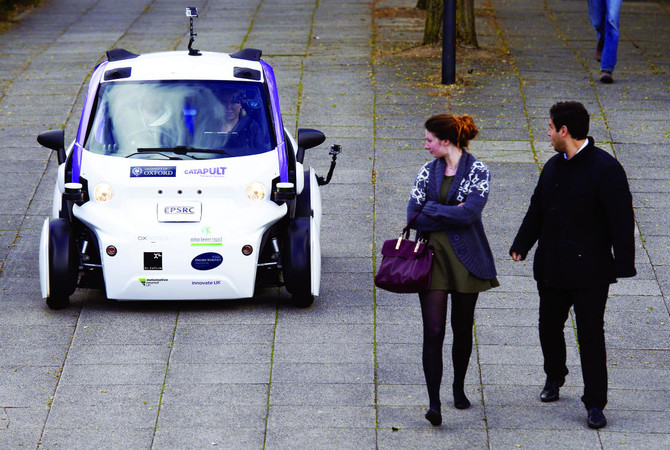
Driverless cars just round the corner

BYD Americas CEO hails Middle East as ‘homeland for innovation’
- In an interview on the sidelines of Davos, Stella Li highlighted the region’s openness to new technologies and opportunities for growth
DAVOS: BYD Americas CEO Stella Li described the Middle East as a “homeland for innovation” during an interview with Arab News on the sidelines of the World Economic Forum.
The executive of the Chinese electric vehicle giant highlighted the region’s openness to new technologies and opportunities for growth.
“The people (are) very open. And then from the government, from everybody there, they are open to enjoy the technology,” she said.
BYD has accelerated its expansion of battery electric vehicles and plug-in hybrids across the Middle East and North Africa region, with a strong focus on Gulf Cooperation Council countries like the UAE and Saudi Arabia.
GCC EV markets, led by the UAE and Saudi Arabia, rank among the world’s fastest-growing. Saudi Arabia’s Public Investment Fund has been aggressively investing in the EV sector, backing Lucid Motors, launching its brand Ceer, and supporting charging infrastructure development.
However, EVs still account for just over 1 percent of total car sales, as high costs, limited charging infrastructure, and extreme weather remain challenges.
In summer 2025, BYD announced it was aiming to triple its Saudi footprint following Tesla’s entry, targeting 5,000 EV sales and 10 showrooms by late 2026.
“We commit a lot of investment there (in the region),” Li noted, adding that the company is building a robust dealer network and introducing cutting-edge technology.
Discussing growth plans, she envisioned Saudi Arabia and the wider Middle East as a potential “dreamland” for innovation — what she described as a regional “Silicon Valley.”
Talking about the EV ambitions of the Saudi government, she said: “If they set up (a) target, they will make (it) happen. Then they need a technology company like us to support their … 2030 Vision.”


