Turkish, Iraqi officials discuss resuming Kirkuk oil exports

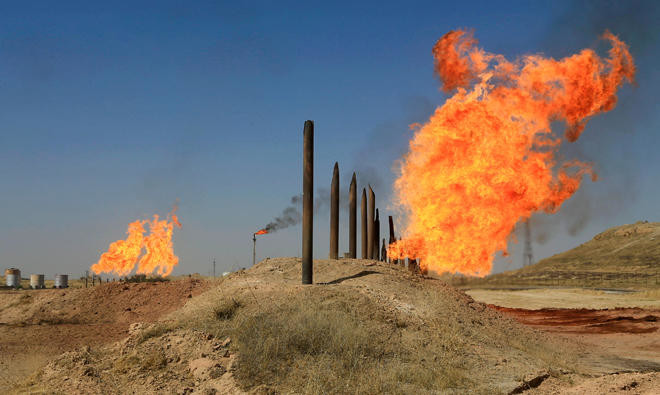
Flames emerge from flare stacks at the oil fields in Kirkuk, Iraq on October 18, 2017. (Reuters)
Updated 16 November 2017
Follow

Turkish, Iraqi officials discuss resuming Kirkuk oil exports

BAGHDAD: A Turkish energy delegation has met with Iraqi top oil officials in Baghdad to discuss issues including the resumption of Kirkuk oil exports via the Turkish port of Ceyhan, Iraq’s oil ministry said in a statement on Thursday.
Exports from oilfields in Kirkuk have been on hold since Iraqi government forces took control of them from the Kurds last month in retaliation for a Kurdish referendum on independence which was widely opposed by Turkey, Iran and Western powers.
“A high level Turkish energy delegation met with senior oil officials, including officials from state-run SOMO, to discuss ways to restart Kirkuk oil exports,” the statement said.
Baghdad’s meeting was attended by senior officials from the Turkish energy ministry, state-owned energy company TPAO and Turkish pipeline operator Botas, according to the oil ministry.
“The two parties discussed financial and technical issues which delay Kirkuk oil exports resumption. The talks are to be completed in Ankara,” the statement said.
Iraqi oil officials accuse Kurdish authorities of not responding to requests made by the oil ministry to use the Kurdish pipeline to resume exports from Kirkuk.
Iraq needs at least three months to repair an old pipeline which was shipping Kirkuk crude to Ceyhan port in Turkey, SOMO has said. The main 600,000 bpd Kirkuk-Ceyhan pipeline had been offline since March 2014 following insurgent attacks.


Saudi non-oil exports jump 21% as trade balance improves: GASTAT 

Updated 5 sec ago
Follow

Saudi non-oil exports jump 21% as trade balance improves: GASTAT 

RIYADH: Saudi Arabia’s non-oil exports, including re-exports, rose 20.7 percent year on year in November to SR32.69 billion ($8.72 billion), official data showed. 

According to preliminary figures released by the General Authority for Statistics, national non-oil exports, excluding re-exports, increased by 4.7 percent in November compared with the same month in 2024. 

The strong performance highlights progress under the Kingdom’s Vision 2030 strategy, which aims to diversify the economy and reduce its long-standing dependence on crude oil revenues. 

In its latest report, GASTAT stated: “The ratio of non-oil exports, including re-exports, to imports increased in November 2025, reaching 42.2 percent, compared with 34.9 percent in November 2024. This increase was driven by a 20.7 percent rise in non-oil exports, alongside a 0.2 percent decline in imports over the same period.”  

It added: “The value of re-exported goods increased by 53.1 percent during the same period, driven by an 81.9 percent increase in ‘machinery, electrical equipment and parts’, which accounted for 51.5 percent of total re-exports.”  

Machinery, electrical equipment and parts also led the non-oil export basket, making up 24.2 percent of outbound shipments and recording an 81.5 percent annual increase. This was followed by products of the chemical industries, which represented 20.3 percent of total non-oil exports and rose 0.5 percent year on year. 

The data adds to signs of resilience in Saudi Arabia’s non-oil economy, with S&P Global’s Purchasing Managers’ Index at 57.4 in December, well above the 50 threshold that separates expansion from contraction. 

Top non-oil destinations 

The UAE was the leading destination for Saudi non-oil exports in November, with shipments valued at SR10.48 billion. 

India ranked second at SR3.01 billion, followed by China at SR2.32 billion, Singapore at SR1.76 billion and Bahrain at SR900.7 million. 

Exports to Egypt totaled SR815.5 million during the month, while Turkiye and Jordan received goods worth SR799.1 million and SR773.3 million, respectively. 

GASTAT said ports and airports played a central role in facilitating non-oil shipments in November. 

By sea, Jeddah Islamic Seaport handled the largest volume of non-oil exports at SR3.57 billion, followed by King Fahad Industrial Seaport in Jubail at SR3.51 billion. 

Ras Al-Khair Seaport was the exit point for non-oil goods valued at SR2.66 billion, while Jubail Seaport and King Abdulaziz Seaport in Dammam handled outbound shipments worth SR2.32 billion and SR2.14 billion, respectively. 

By air, King Abdulaziz International Airport handled goods worth SR5.60 billion, while King Khalid International Airport in Riyadh processed exports valued at SR3.53 billion. 

Exports and imports 

Saudi Arabia’s total merchandise exports reached SR99.73 billion in November, representing a 10 percent increase compared with the same month in 2024. 

“Merchandise exports in November 2025 increased by 10.0 percent compared to November 2024, and oil exports increased by 5.4 percent. The percentage of oil exports in total exports declined from 70.1 percent in November 2024 to 67.2 percent in November 2025,” GASTAT added.  

China remained the Kingdom’s largest export destination, accounting for 13.5 percent of total exports, followed by the UAE at 11.7 percent and Japan at 9.9 percent. India, South Korea, the US, Egypt, Singapore, Bahrain and Poland were also among the top 10 destinations, which together accounted for 71.4 percent of total exports. 

Imports declined by 0.2 percent year on year in November to SR77.38 billion, while the merchandise trade surplus surged by 70.2 percent, the report showed. 

China was the Kingdom’s largest source of imports, accounting for 26.7 percent of inbound shipments, followed by the US at 10.2 percent and the UAE at 6.2 percent.  

“Germany, Japan, India, Italy, France, Switzerland, and Egypt were also among the top ten import sources, with total imports from these ten countries representing 68.6 percent of Saudi Arabia’s overall imports,” added GASTAT.  

King Abdulaziz Port in Dammam was the leading entry point for goods, handling 22.8 percent of imports in November. Jeddah Islamic Port followed with 22.6 percent, ahead of King Khalid International Airport in Riyadh at 17 percent and King Abdulaziz International Airport in Jeddah at 11.9 percent.