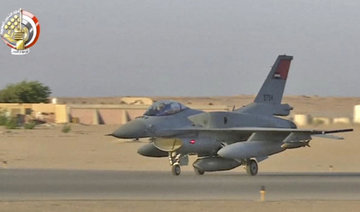
CAIRO: Egyptian military jets destroyed 10 vehicles carrying weapons, ammunition and smuggled goods near the country’s western desert border with Libya, the army said.
Egypt’s porous border with Libya has long been a headache for security forces as weapons flow across the frontier, but an attack on police last month claimed by a new militant group has highlighted the security challenges in the western desert.
“The air force dealt with them and destroyed them completely and killed all the elements inside,” the army statement said, without giving a date of the operation.
Egypt’s security forces are battling Daesh insurgency in the northern Sinai region, where militants have killed hundreds of police and troops since 2014 when attacks there started to increase.
Earlier, medical and security sources said on Friday in the country said that suspected militants shot dead at nine truck drivers in Sinai when they targeted a transport convoy, setting the vehicles on fire.
Two security sources in Al-Arish, the area capital, said armed men attacked the convoy, which was carrying coal to a cement factory.
The bodies of the truck drivers, all shot to death, were taken to the morgue of Suez public hospital, four medical sources said.
A military spokesman said there was no official statement. An Interior Ministry official did not respond to a request for information.
No group immediately claimed responsibility for the attack.
“They have threatened us repeatedly, asking that we don’t work for the army’s companies. We informed the factory management of the threats and asked them for more protection,” one local truck driver, Ismail Abdel-Raouf, told Reuters.
A home-grown militant group, Ansar Bayt Al-Maqdis, declared allegiance to Daesh in 2014 and has since tried to spread outside the peninsula by targeting Christians with attacks on churches on the mainland.
President Abdel-Fatah El-Sisi, who presents himself as a bulwark against militants in the Middle East, has said Daesh fighters might try to enter Libya and Egypt after their defeats in Iraq and Syria.

Egyptian forces destroy arms smugglers’ vehicles on Libya border
Fledgling radio station aims to be ‘voice of the people’ in Gaza
- The electricity crisis is one of the most serious and difficult problems in the Gaza Strip, says Shereen Khalifa Broadcaster
DEIR EL-BALAH: From a small studio in the central city of Deir El-Balah, Sylvia Hassan’s voice echoes across the Gaza Strip, broadcast on one of the Palestinian territory’s first radio stations to hit the airwaves after two years of war.
Hassan, a radio host on fledgling station “Here Gaza,” delivers her broadcast from a well-lit room, as members of the technical team check levels and mix backing tracks on a sound deck. “This radio station was a dream we worked to achieve for many long months and sometimes without sleep,” Hassan said.
“It was a challenge for us, and a story of resilience.”
Hassan said the station would focus on social issues and the humanitarian situation in Gaza, which remains grave in the territory despite a US-brokered ceasefire between Israel and Hamas since October.
“The radio station’s goal is to be the voice of the people in the Gaza Strip and to express their problems and suffering, especially after the war,” said Shereen Khalifa, part of the broadcasting team.
“There are many issues that people need to voice.” Most of Gaza’s population of more than 2 million people were displaced at least once during the gruelling war.
Many still live in tents with little or no sanitation.
The war also decimated Gaza’s telecommunications and electricity infrastructure, compounding the challenges in reviving the territory’s local media landscape. “The electricity problem is one of the most serious and difficult problems in the Gaza Strip,” said Khalifa.
“We have solar power, but sometimes it doesn’t work well, so we have to rely on an external generator,” she added.
The station’s launch is funded by the EU and overseen by Filastiniyat, an organization that supports Palestinian women journalists, and the media center at the An-Najah National University in Nablus, in the occupied West Bank.
The station plans to broadcast for two hours per day from Gaza and for longer from Nablus. It is available on FM and online.
Khalifa said that stable internet access had been one of the biggest obstacles in setting up the station, but that it was now broadcasting uninterrupted audio.
The Gaza Strip, a tiny territory surrounded by Israel, Egypt, and the Mediterranean Sea, has been under Israeli blockade even before the attack on Oct. 7, 2023, which sparked the war. Despite the ceasefire, Israel continues to strictly control the entry of all goods and people to the territory.
“Under the siege, it is natural that modern equipment necessary for radio broadcasting cannot enter, so we have made the most of what is available,” she said.