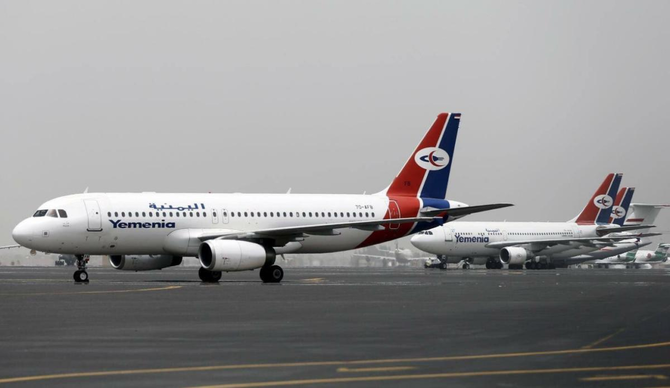
Saudi-led coalition lifts ban on commercial flights to Yemen

Saudi-led military coalition will allow the resumption of international commercial flights to the country. (Photo courtesy: social media)
Updated 12 November 2017
Follow

Saudi-led coalition lifts ban on commercial flights to Yemen

RIYADH: Commercial flights in and out of Yemen will resume on Sunday after the Saudi-led coalition fighting to restore the legitimate government lifted a week-long ban.
The coalition closed all air, land and sea ports to stem the flow of weapons to Houthi rebels in Yemen after an Iranian-supplied ballistic missile was launched at Riyadh from Houthi-held territory on Nov. 4. Saudi defense forces shot the missile down and there were no casualties.
The Houthis have fired more than 70 missiles into Saudi Arabia in the past two years, but the Riyadh attack was the deepest into Saudi territory.
“Flights by national carrier Yemenia to the coalition-controlled cities of Aden and Seiyun will resume on Sunday,” Yemeni Transport Minister Mourad Al-Halimi said on Saturday.
Sohaib Al-Hamdan, a travel agent, said: “The resumption of flights will help to ferry Yemeni and non-Yemeni passengers bound for Yemen, who have been waiting in transit at various locations.
“Several of the 26 Yemeni airports are currently not operational, and flights are neither taking off nor landing at those airports for security reasons.”
The Yemeni government-held southern port of Aden reopened on Wednesday, but ports in Houthi-held areas are still closed.
The Yemeni Vice President Ali Mohsen Al-Ahmar praised the Arab coalition for supporting the legitimacy of his government. He said Yemen was at an extraordinary stage, and that the Houthi coup had caused great suffering.
The Iran-backed Houthi militias were a danger to the region and a threat to international peace and security, Al-Ahmar said.


Death toll in Iran protests over 3,000, rights group says

Updated 7 sec ago
Follow

Death toll in Iran protests over 3,000, rights group says

  • The protests erupted on December 28 over economic hardship and swelled into widespread demonstrations calling for the end of clerical rule
  • President Donald Trump, who had threatened ‘very strong action’ if Iran executed protesters, said Tehran’s leaders had called off mass hangings

DUBAI: More than 3,000 people have died in Iran’s nationwide protests, rights activists said on Saturday, while a “very slight rise” in Internet activity was reported in the country after an eight-day blackout.

The US-based HRANA ​group said it had verified 3,090 deaths, including 2,885 protesters, after residents said the crackdown appeared to have broadly quelled protests for now and state media reported more arrests.

The capital Tehran has been comparatively quiet for four days, said several residents reached by Reuters. Drones were flying over the city, but there were no signs of major protests on Thursday or Friday, said the residents, who asked not to be identified ‌for their safety.

A ‌resident of a northern city on the ‌Caspian ⁠Sea ​said ‌the streets there also appeared calm.

The protests erupted on December 28 over economic hardship and swelled into widespread demonstrations calling for the end of clerical rule in the Islamic Republic, culminating in mass violence late last week. According to opposition groups and an Iranian official, more than 2,000 people were killed in the worst domestic unrest since Iran’s 1979 Islamic Revolution.

“Metrics show a very ⁠slight rise in Internet connectivity in #Iran this morning” after 200 hours of shutdown, the ‌Internet monitoring group NetBlocks posted on X. Connectivity ‍remained around 2 percent of ordinary levels, ‍it said.

A few Iranians overseas said on social media that ‍they had been able to message users living inside Iran early on Saturday.

US President Donald Trump, who had threatened “very strong action” if Iran executed protesters, said Tehran’s leaders had called off mass hangings.

“I greatly respect the fact that all scheduled ​hangings, which were to take place yesterday (Over 800 of them), have been canceled by the leadership of Iran. Thank you!” he ⁠posted on social media.

Iran had not announced plans for such executions or said it had canceled them.

Indian students and pilgrims returning from Iran said they were largely confined to their accommodations while in the country, unable to communicate with their families back home.

“We only heard stories of violent protests, and one man jumped in front of our car holding a burning baton, shouting something in the local language, with anger visible in his eyes,” said Z Syeda, a third-year medical student at a university in Tehran.

India’s External Affairs Ministry said on Friday that commercial flights were available and that ‌New Delhi would take steps to secure the safety and welfare of Indian nationals.