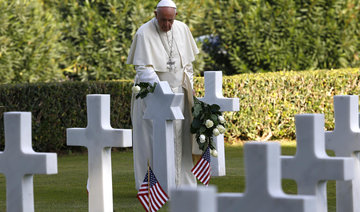
VATICAN CITY: Pope Francis on Friday renewed calls for global nuclear disarmament, warning that new technology had increased the risk of deadly weapons falling into the hands of terrorists.
“You only have to note that nuclear technologies are spreading, partly because of digital communications, and the instruments of international law have not prevented new states from joining those already in possession of nuclear weapons,” Francis told a seminar at the Vatican.
“The resulting scenarios are deeply disturbing if we consider the challenges of contemporary geopolitics, like terrorism or asymmetric warfare.”
Francis was addressing a Vatican conference on disarmament that was attended by several Nobel peace prize winners and top UN and NATO officials, against the backdrop of tensions over North Korea’s nuclear and missile tests.
Western powers are also increasingly concerned over the possibility of groups like Islamic State getting their hands on the technology that could allow them to manufacture an improvised nuclear device.
Describing the current international situation as marked by a “climate of instability and conflict,” the Argentine pontiff said the prospects for disarmament appeared “increasingly remote.”
“The escalation of the arms race continues unabated and the price of modernizing and developing weaponry, not only nuclear weapons, represents a considerable expense for nations.
“As a result, the real priorities facing our human family, such as the fight against poverty, the promotion of peace, the undertaking of educational, ecological and health care projects, and the development of human rights, are relegated to second place.”
Citing the memory of the victims and survivors of the Hiroshima and Nagasaki nuclear bombs at the end of World War II, Francis said any new use of such weapons would have “catastrophic humanitarian and environmental effects.”
“If we also take into account the risk of an accidental detonation as a result of error of any kind, the threat of their use, as well as their very possession, is to be firmly condemned.
“Weapons of mass destruction, particularly nuclear weapons, create nothing but a false sense of security.”
Despite his overall gloomy tone, Francis said he was encouraged by a recent UN vote declaring the use of nuclear weapons illegal, even in warfare.

Pope warns of nuclear terror threat
Rubio to visit eastern Europe, bolster ties with pro-Trump leaders
- Energy cooperation and NATO commitments will be discussed
- Trump’s hard-right supporters view Hungary’s Orban as a model
MUNICH: US Secretary of State Marco Rubio is set to begin a two-day trip on Sunday, to bolster ties with Slovakia and Hungary, whose conservative leaders, often at odds with other European Union countries, have warm ties with President Donald Trump.
Rubio will use the trip to discuss energy cooperation and bilateral issues, including NATO commitments, the State Department said in an announcement last week.
“These are countries that are very strong with us, very cooperative with the United States, work very closely with us, and it’s a good opportunity to go see them and two countries I’ve never been in,” Rubio told reporters before departing for Europe on Thursday.
Rubio, who in his dual role also serves as Trump’s national security adviser, will meet in Bratislava on Sunday with Slovak Prime Minister Robert Fico, who visited Trump in Florida last month. The US diplomat’s trip follows his participation in the Munich Security Conference over the last few days.
WILL MEET VIKTOR ORBAN ON MONDAY
On Monday, Rubio is expected to meet with Hungarian leader Viktor Orban, who is trailing in most polls ahead of an election in April when he could be voted out of power.
“The President said he’s very supportive of him, and so are we,” Rubio said. “But obviously we were going to do that visit as a bilateral visit.”
Orban, one of Trump’s closest allies in Europe, is considered by many on the American hard-right as a model for the US president’s tough policies on immigration and support for families and Christian conservatism. Budapest has repeatedly hosted Conservative Political Action Conference events, which bring together conservative activists and leaders, with another due in March.
TIES WITH MOSCOW AND CLASHES WITH THE EU
Both Fico and Orban have clashed with EU institutions over probes into backsliding on democratic rules.
They have also maintained ties with Moscow, criticized and at times delayed the imposition of EU sanctions on Russia and opposed sending military aid to Ukraine.
Even as other European Union countries have secured alternative energy supplies after Moscow invaded Ukraine in 2022, including by buying US natural gas, Slovakia and Hungary have also continued to buy Russian gas and oil, a practice the United States has criticized.
Rubio said this would be discussed during his brief tour, but did not give any details.
Fico, who has described the European Union as an institution that is in “deep crisis”, has showered Trump with praise saying he would bring peace back to Europe.
But Fico criticized the US capture of Venezuelan President Nicolas Maduro in early January.
Hungary and Slovakia have also so far diverged from Trump on NATO spending.
They have raised defense spending to NATO’s minimum threshold of 2 percent of GDP.
Fico has, however, refused to raise expenditure above that level for now, even though Trump has repeatedly asked all NATO members to increase their military spending to 5 percent. Hungary has also planned for 2 percent defense spending in this year’s budget.
On nuclear cooperation, Slovakia signed an agreement with the United States last month and Fico has said US-based Westinghouse was likely to build a new nuclear power plant.
He also said after meeting the chief of France’s nuclear engineering company Framatome during the week he would welcome more companies taking part in the project.