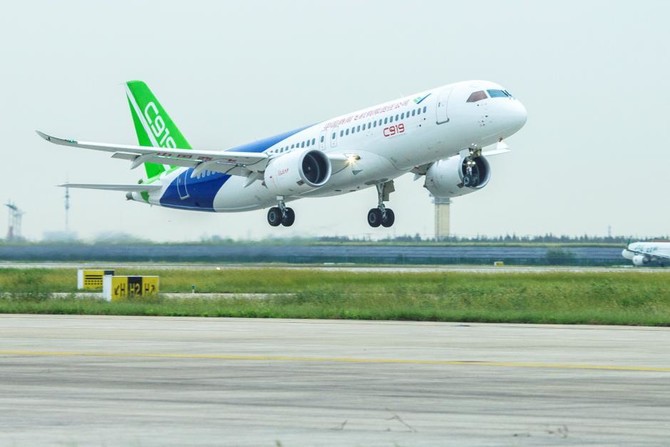
SHANGHAI: China’s self-developed C919 passenger jet completed its first long-distance flight on Friday, in a milestone that its manufacturer said marks the plane’s move into an airworthiness certification phase.
The Commercial Aircraft Corp. of China (COMAC) said in a statement the C919 flew for 2 hours and 23 minutes from Shanghai to the central Chinese city of Xi’an, traveling more than 1,300 kilometers and reaching an altitude of 7,800 meters.
The jet, which China wants to compete with Boeing’s 737 and the Airbus A320, is a symbol of China’s civil aerospace ambitions. It will remain in Xi’an to undergo further testing, the planemaker said.
“This ferry flight indicates that the C919 possess the ability to fly inter-city routes,” COMAC said in the statement. “(It) marks the move into research and development flight-testing and airworthiness certification work.”
The latest flight is the plane’s sixth test since it flew for the first time on May 5. Analysts had questioned the long time gaps between previous test flights.
COMAC is aiming to obtain certification for the plane from Chinese regulators as well as Europe’s aviation safety regulator, which in April agreed to start the certification process.
COMAC said it planned to eventually test six C919 planes and will carry out the first flight for its second jet by the end of this year. The plane currently has 27 customers who have placed orders and commitments for 730 jets, it added.

China’s C919 passenger jet completes first long-distance flight

Lebanese social entrepreneur Omar Itani recognized by Schwab Foundation
- FabricAID co-founder among 21 global recipients recognized for social innovation
DAVOS: Lebanon’s Omar Itani is one of 21 recipients of the Social Entrepreneurs and Innovators of the Year Award by the Schwab Foundation for Social Entrepreneurship.
Itani is the co-founder of social enterprise FabricAID, which aims to “eradicate symptoms of poverty” by collecting and sanitizing secondhand clothing before placing items in stores in “extremely marginalized areas,” he told Arab News on the sidelines of the World Economic Forum in Davos, Switzerland.
With prices ranging from $0.25 to $4, the goal is for people to have a “dignified shopping experience” at affordable prices, he added.
FabricAID operates a network of clothing collection bins across key locations in Lebanon and Jordan, allowing people to donate pre-loved items. The garments are cleaned and sorted before being sold through the organization’s stores, while items that cannot be resold due to damage or heavy wear are repurposed for other uses, including corporate merchandise.
Since its launch, FabricAID has sold more than 1 million items, reached 200,000 beneficiaries and is preparing to expand into the Egyptian market.
Amid uncertainty in the Middle East, Itani advised young entrepreneurs to reframe challenges as opportunities.
“In Lebanon and the Arab world, we complain a lot,” he said. Understandably so, as “there are a lot of issues” in the region, resulting in people feeling frustrated and wanting to move away. But, he added, “a good portion of the challenges” facing the Middle East are “great economic and commercial opportunities.”
Over the past year, social innovators raised a combined $970 million in funding and secured a further $89 million in non-cash contributions, according to the Schwab Foundation’s recent report, “Built to Last: Social Innovation in Transition.”
This is particularly significant in an environment of geopolitical uncertainty and at a time when 82 percent report being affected by shrinking resources, triggering delays in program rollout (70 percent) and disruptions to scaling plans (72 percent).
Francois Bonnici, director of the Schwab Foundation for Social Entrepreneurship and a member of the World Economic Forum’s Executive Committee, said: “The next decade must move the models of social innovation decisively from the margins to the mainstream, transforming not only markets but mindsets.”
Award recipients take part in a structured three-year engagement with the Schwab Foundation, after which they join its global network as lifelong members. The program connects social entrepreneurs with international peers, collaborative initiatives, and capacity-building support aimed at strengthening and scaling their work.