BEIJING: US President Donald Trump decried his country’s “one-sided and unfair” trade deficit with Beijing on Thursday, but he told Chinese President Xi Jinping: “I don’t blame China.”
At a signing ceremony for over $250 billion (SR937.50 billion) in US-Chinese business deals in Beijing, Trump said: “After all, who can blame a country for being able to take advantage of another country for the sake of its citizens?“
However, he pointed the blame at past US administrations “for allowing this out-of-control trade deficit to take place and to grow.”
The Trump administration has aggressively pursued trade remedies in commercial relations with Beijing — investigating Chinese trade practices on intellectual property and in aluminum and steel.
Alleged Chinese misdeeds in commerce were a mainstay of Trump’s populist campaign for the White House but since taking office he has refrained from labeling Beijing a currency manipulator.
Xi has sought to cast himself as a champion of globalization as the US retreats behind Trump’s “America First” policy.
But US and European firms still complain about being barred from certain sectors and forced to share their technologies with local competitors to gain access in some industries.
Speaking after talks with his Chinese counterpart, Trump said that China has to take greater action on market access, forced technology transfers and theft of intellectual property.
“We have to fix this because it just doesn’t work, for our great American companies, and it doesn’t work for our great American workers,” he said.
Xi delivered a brief speech following Trump’s remarks, where he said China welcomed the international business community.
“To keep opening up is our long term strategy. We will not narrow or close our doors. We will open wider and wider,” Xi said.
“I will encourage Chinese businesses to do more investment in US and at the same time, invite more US companies to take part in One Belt One Road,” Xi added.
He was referring to China’s Silk Road project to revive ancient trade routes with a massive network of rail and maritime links.
Annually, the US runs a steep trade deficit in goods with China of about $350 billion.


![]()
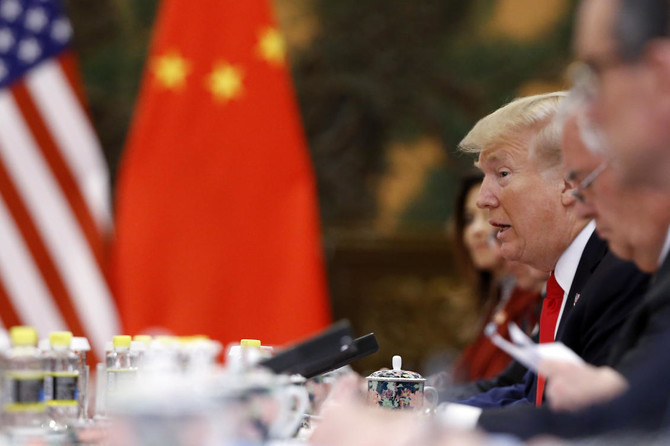
Trump says US trade deficit with Beijing unfair, adds ‘I don’t blame China’
Trump says US trade deficit with Beijing unfair, adds ‘I don’t blame China’


Latest updates



© 2026 SAUDI RESEARCH & PUBLISHING COMPANY, All Rights Reserved And subject to Terms of Use Agreement.