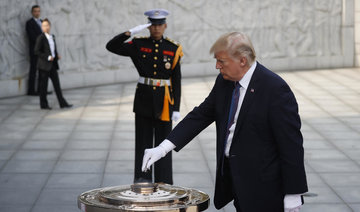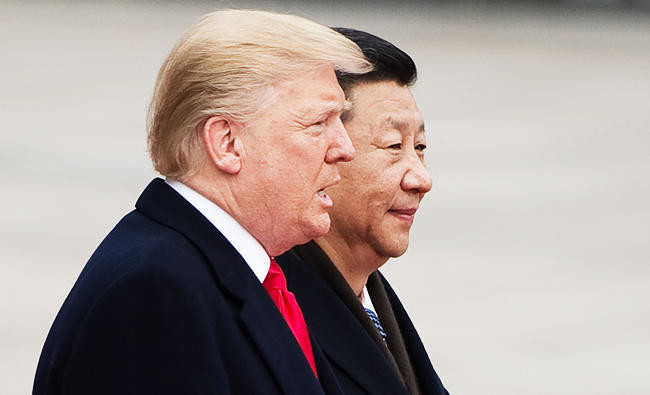
WASHINGTON: It will have to wait until President Donald Trump has finished his tour of Asian capitals, but the United States is expected to return North Korea to its list of state sponsors on terror.
In itself, the designation will not have much practical impact on a pariah state already facing an array of US and international sanctions and intense diplomatic pressure.
But the imminent decision marks another turn of the screw as Washington ratchets up rhetoric designed to convince Kim Jong-Un he will not win his latest nuclear stand-off.
It will also add Pyongyang to a very exclusive list. Only Iran, Syria and Sudan are still blacklisted as terror sponsors, and Sudan is expected to be relieved of the title soon.
Trump’s spokeswoman Sarah Sanders said Wednesday that no decision will be made before the president returns from his Asia trip, on which he is rallying opposition to Pyongyang.
This would imply no sooner than November 15 after the Southeast Asian summit, but for some in Washington that is already late.
While the White House has been mulling a decision on the designation since coming to office in January, in July Congress passed a bill demanding an answer by October 31.
Lawmakers have been chivvying the State Department for a ruling since then, but officials privately argue Trump and Secretary of State Rex Tillerson needed time to consult allies.
The United States and North Korea have been enemies since the 1950 to 1953 war that split the peninsula between the communist North and the westward-leaning South.
In 1988, Pyongyang was added to the US list of state sponsors of terror after Korean Air Flight 858 exploded in midair on a flight between Baghdad and Seoul in November 1987.
Some 115 people were killed and a North Korean agent later confessed to the bombing.
In 2008, then US president George W. Bush’s administration removed North Korea from the list as an incentive to join a round of negotiations on its nuclear program.
Those talks eventually failed and, since Kim Jong-Un took over as dictator from his late father Pyongyang’s nuclear weapons and ballistic missile programs have made rapid progress.
Foreign policy hawks in Washington now want to tag the North again, citing in particular Pyongyang’s presumed implication in the murder of Kim’s older brother and rival, Kim Jong-Nam.
The elder Kim died in February after suspected agents of his brother’s regime sprayed a nerve agent in his face in an airport in Kuala Lumpur, Malaysia.
“North Korea was removed from the list in 2008 in part because Pyongyang had promised to end its nuclear weapons program, another promise the Kim regime did not keep,” said Anthony Ruggiero, a sanctions expert with the Federation for Defense of Democracies.
“The determination should make it easier for the Trump administration to draw a line with countries, noting that continued business with Pyongyang aids a state sponsor of terrorism.”
All signs point to Trump deciding that North Korea deserves to return to the list.
“The president’s cabinet is looking at this as part of the overall strategy on North Korea,” National Security Adviser H.R. McMaster told reporters last week.
“But a regime who murders someone in a public airport using nerve agent and a despotic leader who murders his brother in that manner, that’s clearly an act of terrorism that fits in with a range of other actions, so this is something that’s under consideration. You’ll hear more about that soon.”
In addition to the assassination, US officials have been infuriated by the death of Otto Warmbier, a young US student who was arrested in North Korea for a petty offense and held for more than a year before he was released in a comatose state.
Warmbier died, aged 22, shortly after his unconscious body was flown home and, although North Korea claimed he had contracted botulism in detention, Trump has since alleged that he was tortured in custody.