BAGHDAD: Hundreds of houses owned by Iraqi Arabs, Turkmen and Kurds have been seized by the local Kurdish security service in Irbil, the capital of the Kurdish region in northern Iraq, residents and local officials have told Arab News.
Hundreds of members of Assayish, which is in charge of the internal security of the Kurdish areas and was displaced from Kirkuk after Iraqi federal security forces recaptured the city last month, broke into the houses and seized them. Federal security sources confirmed the claims of the residents.
Photographs circulated by local Iraqi media showed the houses with Assayish, followed by a name and a mobile number, written on the walls.
“Five days ago, armed Assayish members came at night, broke the locks and took over our houses,” a Kurdish resident in Irbil, talking on condition of anonymity, told Arab News.
“They took my house, my brother and several of our friends’ houses, bought during the past years to spend the holidays in Irbil from time to time,” the resident said. “People are scared and they cannot talk as they would be arrested if they complain,” he said.
Many other Arab owners reached by Arab News said that their houses had been taken too.
“I put all I have earned into this house. This house represents all that I owned and now it’s gone,” an Arab owner whose home was taken by Assayish told Arab News. He also refused to reveal his name for fear of retaliation by Kurdish authorities in the region.
Tensions between Kurds and Arabs are at a peak since Iraqi Kurdish authorities held a controversial referendum on independence in September. Baghdad has responded by driving Kurdish troops from the oil hub city of Kirkuk, its lucrative oil fields and most of the disputed areas controlled by the Kurdish regional government for the past 14 years.
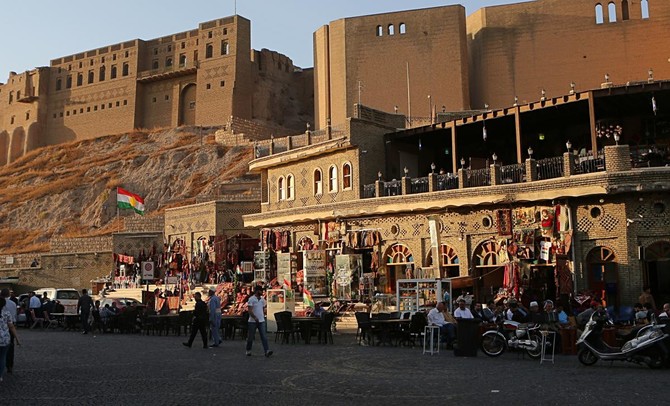
Most of the seized houses were empty and located in newly established investment complexes such as Ashti Du, Kalar City and Dashti Bhasht, which are mainly owned by Arabs, Turkmen and Kurds who have been spending the summer months and the holidays away from the explosions in Baghdad and the security-destabilized provinces.
Local Kurdish officials said that the houses were “temporarily” used to host Kurdish families displaced from Kirkuk in the past few weeks and that no Arab families were forced to leave Irbil.
“Some of the families were placed in the Eshte Du complex by an agreement between the owner of Ashti and Irbil to house these displaced families,” said a statement released by Assayish on Monday.
“The names are written on the (wall of these) houses (to show that they) are owned by the company and have not been sold to anyone,” the statement read. “No home owned by displaced Arabs has been subjected to any problem.”


Iraqi Kurdish security forces ‘seize Arab-owned empty houses’ in Irbil
Iraqi Kurdish security forces ‘seize Arab-owned empty houses’ in Irbil

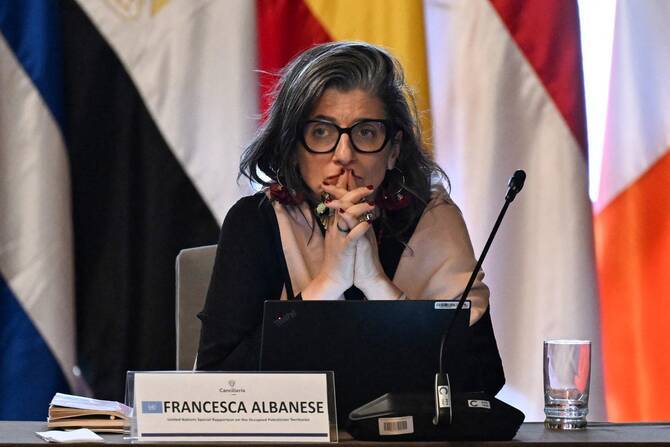
Independent UN body condemns ‘vicious attacks’ on UN expert on Palestinian rights
- The UN Coordination Committee accused European ministers of relying on “manufactured facts“
- UN experts are commissioned to monitor and document specific human rights crises
GENEVA: An independent United Nations body on Tuesday condemned what it described as vicious attacks based on disinformation by several European ministers against the organization’s special rapporteur for Palestine, Francesca Albanese.
In the past week several European countries, including Germany, France and Italy, called for Albanese’s resignation over her alleged criticism of Israel. Albanese, an Italian lawyer, denies making the remarks.
On Friday, the Czech Republic’s Foreign Minister Petr Macinka quoted Albanese on X as having called Israel a “common enemy of humanity,” and he also called for her resignation.
A transcript of Albanese’s remarks made in Doha on February 7 seen by Reuters did not characterise Israel in this way, although she has consistently criticized the country in the past over the Gaza conflict.
The UN Coordination Committee — a body of six independent experts which coordinates and facilitates the work of Special Rapporteurs — accused European ministers of relying on “manufactured facts.”
“Instead of demanding Ms Albanese’s resignation for performing her mandate...these government representatives should join forces to hold accountable, including before the International Criminal Court, leaders and officials accused of committing war crimes and crimes against humanity in Gaza,” the Committee said.
It said the pressure exerted on Albanese was part of an increasing trend of politically motivated and malicious attacks against independent human rights experts, UN officials and judges of international courts.
US President Donald Trump’s administration imposed sanctions on Albanese after she wrote letters to US companies accusing them of contributing to gross human rights violations by Israel in Gaza and the West Bank.
UN experts are commissioned by the Geneva-based Human Rights Council to monitor and document specific human rights crises but are independent of the organization itself.
There is no precedent for removing a special rapporteur during their term, although diplomats said that states on the 47-member council could in theory propose a motion to do so.
However, they said strong support for Palestinian rights within the body means that such a motion was unlikely to pass.