Saudi Cabinet acclaims royal order to form anti-corruption committee

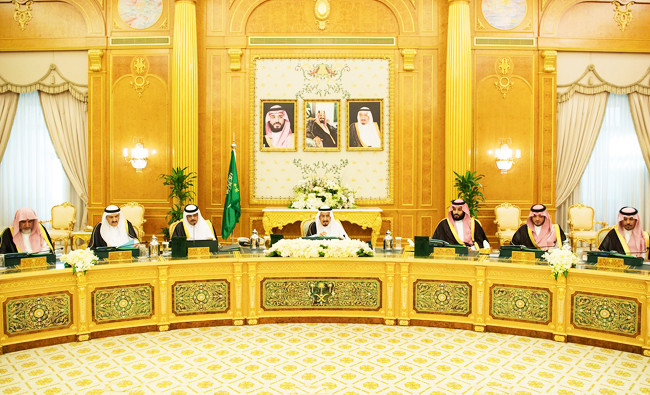
King Salman presiding over the Cabinet meeting in Riyadh on Monday. (SPA)
Updated 12 November 2017
Follow

Saudi Cabinet acclaims royal order to form anti-corruption committee

RIYADH: The Saudi Cabinet on Tuesday appreciated the royal order to form a supreme committee chaired by the crown prince to identify violations, crimes, individuals and entities involved in public corruption cases.
The Cabinet stressed that royal order emanates from the king’s responsibility toward the homeland and citizens and his consideration of the risks of corruption and its bad effects on the state at political, social, economic and security levels.
The weekly meeting was chaired by King Salman at Al-Yamamah Palace in Riyadh.
The king began the session by briefing attendees on the outcome of his talks with US President Donald Trump; Egyptian President Abdel Fattah El-Sisi; Japanese Premier Shinzo Abe; Italy Premier Paolo Gentiloni; Lebanon Premier Saad Al-Hariri; and Russian Energy Minister Alexander Novak.
The Minister of Culture and Information Awwad bin Saleh Al-Awwad said that the Cabinet renewed the Kingdom’s condemnation of the launching of a ballistic missile by Houthi armed militias from Yemeni territories on the capital Riyadh to target populated civilian areas.
The Cabinet stressed that this hostile and indiscriminate action proved Iranian involvement in supporting Houthi armed groups with qualitative capabilities in defiance of the UN resolution 2216. It is considered as an open aggression targeting neighboring countries and international peace and security in the region and the world, and it affirms the Kingdom’s right to legitimate defense of its territory and people under Article 51 of the UN Charter.
Ministers dealt with the World Bank Group’s report on the Kingdom’s unprecedented progress in indicators of the ease of doing business after implementing many reforms and procedures that have improved the business and investment environment, as well as investor confidence.
The report also referred to the Kingdom’s ranking among the top 20 reformist countries in the world, and its position of second among the best high-income countries and G-20 countries in terms of implementing reforms to improve the business environment.
The Cabinet also pointed out the Kingdom’s strong condemnation of a UN committee report that the UN had presented $14 million to the so-called Yemeni Ministry of Education, an affiliate of Houthi militias which are planting thousands of mines inside Yemen and on the Saudi border. It asked for reconsideration of the report submitted to the committee to reflect the facts that had been ignored and the commitment of all UN organs to the relevant Security Council resolutions, including resolution 2216, stressing that UN support for Houthi militias was unjustifiable or unacceptable.
Ministers expressed their condemnation of the recent truck-ramming accident in New York, the suicide bombing in Kabul and the two suicide attacks in Kirkuk, Iraq, which resulted in a number of victims and injuries. It expressed its condolences to the families of the victims, the US administration and people in addition to the governments and peoples of Afghanistan and Iraq.
The Cabinet reiterated the Kingdom’s firm stance rejecting terrorism in all its forms and manifestations and the importance of international efforts to confront and eradicate it.


National program identifies 165 native plants for afforestation efforts in Asir

Updated 29 December 2025
Follow

National program identifies 165 native plants for afforestation efforts in Asir

  • The survey is part of broader plans focused on restoring degraded land, using native vegetation 

JEDDAH: Saudi Arabia’s National Afforestation Program has identified more than 165 species of native plants suitable for afforestation in the Asir region, highlighting the ecological diversity of one of the Kingdom’s most environmentally varied areas, the Saudi Press Agency reported.

The findings form part of broader national efforts to expand vegetation cover, address land degradation, and support sustainability goals linked to the Saudi Green Initiative and Vision 2030.

According to the program, the identified species are distributed across a wide range of natural environments in Asir, including mountainous terrain, highlands, slopes, valleys, plains, rocky landscapes, and coastal areas stretching from the Red Sea to Tihama.

The species belong to numerous plant families, including Fabaceae, Anacardiaceae, Burseraceae, Capparaceae, Ebenaceae, Euphorbiaceae, Malvaceae, Myrtaceae, Oleaceae, and Primulaceae, among others.

Plants suitable for afforestation range from large and small trees to perennial and annual shrubs, herbs, succulents, bulbs, and climbing plants. 

Among the most notable species identified are the grey mangrove, mastic tree, mooring or ben tree, juniper, sycamore fig, wild olive, henna, wild jasmine, hawthorn, and arak.

The Saudi Arabian Botanical Society described the announcement as an important step in protecting plant diversity and strengthening the ecosystem conservation in the Kingdom. 

Munirah bin Hamad Al-Hazani, founder and president of the society, said that prioritizing native species is central to sustainable afforestation.

“Focusing on the cultivation of native plants adapted to diverse environments forms the cornerstone of sustainable afforestation projects, as it plays a pivotal role in enhancing vegetation cover, combating land degradation, and conserving natural and financial resources,” she told Arab News.

Al-Hazani added that long-term success depends on cooperation between government bodies and the nonprofit sector, alongside community involvement and environmental awareness programs.

The National Afforestation Program has increasingly emphasized community participation, working with government agencies, private companies, and nonprofit organizations to support planting initiatives and environmental education. Its approach includes promoting volunteerism and discouraging harmful environmental practices, while focusing on the use of native plants adapted to local conditions.

Parallel efforts are underway in other regions of the Kingdom to support vegetation restoration through research and infrastructure development. In Jouf, often referred to as the Kingdom’s food basket, the King Salman bin Abdulaziz Royal Reserve Development Authority has established a Central Nursery and a Wild Seeds Research and Production Station to address the growing demand for reliable sources of native seeds and seedlings.

The project was launched in 2023 under the directive of Prince Abdulaziz bin Saud bin Naif, the minister of interior and chairman of the authority’s board of directors. 

Since then, the facilities has become a key component of vegetation restoration efforts within the reserve.

The authority has focused on building operational capacity by recruiting and training specialists to manage cultivation and research activities. The research and production station includes 14 mother-seed production fields containing over 400,000 trees and shrubs. 

Planting began in late 2024, with more than 30 native plant species represented, selected for their role in the reserve’s natural ecosystem. 

The facility also includes two seed storage units with a combined capacity of 3,000 kilograms. Seeds are collected annually from multiple sites within the reserve and used for seedling production habitat rehabilitation.

The Central Nursery spans 6,000 square meters and includes 30 greenhouses spanning 1,500 square meters, as well as two shade houses used during summer months. A plant hardening facility, designed to prepare seedlings for natural environmental conditions, covers 10,000 square meters and is divided into seven sections. The nursery’s annual production capacity reaches 1.5 million seedlings, representing more than 15 native plant species. 

Together, these initiatives underscore the growing role of native plant research and propagation in Saudi Arabia’s afforestation strategy, particularly as the Kingdom works to balance environmental restoration with long-term sustainability goals.