

Turkish PM hails US visa move, calls for Gulen’s extradition

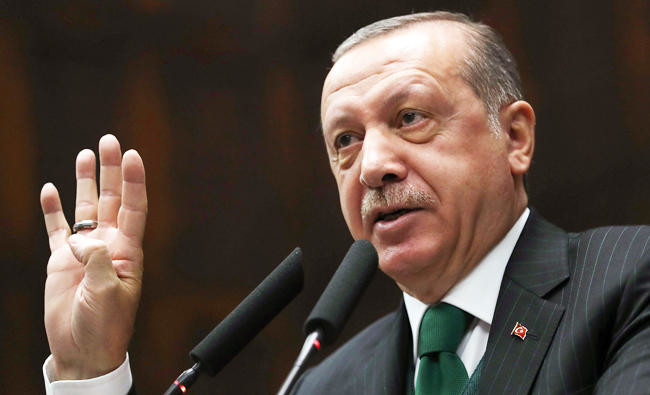
Turkey's President Recep Tayyip Erdogan addresses members of parliament of the ruling Justice and Development Party (AKP) in Ankara on Tuesday. (AFP)
Updated 08 November 2017
Follow

Turkish PM hails US visa move, calls for Gulen’s extradition

ANKARA/ISTANBUL: Turkish Prime Minister Binali Yildirim on Tuesday described the US’ move to partially resume issuing visas in Turkey as a positive step, but said Washington should extradite a cleric blamed for last year’s failed military coup in Turkey.
“The limited reissuing of visas between the United States and Turkey... prior to our visit can be seen as a positive development,” Yildirim told reporters before leaving for the US, where he is due to meet US Vice President Mike Pence.
The US said on Monday it would resume “limited visa services” in Turkey after getting what it said were assurances about the safety of its local staff. Washington halted issuing visas at its missions in Turkey last month, citing the detention of two local employees.
Turkey said it would match the move, relaxing a visa ban of its own that was instituted last month in retaliation against Washington. However, Yildirim reiterated Turkey’s stance that it had not offered assurances to Washington.
“Both countries are states of law, and procedures are being carried out in accordance with the law. Negotiations regarding the offering of assurances to the United States or vice-versa would breach the principles of laws of state,” he said.
In May, a translator at the US consulate in the southern province of Adana was arrested and, more recently, a US Drug Enforcement Administration worker was detained in Istanbul. Both are accused of links to last year’s coup attempt. The US Embassy has said the accusations are baseless.
Turkey has been angered by what it sees as US reluctance to hand over the cleric Fethullah Gulen, who has lived in Pennsylvania since 1999 and whom Ankara blames for orchestrating the coup. US officials have said courts require sufficient evidence to order his extradition.
Yildirim said Gulen’s extradition would be discussed during his visit, as well as the fate of some Turkish citizens arrested in the US — a reference to the wealthy gold trader who was arrested over Iran sanctions evasion last year and an executive at a state-owned bank arrested this year.
“We have strong evidence that Gulen was behind the July 15 coup attempt and we want his extradition. We want the concerns we have regarding the cases of our citizens arrested in the United States to be eased,” Yildirim said.
“They also have similar requests, and diplomatic channels are being used for discussions, we are both seeking a way out.”

Arrest warrants
A Turkish prosecutor has issued detention warrants for 53 active sergeants over alleged links to Gulen, state media said on Tuesday.
Twenty of the suspects have so far been detained in the operation across 12 provinces, state-run Anadolu Agency said. Thirty-three other soldiers were currently being sought, it said.
The Interior Ministry said on Monday that nearly 700 people had been detained over the previous week on allegations of ties to what Ankara calls the “Gulenist Terror Group.”
Some 50,000 people have been arrested since the failed putsch in July and around 150,000 dismissed or suspended, including soldiers, police, teachers and public servants, over alleged links with the movement of the US-based cleric.


UAE to withdraw counter-terrorism units in Yemen, reiterates respect for Saudi sovereignty

Updated 35 min 11 sec ago
Follow

UAE to withdraw counter-terrorism units in Yemen, reiterates respect for Saudi sovereignty

  • Abu Dhabi emphasized its commitment to maintaining close coordination with Riyadh on all matters of mutual concern

ABU DHABI: The UAE announced the withdrawal of its remaining counter-terrorism units in Yemen on Tuesday, citing recent developments and concerns over the safety and effectiveness of ongoing operations.

In a statement issued on Tuesday carried on Emirates News Agency, the Ministry of Defense said the decision was taken voluntarily and in coordination with relevant international partners, ensuring the safety of UAE personnel.

The move follows a comprehensive assessment of current conditions and aligns with the UAE’s broader commitments to regional security and stability, the statement added.

The ministry reiterated that the UAE formally ended its military presence in Yemen in 2019 after completing its agreed missions as part of the Coalition to Restore Legitimacy in Yemen.

Since then, its presence had been limited to specialized counter-terrorism teams operating alongside international partners.

The UAE has been part of the coalition since 2015, contributing to efforts to support legitimacy in Yemen, combat terrorist organizations, and promote security and stability in the country, the statement added.

Earlier on Tuesday, the UAE reaffirmed its unwavering commitment to Saudi Arabia’s security and sovereignty, rejecting any actions that could threaten the Kingdom or undermine regional stability.

In a statement issued in response to recent remarks by Saudi Arabia regarding developments in Yemen, the UAE stressed that it fully respects Saudi Arabia’s national security and considers the fraternal and historical ties between the two countries a cornerstone of regional stability.

Abu Dhabi emphasized its commitment to maintaining close coordination with Riyadh on all matters of mutual concern.

The UAE said its position since the start of events in Yemen’s eastern governorates of Hadramawt and Al-Mahra has been focused on containing tensions, supporting de-escalation, and working toward understandings that preserve security, stability, and the protection of civilians, in coordination with Saudi Arabia.

Abu Dhabi categorically rejected any attempt to implicate it in tensions between Yemeni factions, condemning allegations that it pressured or directed any party to carry out military operations that threaten Saudi Arabia’s security or target its borders.

The UAE also called for recent developments in eastern Yemen to be handled responsibly to prevent escalation, urging reliance on verified facts and coordination among all relevant parties to safeguard shared interests and maintain regional security and stability.
