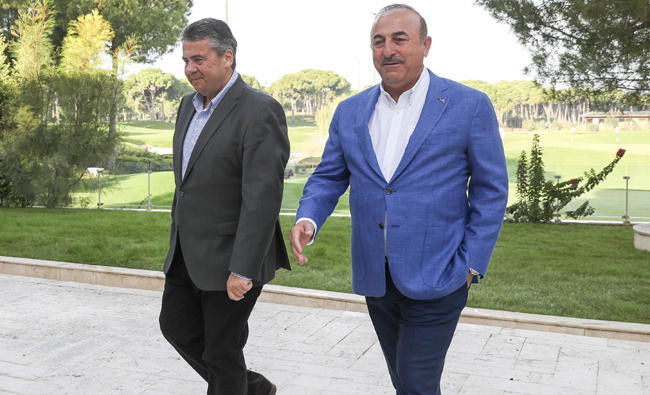
ANKARA: With relations between their countries at an all-time low in the run-up to Germany’s September elections, Turkish Foreign Minister Mevlut Cavusoglu and his German counterpart Sigmar Gabriel held a long-awaited one-to-one meeting on Nov. 4 in Turkey’s southern resort province of Antalya.
“I met my colleague Sigmar Gabriel informally to discuss bilateral relations; including the difficult issues and mutual expectations,” Cavusoglu tweeted after the meeting.
On Sunday, Turkish presidential spokesperson Ibrahim Kalin told Turkish news channel NTV that Turkey is seeking good relations with Germany because “it is one of the most important countries of the EU.”
Kalin added that the arrests made Saturday during a pro-PKK (Kurdistan Worker’s Party) rally in Dusseldorf were “a good but insufficient step. The German government needs to take more steps on counterterrorism.”
The outlawed PKK, considered a terrorist group by Turkey, the US and the EU, has also been banned in Germany since 1993.
The main disagreements between Turkey and Germany center on Ankara’s accusing Berlin of tolerating the outlawed PKK members and their activities in its territories and of granting asylum to the Gulenists following the failed coup attempt last year.
Instead, Germany criticizes Turkey for arresting German nationals, including journalists and rights activists, without offering legitimate reasons.
Turkey recently released a German national, Peter Steudtner, who was accused of terror charges, as well as another German whose name has not been disclosed, and these have widely been seen as positive steps taken by Ankara to restore ties and dampen the crisis.
“Many were expecting that the German modus operandi toward Turkey would change after the elections — if Ankara would meet some of Berlin’s most pressing demands,” Magdalena Kirchner, Mercator-IPC fellow at the Istanbul Policy Center, told Arab News.
“The visit is a clear signal that the German government appreciated that, as Gabriel had said himself, ‘the Turkish government has kept all its promises’ regarding the release of Peter Steudtner in late October,” she added.
But, according to Kirchner, as about a dozen other German citizens are still detained in Turkey on terrorism-related and other charges, Cavusoglu and Gabriel might have looked at how to move on from this first successful step.
“Also for Ankara, maintaining a permanent dialogue despite ongoing coalition negotiations in Berlin and uncertainty over their exact outcome, is of high importance in terms of economic and security cooperation,” Kirchner noted.
“In order to revive at least a dialogue about the modernization of the EU customs union and reach a minimum of consensus on terrorism issues with Western partners, Berlin remains key for Ankara’s foreign policy. Therefore, it was also important that the meeting was aimed at reassessing bilateral relations beyond the case of German detainees.”
For Kirchner, the termination of election campaigning in Germany and the forthcoming end of Gabriel’s term as foreign minister — as soon as a new coalition government is formed in Berlin — have also helped to foster a better relationship between the two countries.
“Hence, he can take on to a certain extent the role of an ‘elder statesman,’ setting a more reconciliatory tone and preventing an all-too-bumpy start for the incoming government,” she noted.
During the election campaign, Gabriel had advocated against breaking off membership talks with Turkey, and reminded that Ankara was a key neighbor and a partner in the NATO alliance who could otherwise side with Russia.
Although denied by Ankara, Gabriel last month thanked former German Chancellor Gerhard Schroeder, who still maintains close contact with Turkish President Recep Tayyip Erdogan, for mediating for the release of German citizens detained in Turkey.
“While we certainly see a de-escalation of the tension between Germany and Turkey, this is not a sign of a return to the status quo ante as most of the problems that caused the crises are not addressed,” Ozgur Unluhisarcikli, who heads the German Marshall Fund in Ankara, told Arab News.
On the other hand, Unluhisarcikli says, Germany will probably refrain from doing everything it had talked about earlier primarily because some of these measures, such as suspending EU accession negotiations with Turkey, are not supported by a critical mass of EU member states.
“The Germany-Turkey relationship is structurally very resilient and will eventually normalize. Both countries could accelerate this process by addressing each other’s legitimate concerns sooner rather than later,” he added.


![]()
Turkey and Germany take steps to restore ties
Turkey and Germany take steps to restore ties
Latest updates





© 2026 SAUDI RESEARCH & PUBLISHING COMPANY, All Rights Reserved And subject to Terms of Use Agreement.