Germany jails two extremists for fighting in Somalia, Syria

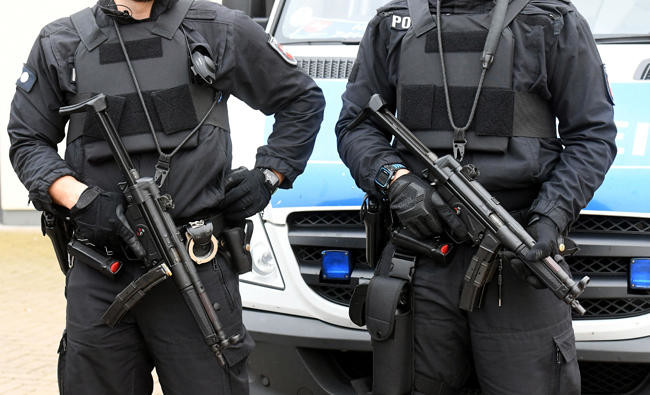
Policemen stand guard in Celle near Hanover, central Germany, in this September 26, 2017 photo. (AFP)
Updated 28 October 2017
Follow

Germany jails two extremists for fighting in Somalia, Syria

BERLIN: A Frankfurt court has sentenced two men to jail in separate cases for joining extremist fighters in Somalia and Syria.
A Somali-born German national, identified only as 29-year-old Abshir A., was found guilty of membership of a foreign terrorist group for fighting alongside Al-Qaeda-linked Al-Shabab militants.
The court in the western German city handed him a prison term of two years and ten months.
The same court sentenced Turkish-origin Ozkan C., 29, to two years and eight months for joining the militia Junud Al-Sham in Syria.
In the first case, the court said the Mogadishu-born accused left Germany for Somalia in 2012 after becoming radicalized and was active for the militant group until early 2014.
He spent around four months in combat training after arriving, during which time Al-Shabab militia taught him how to handle weapons and employ guerrilla tactics, according to the court statement.
He was then sent to an Al-Shabab base but left “shortly afterwards because of health problems,” it added.
He, however, remained in Somalia until returning to Germany last year when he was arrested at the airport.
The accused denied taking part in any fighting in Somalia, where the Al-Shabab is seeking to overthrow the country’s internationally-backed government.
In the second case, the court said Ozkan C. traveled to Syria with his wife in 2013 to join Junud Al-Sham, many of whose fighters later defected to Daesh.
The accused received weapons training and taught Arabic to other German-speaking radicals, the court said.
He returned to Germany in late 2013 and was arrested last year.
German courts have jailed a number of returning extremists for their membership in terror groups abroad.
Five men were sentenced to prison terms of up to five years in 2016 for having joined the Al-Shabab in Somalia.
In another case that year, a court jailed three young German men for up to four-and-a-half years for having joined extremist fighters in Syria in 2013.


Zelensky says Ukrainian air force needs to improve as Russian drone barrages take a toll

Updated 9 sec ago
Follow

Zelensky says Ukrainian air force needs to improve as Russian drone barrages take a toll

  • Zelensky said Friday he had discussed with his defense minister and the air force commander what new air defense measures Ukraine needs to counter the Russian barrages
  • Russia fired 328 drones and seven missiles at Ukraine overnight and in the early morning

KYIV: Ukrainian President Volodymyr Zelensky on Friday described the performance of the air force in parts of the country as “unsatisfactory,” and said that steps are being taken to improve the response to large-scale Russian drone barrages of civilian areas.
The repeated Russian aerial assaults have in recent months focused on Ukraine’s power grid, causing blackouts and disrupting the heating and water supply for families during a bitterly cold winter.
With the war about to enter its fifth year later this month following Russia’s all-out invasion of its neighbor, there is no sign of a breakthrough in US-led peace efforts following the latest talks this week.
Further US-brokered meetings between Russian and Ukrainian delegations are planned “in the near future, likely in the United States,” Zelensky said.
Zelensky said Friday he had discussed with his defense minister and the air force commander what new air defense measures Ukraine needs to counter the Russian barrages. He didn’t elaborate on what would be done.
Russia fired 328 drones and seven missiles at Ukraine overnight and in the early morning, the air force said, claiming that air defenses shot down 297 drones.
One person was killed and two others were injured in an overnight Russian attack using drones and powerful glide bombs on the central Dnipropetrovsk region, according to the head of the regional military administration, Oleksandr Hanzha.
A Russian aerial attack on the southern Zaporizhzhia region during early daylight hours injured eight people and damaged 18 apartment blocks, according to regional military administration head Ivan Fedorov.
A dog shelter in the regional capital was also struck, killing 13 dogs, Zaporizhzhia City Council Secretary Rehina Kharchenko said.
Some dogs were rushed to a veterinary clinic, but they could not be saved, she said. Seven other animals were injured and are receiving treatment.
Amid icy conditions in Kyiv, more than 1,200 residential buildings in multiple districts of the capital have had no heating for days due to the Russian bombardment of the power grid, according to Zelensky.
The UK defense ministry said Friday that Ukraine’s electricity network “is experiencing its most acute crisis of the winter.”
Mykola Tromza, an 81-year-old pensioner in Kyiv, said he has had his power restored, but recently went without heating and water at home for a week.
“I touched my nose and by God, it was like an icicle,” Tromza said. He said he ran up and down to keep warm.
Russia’s Defense Ministry said that air defenses downed 38 Ukrainian drones overnight, including 26 over the Bryansk region.
Bryansk Gov. Alexander Bogomaz said the attack briefly cut power to several villages in the region.
Another Ukrainian nighttime strike damaged power facilities in the Russian city of Belgorod, disrupting electricity distribution, Gov. Vyacheslav Gladkov said.
Local reports said that Ukrainian missiles hit a power plant and an electrical substation, cutting power to parts of the city.
Fierce fighting has also continued on the front line despite the frigid temperatures.
Ukraine’s Commander in Chief, Col. Gen. Oleksandr Syrskyi, said the front line now measures about 1,200 kilometers (750 miles) in length along eastern and southern parts of Ukraine.
The increasing technological improvements to drones on both sides mean that the so-called “kill zone” where troops are in greatest danger is now up to 20 kilometers (12 miles) deep, he told reporters on Thursday in comments embargoed until Friday.