15-year-old girl among Japan ‘serial killer’ mutilation victims

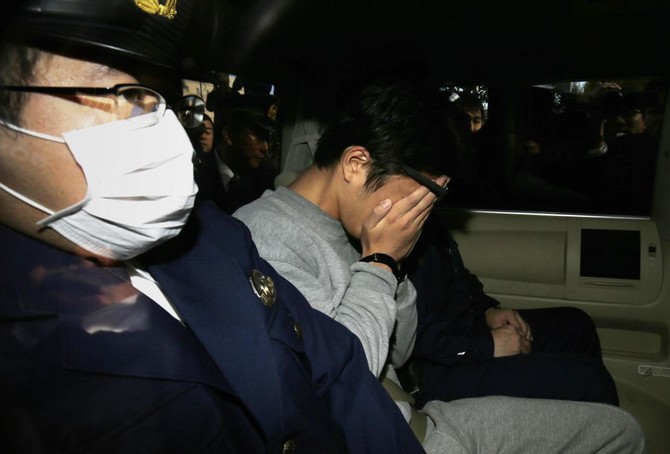
Suspect Takahiro Shiraishi (C) covers his face with his hands as he is transported to the prosecutor’s office from a police station in Tokyo on Nov. 1, 2017. The 27-year-old Japanese man, who was arrested after police found nine dismembered corpses rotting in his house, has confessed to killing all his victims over a two-month spree after contacting them via Twitter, media reports. (AFP/Jiji Press/STR)
Updated 06 November 2017
Follow

15-year-old girl among Japan ‘serial killer’ mutilation victims

TOKYO: Three high school girls, including a 15-year-old, were among the nine people mutilated by a suspected serial killer in Japan, reports said Monday, as one woman described how she had a lucky escape.
At least three of the victims were high school pupils from different regions and one of them was a 15-year-old girl who went missing in late August, several media quoted police sources as saying.
Not all of the victims have been identified but some were tracked down via bank cards and other items left in the apartment room of Takahiro Shiraishi, where the Japanese man allegedly murdered and hacked up nine young people.
Some cellphones also lost contact near the apartment, reports said.
On the morning of Halloween, police uncovered a grisly house of horrors behind Shiraishi’s front door: nine dismembered bodies with as many as 240 bone parts stashed in coolers and tool boxes, sprinkled with cat litter in a bid to hide the evidence.
He moved into the one-room apartment in Zama, a southwestern suburb of Tokyo, on August 22.
He is suspected of having lured people with suicidal tendencies via Twitter by telling them he could help them in their plans or even die alongside them.
He reportedly went ahead with killing people even after realizing what they had wanted was just to talk rather than to die.
“I had no intention of killing myself at all. None (of the victims) wanted to die actually,” the private Fuji television network quoted Shiraishi as telling investigators.
He allegedly hanged victims after giving them alcohol or sleeping pills or strangling them until they fainted.
He may have continued to kill if not arrested.
A woman in her 20s claims to have arranged a meeting with Shiraishi for the day after he was eventually arrested after discussing suicide via email and phone for two months.
He refused to talk when she said she could hear a woman groaning in the background during a telephone conversation on one October night.
“He had given me two options. One was that he makes me unconscious by putting sleep drug in my drink and then strangles me with a rope. The other was that he strangles me with a rope from behind while I’m watching TV or something,” she told the Fuji network.
“If I had met with him, I may have been dismembered like other victims. I may be lucky but I’m rather scared now.”


In southeast Pakistan, Ramadan brings Hindus and Muslims closer

Updated 10 March 2026
Follow

In southeast Pakistan, Ramadan brings Hindus and Muslims closer

MITHI: Partab Shivani, a Hindu in Muslim-majority Pakistan, has fasted on and off during Ramadan for years, but this time is different as he practices abstinence for the entire holy month.
Every year, he and his friends in the southeastern city of Mithi arrange iftar, when Muslims break their daily fast, to foster peace and solidarity between the two religions.
“I believe we need to promote interfaith harmony. First, we are humans — religions came later,” Shivani, a 48-year-old social activist, told AFP, adding that he also reads the teachings of the Buddha.
“His message is about peace and ending war. Peace can spread through solidarity and by standing with one another. Distance only widens the gap between people,” he added.
Ninety-six percent of Pakistan’s 240 million people are Muslim. Just two percent are Hindu, most of them living in rural areas of Sindh province where Mithi is located.
In Mithi itself, most of the 60,000 inhabitants are Hindu.
Many of the city’s Hindus also observe Ramadan and iftar has become a social gathering where people from both faiths happily participate.
“This has been a wonderful tradition of ours for a very long time,” said Mir Muhammad Buledi, a 51-year-old Muslim friend who attended Shivani’s iftar gathering.
“It is a beautiful example of harmony between the two communities.”
Like brothers
Discrimination against minorities runs deep in Pakistan.
Following the end of British rule in South Asia in 1947, the subcontinent was partitioned into mainly Hindu India and Muslim-majority Pakistan.
That triggered widespread religious bloodshed in which hundreds of thousands were killed and millions displaced.
According to the Human Rights Commission of Pakistan, freedom of religion or belief is under constant threat, with religiously motivated violence and discrimination increasing yearly.
State authorities, often using religious unrest for political gain, have failed to address the crisis, the independent non-profit says.
But such tensions are absent in Mithi.
“I am a Hindu but I keep all the fasts during this month,” said Sushil Malani, a local politician. “I feel happy standing with my Muslim brothers.
“We celebrate Eid together as well. This tradition in the region is very old.”
Restaurants and tea stalls are closed across Pakistan during Ramadan.
Ramesh Kumar, a 52-year-old Hindu man who sells sweets and savoury items outside a Muslim shrine, keeps his push cart covered and closed until iftar.
“There is no discrimination among us if someone is Muslim or Hindu. I have been seeing this since my childhood that we all live together like brothers,” he said.
Muslim shrine, Hindu caretaker
Locals say Mithi’s peaceful religious coexistence can be traced to its remote location, emerging from the sand dunes of the Tharparkar desert, which borders the modern Indian state of Rajasthan.
Cows — considered sacred in Hinduism — roam freely in Mithi city, as they do in neighboring India.
At two Sufi Muslim shrines in the middle of the city, Hindu families arrange meals, bringing fruit, meals and juices for their Muslim neighbors to break their fasts.
“We respect Muslims,” said Mohan Lal Malhi, a Hindu caretaker of one of the shrines.
Mohan said his parents and elders taught him to respect people regardless of religion or color, and the traditions pass from one generation to the next.
Local residents said both communities consider their social relationships more important than their religious identity.
“You will see a (Sikh) gurdwara, a mosque, and a shrine standing side by side here,” Mohan said. “The atmosphere of this area teaches humanity.”