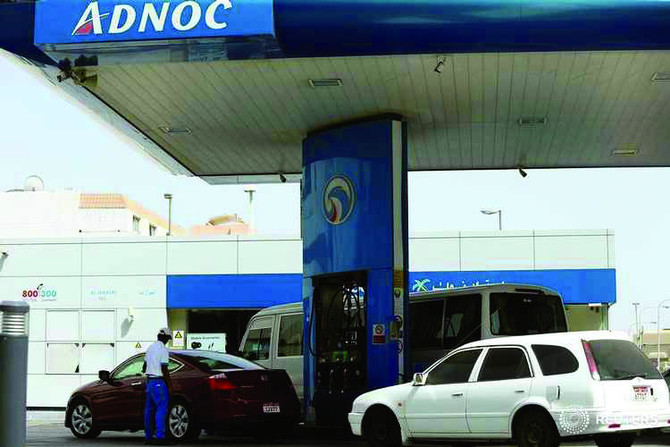
ADNOC ‘expected to sign $6bn loan with 13 banks’

ADNOC is also preparing an initial public offer of shares in its fuel-retail business. (Reuters)
Updated 06 November 2017
Follow

ADNOC ‘expected to sign $6bn loan with 13 banks’

DUBAI: Abu Dhabi National Oil Co. (ADNOC), the UAE oil giant, is expected to sign by the end of this week a $6 billion loan which has received commitments from a group of 13 banks, sources close to the situation said on Sunday.
ADNOC, which manages almost all of the proven oil reserves in the UAE, is raising the financing as part of an overhaul of its capital structure which involves, among other things, additional debt raising exercises and the initial public offering (IPO) of minority stakes in some of its units.
The club loan has been largely oversubscribed, having attracted commitments of $750 million each from a group of 13 banks. Commitments will be scaled down to reach the targeted size of $6 billion, said the sources.
The group of banks comprises Bank of America Merrill Lynch, Bank of Tokyo-Mitsubishi, BNP Paribas, Citi, First Abu Dhabi Bank, Goldman Sachs, HSBC, JP Morgan, Mizuho, Societe Generale, Standard Chartered, Sumitomo Mitsui Banking Corporation, and UniCredit, said one source close to the matter.
A spokesman for ADNOC, when asked about the loan, said the company is “taking a more active approach to optimizing its capital structure to unlock value, free-up capital, enhance returns and drive smart growth. ADNOC is therefore considering various options with regards to its financing strategy.
“The phased and prudent use of bank and other forms of financing represents an attractive and viable funding option for a more efficient and optimal ADNOC capital structure, whilst also allowing access to new and more diverse pools of liquidity.” ADNOC started discussions with banks about the loan and other financing facilities earlier this year, in a sign that Middle East energy companies are rethinking their expansion strategies in an era of lower oil prices.
A company controlled by ADNOC, the Abu Dhabi Crude Oil Pipeline, raised a debut bond of around $3 billion last month, attracting orders of over $11 billion while the deal was marketed.
ADNOC is also preparing an initial public offer of shares in its fuel-retail business which could raise up to $2 billion, sources told Reuters.
It could list more than 10 percent of its fuel-retail business by early 2018.
The $6 billion loan that ADNOC is expected to sign this week includes three-year and five-year tranches.
Sources told Reuters last month that the facility offers an interest rate in the region of 50 basis points over London Interbank Offered Rates for the five-year tranche and 35 bps over Libor for the three-year tranche.
— REUTERS


Saudi retail spending holds steady near $4bn during early Ramadan, while postal services rise

Updated 8 sec ago
Follow

Saudi retail spending holds steady near $4bn during early Ramadan, while postal services rise

RIYADH: Saudi Arabia’s point-of-sale spending remained close to $4 billion in the week ending Feb. 21, even as overall transaction volumes declined during the early days of Ramadan, central bank data showed. 

According to the latest data from the Saudi Central Bank, also known as SAMA, total POS transactions settled at SR13.9 billion ($3.71 billion), representing a 9.3 percent week-on-week decline, while the number of transactions fell 12.5 percent to 220.57 million. 

Spending on freight transport, postal and courier services rose 24.4 percent week on week to SR80.68 million, marking one of the strongest sectoral gains as demand for deliveries increased during the holy month. 

In an interview with Arab News, Saudi economist Talat Hafiz attributed the broader slowdown in spending to seasonal consumption patterns linked to Ramadan. 

“During the first week of Ramadan, consumer behavior typically shifts, as individuals focus more on purchasing goods related to the holy month while reducing discretionary spending,” he said. 

SAMA’s report showed that spending on food and beverages increased by 2.1 percent to SR2.62 billion, accounting for the largest share of total POS transactions.

Meanwhile, spending at restaurants and cafes fell by 28.3 percent to SR1.24 billion. 

Hafiz said this purchasing pattern is expected to continue as Eid Al-Fitr approaches. 

“Spending behavior is likely to shift again, with increased expenditure on travel-related services, apparel, clothing, and accessories in preparation for Eid. During the Eid holiday itself, we can expect a noticeable rebound in spending on recreation, entertainment, restaurants, and cafes,” he added. 

Expenditure on public utilities saw an increase of 2.3 percent to SR63.06 million, while spending on apparel and clothing outlays followed with a 4.8 percent decrease to reach SR1.32 billion. 

Spending at pharmacies and medical supply outlets decreased by 7.9 percent to SR206.1 million, while spending on medical services fell by 10.6 percent to SR482.53 million. Expenditure on personal care declined by 23.6 percent to SR93.34 million. 

The Kingdom’s key urban centers mirrored the negative changes. Riyadh, which accounted for the largest share of total POS spending, saw a 10.8 percent drop to SR4.75 billion. The number of transactions in the capital reached 69.8 million, down 13.3 percent week on week. 

In Jeddah, transaction values decreased 11.1 percent to SR1.88 billion, while Dammam reported a 9.1 percent fall to SR678.29 million. 

POS data, tracked weekly by SAMA, provides an indicator of consumer spending trends and the ongoing growth of digital payments in Saudi Arabia. 

The data also highlights the expanding reach of POS infrastructure, extending beyond major retail hubs to smaller cities and service sectors, supporting broader digital inclusion initiatives.