BARCELONA: Catalonia’s deposed leader Carles Puigdemont has called for separatists to unite in a December election called by Spain to try to avert a disputed push for the region’s independence.
Puigdemont’s rallying cry came a day after a Spanish judge issued an arrest warrant against him, with prosecutors seeking to charge him with rebellion, sedition and misuse of public funds over his secessionist drive.
“The time has come for all democrats to unite. For Catalonia, for the release of political prisoners and for the republic,” he said on Twitter.
The 54-year-old has been holed up in Belgium since Monday and ignored a summons to appear before the judge in Madrid, saying he wants guarantees he will receive a fair trial.
The judge issued the European arrest warrants late on Friday for Puigdemont and four of his allies who are also in Belgium, to force them to return to Spain.
The Belgian public prosecutor’s office confirmed on Saturday it had received the warrants, saying a decision would happen within 24 hours of them appearing before a judge.
But the authorities said any appeals process could last for up to three months.
“The EU Framework Decision provides that the final decision must be taken within 60 days, with an extension to 90 days under exceptional circumstances,” the Belgian Justice Ministry said in a statement.
The warrants have further fueled separatists’ anger and frustration after deposed members of Puigdemont’s government who did not flee to Belgium, including his deputy, appeared before a Spanish judge on Thursday and were detained pending a possible trial.
Protesters in the wealthy northeastern Catalonia region have held frequent demonstrations, chanting and waving Catalan flags, calling for their release.
Spain’s worst political crisis in decades flared up after the regional Parliament in Catalonia voted to proclaim an independent republic following a referendum on Oct. 1 that was declared illegal by the country’s Constitutional Court.
The central government responded by dismissing Puigdemont’s executive, imposing direct rule on the region and calling fresh elections in Catalonia on Dec. 21.
Puigdemont said on Friday he was ready to run as a candidate in the poll and on Saturday called for separatist parties to form a united front.
In his tweet, he referred to an online petition calling for the creation of a combined independent candidate list, which by Saturday had received more than 14,000 signatures.
Puigdemont’s PDeCAT party has been in power in Catalonia for much of Spain’s modern democratic era.
Separatist parties have 72 seats in the 135-seat parliament but PDeCAT is seen running fourth or fifth in the December vote according to opinion polls.
“It’s absolutely indispensable that we have a joint strategy to battle the repression,” Sergi Sabria, a spokesman for the separatist ERC party, told Catalunya Radio, in a sign the two main parties could work together.
Whether Puigdemont and his colleagues in Brussels, Maria Serret Aleu, Antoni Comin Oliveres, Luis Puig Gordi and Clara Ponsati Obiols, will be able to take part in the election is an open question.
The Belgium Justice Ministry said there are “some situations” where European arrest warrants can be refused, but added: “If the decision is to execute the (warrant), the person is in principle surrendered to the authorities of the issuing state within 10 days following the decision.”
Puigdemont has repeatedly called on the international community to back him, but apart from Scotland’s separatist First Minister Nicola Sturgeon criticizing the “jailing of political opponents,” there are no signs that other countries will recognize the independence move.
Spain’s allies in Europe have voiced steadfast support for the nation’s unity and said they back the independence of the judiciary.
The 7.5 million people of Catalonia, which until this past week had considerable autonomy, are fiercely proud of their language and culture but are also deeply divided about the wisdom of independence.
Even though Catalonia is one of Spain’s wealthiest regions, Spain’s Central Bank has warned of a possible recession and unemployment in the region rose strongly in October.
Despite the negative economic headwinds, Peter Ceretti at the Economist Intelligence Unit said pro-independence parties might win the December election, as the jailed ministers could deliver an “important propaganda” boost.


![]()
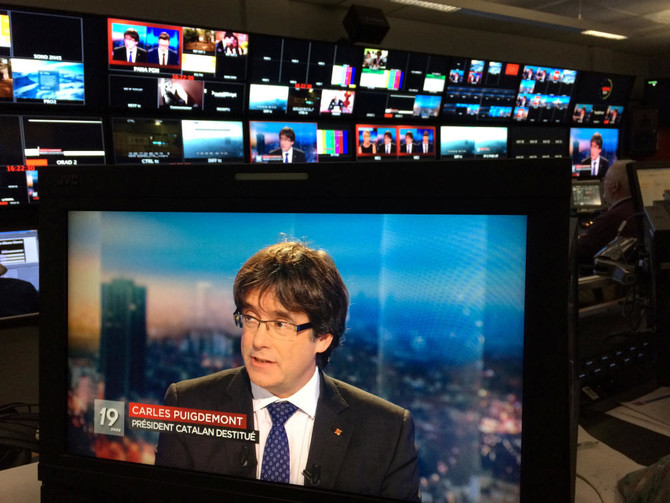
Deposed Catalan leader urges separatist ‘unity’ for vote
Deposed Catalan leader urges separatist ‘unity’ for vote


Latest updates


© 2026 SAUDI RESEARCH & PUBLISHING COMPANY, All Rights Reserved And subject to Terms of Use Agreement.