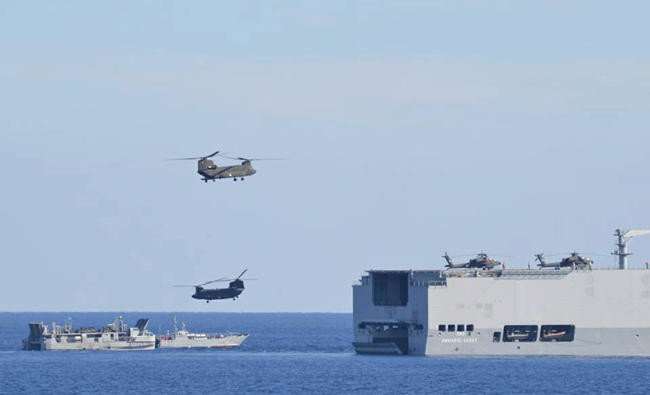

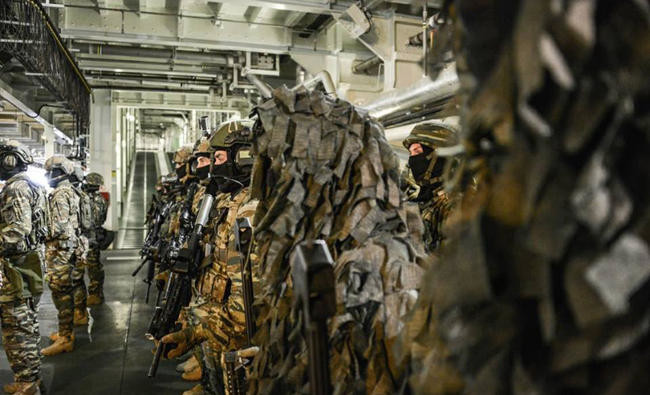
CAIRO: Greece’s joint military exercise with Egypt, Medusa 5, has brought an angry response from Turkey.
The exercise, which began on Monday on the Greek island of Rhodes and ends today, included joint naval operations and search-and-rescue drills. Egyptian naval and air forces took part.
In a written statement, Turkey’s Foreign Ministry alleged the exercise is illegal, citing the 1947 Treaty of Paris, which prohibits any kind of military education activities on Rhodes.
The island was informally united with Greece after World War II on the condition that it would remain demilitarized.
“Therefore, this … is an open breach of international law,” the statement claimed.
Turkey and Greece came to the brink of war as recently as 1996, when a dispute over the ownership of uninhabited islets known as Imia in Greek and Kardak in Turkish threatened to escalate out of control, before US diplomatic intervention calmed the situation. But that territorial dispute — along with the wider disagreements over sovereignty in and around the Aegean Sea.
According to the Anadolu news agency, the statement said Turkey had conveyed warnings to the Greek Embassy in Ankara and reminded them of the importance of avoiding unilateral actions that could increase tensions in the Aegean Sea.
Rhodes is located in the southeastern part of the sea, close to the Turkish coast. In July, the Greek coastguard opened fire on a Turkish commercial ship in international waters off the island’s coast.
“In this framework, we stress our expectation that Greece will avoid hostile acts and acts against international law, and we invite third parties not to be partners to these kinds of violations by Greece,” the statement added.
Observers from four countries — America, Italy, Cyprus and the UAE — have been invited to Medusa 5.
Meanwhile, Greek Minister of National Defense Panos Kammenos told the press on October 1 that Greece is planning to hold joint military exercises with Cyprus, Egypt and Israel — a move that many suggest was intended as a message to Ankara that major regional powers support Greece’s stance against Turkey, which Greece claims is stealing its right to gas in the Eastern Mediterranean.
While Turkish President Recep Tayyip Erdogan reportedly plans to visit Greece in late November or early December, tensions have been rising between the traditional rivals since the failed coup attempt in Turkey in July 2016.
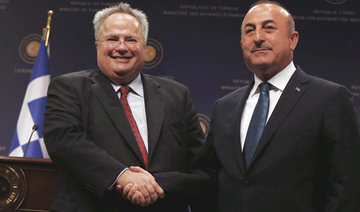
During a joint news conference with his Greek counterpart, Nikos Kotzias, on Oct. 24, Turkish Foreign Minister Mevlut Cavusoglu urged Greece not to become a “safe haven” for the architects of the coup attempt, citing the 995 people who have applied for asylum in Greece since then.
In response, Kotzias said decisions on asylum seekers were made by the Greek judiciary and had to be respected “even if it doesn’t please some.”
Mohamed Abd Elkader, editor-in-chief of Turkish Affairs, a review published by Egypt’s Al Ahram Center for Political and Strategic Studies, said he believes the current posturing is unlikely to escalate into any serious military confrontation.
“Egypt, Greece and Cyprus have greatly enhanced cooperation in the last three years, and that has increased Turkey's concerns in the Eastern Mediterranean,” he told Arab News.
“Turkey sent some of its military planes to eavesdrop and spy on the drills, but no further response is probable,” he added.
“The two nations are both using their political leverage for the time being, but the military balance and regional context in Europe or in the Middle East don’t offer the possibility of a military option,” Abd Elkader concluded.