New terror group claims responsibility for Egypt attack

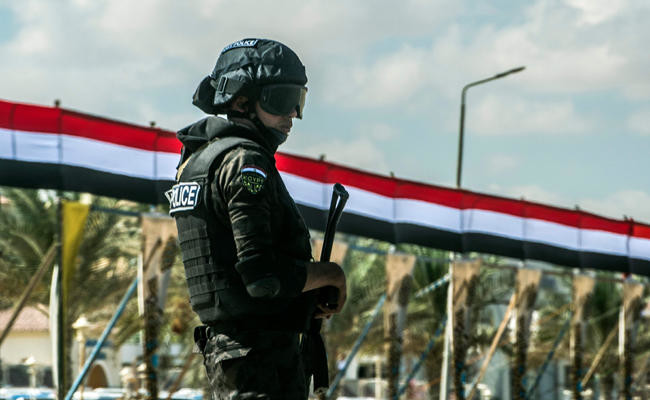
An Egyptian policeman stands guard in the new city of El-Alamien, west of Alexandria. (AFP)
Updated 03 November 2017
Follow

New terror group claims responsibility for Egypt attack

CAIRO: A previously unknown militant group with links to Al-Qaeda claimed responsibility on Friday for an attack in Egypt’s Western Desert that killed at least 16 policemen two weeks ago, announcing the start of a holy war against the Egyptian state.
The new group, Ansar Al-Islam, gave no evidence for its claim of responsibility for the Oct. 21 attack but said Abu Hatem Emad Al-Din Abd Al-Hamid, a fighter suspected by the authorities of involvement, was one of its leaders. He was killed this week in an air strike.
“We have started our jihad with the battle of the Lion’s Den in the Bahariya Oasis area on the borders of Cairo and were victorious against the enemy’s campaign,” the statement said.
Two security sources and a forensic doctor said DNA analysis of bodies of militants killed in the air raid showed Abd Al-Hamid was among them.
The security sources said he was the deputy of Hesham Al-Ashmawy, a former Egyptian military officer turned jihadist who has operated out of the city of Derna across the border in Libya and is blamed for past attacks. The two men graduated from Egypt’s military academy the same year and were both fired from the army for adopting radical religious beliefs.
Ashmawy is known for being loyal to Al-Qaeda, which means that if Ansar Al-Islam’s claim of responsibility is verified it could herald the emergence of a new Egyptian cell of the network founded by Osama bin Laden.
In recent years, most attacks on security forces in Egypt have been blamed on fighters claiming allegiance to the Daesh group. Ashmawy is believed to have switched allegiance from Daesh to Al-Qaeda, which operates more on a system of linked cells rather than a formal hierarchy.
“We have information that Ashmawy and Abd Al-Hamid broke away from (Daesh) after a third colleague of theirs was killed and also for doctrinal issues,” said one officer with Egypt’s Homeland Security agency on condition of anonymity.
Three security sources said at the time of the Oct. 21 attack that at least 52 police officers and conscripts had been killed when their patrol was struck by militants. The Interior Ministry denied that figure the next day, saying 16 policemen had been killed.
The attack was the latest to plague Egypt’s security forces who face a Daesh insurgency mostly focused in the Sinai Peninsula but which has expanded to mainland Egypt. Other militant groups are active in Cairo and other cities.
President Abdel Fattah El-Sisi appointed a new military chief of staff after the militants struck. The Interior Ministry dismissed several high-ranking officials.
Security forces responded with two raids in the span of a week, killing dozens of militants and freeing a police officer who was taken hostage during the attack.
Ansar Al-Islam said it used rocket-propelled grenades in the attack but provided no estimate for how many people were killed.
It said the Egyptian air force struck 11 days later, killing several members including Abd Al-Hamid.
Security sources say Ashmawy has carried out some of the most high-profile attacks in Egypt, including the attempted assassination of a former Interior Minister in 2013 and the killing in 2015 of Egypt’s top public prosecutor in a car bomb.
Ashmawy moved in 2014 to Derna, a hotbed of Libyan radicalism near the border with Egypt, where he runs an Al-Qaeda cell, security sources say. Derna has been hit in air strikes by both the eastern-based Libyan National Army and its ally Egypt. Both denied carrying out air strikes on Derna on Monday which killed at 1east 15 people, however.
Ansar Al-Islam’s statement was carried by groups with Al-Qaeda links, including Guardians of Shariah, whose social media feeds carry statements from Al-Qaeda chief Ayman Al-Zawahiri.


Trump says ‘hopefully’ no need for military action against Iran

Updated 30 January 2026
Follow

Trump says ‘hopefully’ no need for military action against Iran

  • US president said he is speaking with Iran and left open the possibility of avoiding a military operation
  • An Iranian military spokesman warned Tehran’s response to any US action would not be limited

PARIS: US President Donald Trump said on Thursday he hoped to avoid military action against Iran, which has threatened to strike American bases and aircraft carriers in response to any attack.
Trump said he is speaking with Iran and left open the possibility of avoiding a military operation after earlier warning time was “running out” for Tehran as the United States sends a large naval fleet to the region.
When asked if he would have talks with Iran, Trump told reporters: “I have had and I am planning on it.”
“We have a group headed out to a place called Iran, and hopefully we won’t have to use it,” the US president added, while speaking to media at the premiere of a documentary about his wife Melania.
As Brussels and Washington dialed up their rhetoric and Iran issued stark threats this week, UN chief Antonio Guterres has called for nuclear negotiations to “avoid a crisis that could have devastating consequences in the region.”
An Iranian military spokesman warned Tehran’s response to any US action would not be limited — as it was in June last year when American planes and missiles briefly joined Israel’s short air war against Iran — but would be a decisive response “delivered instantly.”
Brig. Gen. Mohammad Akraminia told state television US aircraft carriers have “serious vulnerabilities” and that numerous American bases in the Gulf region are “within the range of our medium-range missiles.”
“If such a miscalculation is made by the Americans, it will certainly not unfold the way Trump imagines — carrying out a quick operation and then, two hours later, tweeting that the operation is over,” he said.
An official in the Gulf, where states host US military sites, said that fears of a US strike on Iran are “very clear.”
“It would bring the region into chaos, it would hurt the economy not just in the region but in the US and cause oil and gas prices to skyrocket,” the official added.
‘Protests crushed in blood’
Qatar’s leader Sheikh Tamim bin Hamad Al-Thani and Iran’s President Masoud Pezeshkian held a call to discuss “efforts being made to de-escalate tensions and establish stability,” the Qatar News Agency (QNA) reported.
The European Union, meanwhile, piled on the pressure by designating the Islamic Revolutionary Guard Corps (IRGC) a “terrorist organization” over a deadly crackdown on recent mass protests.
“’Terrorist’ is indeed how you call a regime that crushes its own people’s protests in blood,” said EU chief Ursula von der Leyen, welcoming the “overdue” decision.
Though largely symbolic, the EU decision has already drawn a warning from Tehran.
Iran’s military slammed “the illogical, irresponsible and spite-driven action of the European Union,” alleging the bloc was acting out of “obedience” to Tehran’s arch-foes the United States and Israel.
Iranian officials have blamed the recent protest wave on the two countries, claiming their agents spurred “riots” and a “terrorist operation” that hijacked peaceful rallies sparked over economic grievances.
Rights groups have said thousands of people were killed during the protests by security forces, including the IRGC — the ideological arm of Tehran’s military.
In Tehran on Thursday, citizens expressed grim resignation.
“I think the war is inevitable and a change must happen. It can be for worse, or better. I am not sure,” said a 29-year-old waitress, speaking on condition of anonymity for fear of reprisals.
“I am not in favor of war. I just want something to happen that would result in something better.”
Another 29-year-old woman, an unemployed resident of an upscale neighborhood in northern Tehran, said: “I believe that life has highs and lows and we are now at the lowest point.”
Trump had threatened military action if protesters were killed in the anti-government demonstrations that erupted in late December and peaked on January 8 and 9.
But his more recent statements have turned to Iran’s nuclear program, which the West believes is aimed at making an atomic bomb.
On Wednesday, he said “time is running out” for Tehran to make a deal, warning the US naval strike group that arrived in Middle East waters on Monday was “ready, willing and able” to hit Iran.
Conflicting tolls
The US-based Human Rights Activists News Agency (HRANA) said it has confirmed 6,479 people were killed in the protests, as Internet restrictions imposed on January 8 continue to slow verification.
But rights groups warn the toll is likely far higher, with estimates in the tens of thousands.
Iranian authorities acknowledge that thousands were killed during the protests, giving a toll of more than 3,000 deaths, but say the majority were members of the security forces or bystanders killed by “rioters.”
Billboards and banners have gone up in the capital Tehran to bolster the authorities’ messages. One massive poster appears to show an American aircraft carrier being destroyed.