National Australia Bank axes 6,000 jobs as annual profit jumps

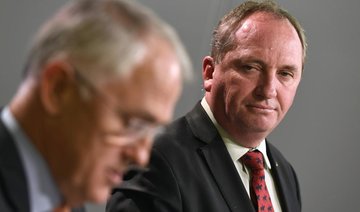
One-off restructuring costs, related to the redundancies, amounting between A$500 million and A$800 million are expected to appear in the National Australia Bank’s first-half results next year. (AFP)
Updated 02 November 2017
Follow

National Australia Bank axes 6,000 jobs as annual profit jumps

SYDNEY: Up to 6,000 jobs will be axed in a major restructuring at National Australia Bank, the lender said Thursday after posting A$5.28 billion in annual net profits.
The positions will go as the bank further automates and simplifies its business to reshape for a digital future. Some 2,000 new jobs will be created.
“This will result in a net reduction in staff currently targeted at approximately 4,000 by the end of full year 2020,” it said. The bank currently has 33,600 employees.
Chief executive Andrew Thorburn said the entire banking industry was under pressure to reshape its workforce.
“As transactions move to digital channels — and this is driven by our customers — we will need fewer people,” he said, while foreshadowing branch closures.
One-off restructuring costs related to the redundancies of between A$500 million and A$800 million are expected to appear in the bank’s first-half results next year.
The overhaul comes with the bank’s net profit bouncing back in the year to September 30 from only A$352 million in the previous corresponding period when it took a hit from writedowns for loss-making assets.
These included spinning off British bank Clydesdale and most of its life insurance business to Japan’s Nippon.
Cash profit, the financial industry’s preferred measure which strips out volatile items, was up 2.5 percent at A$6.64 billion, in line with expectations.
The bank paid a dividend of 99 Aus cents, matching what shareholders received in the first half of the year.
Bad and doubtful debt charges rose 1.3 percent to A$810 million, while revenue was up 2.7 percent. NAB shares ended 2.83 percent lower at A$31.95.
Thorburn said he was “optimistic” about the future after divesting low returning business like Clydesdale and Great Western banks.
“Cash earnings and revenue are up, asset quality is a highlight again, and we have further strengthened our balance sheet,” he said.
“We have made strong progress over the past three years and now we announce an acceleration of our strategy.”
This includes making another A$1.0 billion in savings by 2020, while boosting investment by A$1.5 billion over the next three years.
All of Australia’s big banks are battling higher funding costs and lower interest margins, with rules now demanding they hold more reserves as a buffer against mortgages and fears over rising bad loans.
They also face a hefty new government levy to raise A$6.2 billion over four years through a 0.06 percent charge on the borrowings of the big five banks — ANZ, Commonwealth, Macquarie, NAB and Westpac.
NAB, along with ANZ and Westpac, has also been embroiled in a rate-rigging scandal.
It settled a case with Australia’s corporate regulator last week over possible fixing of the country’s benchmark interest rate. ANZ has also settled although Westpac is yet to do so.


Saudi banking sector outlook stable on higher non-oil growth: Moody’s 

Updated 4 sec ago
Follow

Saudi banking sector outlook stable on higher non-oil growth: Moody’s 

RIYADH: Saudi Arabia’s banking sector outlook remains stable as stronger non-oil economic growth and solid capital buffers support lending and profitability, Moody’s Ratings said, forecasting continued expansion despite liquidity constraints. 

In its latest report, credit rating agency Moody’s said the Kingdom’s non-oil gross domestic product is projected to expand by 4.2 percent this year, up from 3.7 percent recorded in 2025. 

In January, S&P Global echoed a similar view, saying banks operating in Saudi Arabia are expected to sustain strong lending growth in 2026, driven by financing demand tied to Vision 2030 projects. 

Fitch Ratings also underscored the healthy state of Saudi Arabia’s banking system last month, stating that credit growth and high net interest margins are supporting bank profitability in the Kingdom. 

Commenting on the latest report, Ashraf Madani, vice president and senior credit officer at Moody’s Ratings, said: “We expect credit demand to remain robust, but tight liquidity conditions will continue to limit the sector’s lending capacity.” 

Madani added that operating conditions in Saudi Arabia will continue to support banks’ strong asset quality and profitability. 

“The operating environment for banks remains buoyant, underpinned by a forecast increase in non-oil GDP growth, robust solvency and continued progress toward the government’s economic diversification goals,” he added.  

Moody’s said authorities in the Kingdom are introducing business-friendly reforms to bolster investment and private sector activity, while implementing key development projects and preparing for major global events. 

Saudi Arabia continues to advance reforms including full foreign ownership rights, simplified capital market registration procedures and improved investor protections, which could accelerate credit growth to 8 percent this year. 

Problem loans are expected to remain near historical lows at around 1.3 percent of total loans, supported by ongoing credit growth, favorable operating conditions and lower interest rates, which collectively strengthen borrowers’ repayment capacity. 

Retail credit risk remains controlled in Saudi Arabia because most borrowers are government employees with stable income streams. 

“Concentration of single borrowers and specific sectors remains high although the growing proportion of consumer loans — now nearing 50 percent of overall sector lending — continues to reduce aggregate concentration risk,” added Moody’s.  

The report said profitability is expected to remain solid among Saudi banks, supported by sustained loan growth and fee income. 

Margins are expected to remain stable despite lower asset yields as banks take advantage of credit demand to widen loan spreads on existing and new lending. 

Moody’s expects net income to tangible assets to remain stable at 1.8 percent to 1.9 percent this year. 

The report added that Saudi banks benefit from a very high likelihood of government support in the event of any failures. 

“We assume a very high likelihood of government support in the event of a bank failure. This is based on the government’s track record of timely intervention,” Moody’s said.  

It added that Saudi Arabia remains the only G-20 country that has not adopted a banking resolution framework. However, it is the only Gulf Cooperation Council member to have introduced a law for systemically important financial institutions.