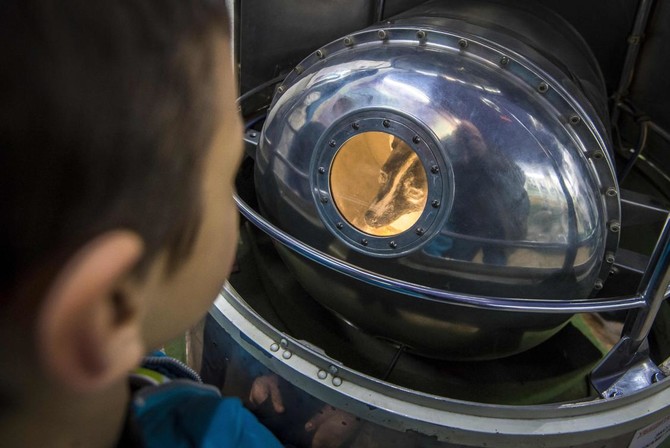
PARIS: Sixty years after Laika the dog became the first living creature to go into orbit, animals are still being sent into space — though these days much smaller creatures are going up.
Julie Robinson, chief scientist for the International Space Station program, explains what we are still learning from animals in orbit.
When those animals were sent into space, it was because people were afraid that mammalian species in general could not survive without gravity, and that people might suffocate.
We really didn’t know what it might be like to live in space without gravity.
Today when we send animal into space we send large numbers of small animals in order to accomplish biomedical research goals.
Just as we do with research on Earth, we typically use rodents, fruit flies, fish and other small animals.
There have been some scientific studies with snails; we are considering rats for the future.
For any experiment we do in space, the astronauts need special training and that is true for animal experiments as well, so they need to know how to operate the habitat and how to do the experiment activities.
With mice, launching is a stressful experience that is stressful for astronauts, too.
When they come onboard and start floating, they are surprised but pretty soon they learn how to use their habitat, how to move around and drink, sleep and eat in a pretty normal way.
Once they are settled, it is a relatively peaceful experience.
The fish adapt very quickly.
The experiments that are done with mice in space are very similar to experiment done with mice on the ground. They are generally targeting areas where we are trying to improve human health such as treatments for osteoporosis and muscle loss.
In space, those small animals are floating like humans do, and they lose (...) bone if they don’t exercise. Same with muscles because they don’t use many muscles.
With mice, those disease processus move pretty quickly; it can be useful for developing treatments for bone loss on Earth or for other aspects of aging.
Fish are also important for looking at bone loss and muscle wasting.
Generally our research has dual purposes — We want to reduce the risk of futures explorations beyond Earth’s orbit, but we also want to have an impact here on Earth, because a lot of those processus are also happening as we age.


![]()
Animals in orbit: mice, fish and flies still being sent into space
Animals in orbit: mice, fish and flies still being sent into space



Latest updates


© 2026 SAUDI RESEARCH & PUBLISHING COMPANY, All Rights Reserved And subject to Terms of Use Agreement.