Colombia declares FARC war over as last guns roll away

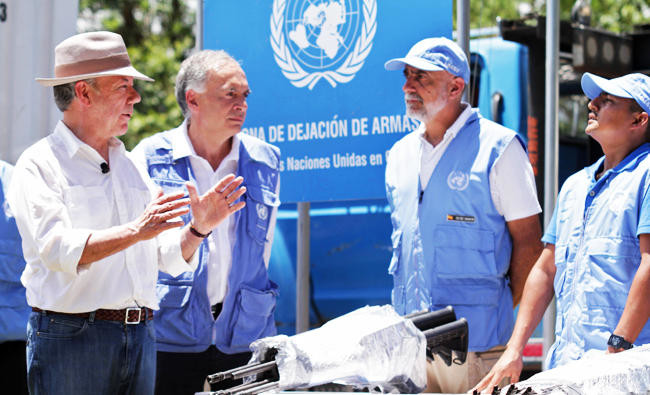
Handout photo released by the Colombian presidency's press office showing Colombian President Juan Manuel Santos (L) speaking with UN observers next to the head of the UN Mission in Colombia, Jean Arnault (2-L), before closing the last container with weapons surrendered by the Revolutionary Armed Forces of Colombia (FARC), at a Transitional Standardization Zone in Pondores, Guajira department, Colombiaon on Tuesday. (AFP)
Updated 16 August 2017
Follow

Colombia declares FARC war over as last guns roll away

BOGOTA: President Juan Manuel Santos declared Colombia’s 50-year conflict with FARC guerrillas finally over on Tuesday, as the last truckloads of decommissioned weapons rolled away to be melted down.
Santos himself shut a padlock on the last lot of decommissioned rifles before it was taken out of a remote demobilization camp to formally seal the UN-supervised disarmament by the Revolutionary Armed Forces of Colombia (FARC).
“With the laying down of arms ... the conflict is truly over and a new phase begins in the life of our nation,” Santos said at a ceremony in Pondores, a remote area in the northern Guajira department.
“This is truly a historic moment for the country,” he said.
“We have been a republic for 198 years. Never had we had such a long conflict and today is indeed the last breath of that conflict.”
The leftist rebel force has said it will officially transform into a political party on September 1, a major step in reintegrating into civilian life as part of a historic peace deal signed last year.
“Soon we will be holding a founding congress for the new political party that will be called the Alternative Revolutionary Force of Colombia,” said one of the FARC’s senior leaders, Ivan Marquez, at Tuesday’s ceremony.
“We do not want to break with our past. We were and will continue to be a revolutionary force,” said Marquez.
The FARC arose in May 1964 from a peasants’ revolt, and its ranks were made up mostly of country-dwellers who rallied behind the group’s Marxist-Leninist ideology, with land reform its key demand.
As well as a quarter of a million dead, about 60,000 Colombians remain unaccounted for and seven million have been displaced in the conflict.
A small rebel group called the National Liberation Army is now in peace talks with the government. And 450 renegade FARC members are refusing to embrace the idea of peace.
For now, former FARC rebels will live in 26 demobilization camps.
On Tuesday the group also brought out 24 minors who were child soldiers still under the protection of the FARC. They joined another 88 who were already turned over to the government, the International Committee of the Red Cross said.

So far, 88 such minors have been turned over to the authorities.
Amid the sense of exhausted relief that many Colombians feel after so much war, the road ahead is fraught with challenges.
One issue is how to ensure the physical safety of former rebel fighters, who many Colombians feel are getting off too easy. Marquez said two former rebels have been murdered in recent days.
Another, even bigger problem is how the former fighters will make a living.
“The guerrillas do not know what is going to happen to them the day after tomorrow,” said Ariel Avila, director of a foundation that is monitoring the peace accord.
Then there is there is the issue of justice for atrocities committed during the war.
The accord calls for non-prison punishment for rebels and soldiers who confess to crimes, pay reparations to victims and pledge to renounce violence forever.


India accelerates free trade agreements against backdrop of US tariffs

Updated 9 sec ago
Follow

India accelerates free trade agreements against backdrop of US tariffs

  • India signed a CEPA with Oman on Thursday and a CETA with the UK in July 
  • Delhi is also in advanced talks for trade pacts with the EU, New Zealand, Chile 

NEW DELHI: India has accelerated discussions to finalize free trade agreements with several nations, as New Delhi seeks to offset the impact of steep US import tariffs and widen export destinations amid uncertainties in global trade. 

India signed a Comprehensive Economic Partnership Agreement with Oman on Thursday, which allows India to export most of its goods without paying tariffs, covering 98 percent of the total value of India’s exports to the Gulf nation. 

The deal comes less than five months after a multibillion-dollar trade agreement with the UK, which cut tariffs on goods from cars to alcohol, and as Indian trade negotiators are in advanced talks with New Zealand, the EU and Chile for similar partnerships. 

They are part of India’s “ongoing efforts to expand its trade network and liberalize its trade,” said Anupam Manur, professor of economics at the Takshashila Institution. 

“The renewed efforts to sign bilateral FTAs are partly an after-effect of New Delhi realizing the importance of diversifying trade partners, especially after India’s biggest export market, the US, levied tariff rates of up to 50 percent on India.” 

Indian exporters have been hit hard by the hefty tariffs that went into effect in August. 

Months of negotiations with Washington have not clarified when a trade deal to bring down the tariffs would be signed, while the levies have weighed on sectors such as textiles, auto components, metals and labor-intensive manufacturing. 

The FTAs with other nations will “help partially in mitigating the effects of US tariffs,” Manur said. 

In particular, Oman can “act as a gateway to other Gulf countries and even parts of Eastern Europe, Central Asia, and Africa,” and the free trade deal will most likely benefit “labor-intensive sectors in India,” he added. 

The chances of concluding a deal with Washington “will prove to be difficult,” said Arun Kumar, a retired economics professor at the Jawaharlal Nehru University.

“With the US, the chances of coming to (an agreement) are a bit difficult, because they want to get our agriculture market open, which we cannot do. They want us to reduce trade with Russia. That’s also difficult for India to do,” he told Arab News.  

US President Donald Trump has threatened sanctions over India’s historic ties with Moscow and its imports of Russian oil, which Washington says help fund Moscow’s ongoing war with Ukraine.

“President Trump is constantly creating new problems, like with H-1B visa and so on now. So some difficulty or the other is expected. That’s why India is trying to build relationships with other nations,” Kumar said, referring to increased vetting and delays under the Trump administration for foreign workers, who include a large number of Indian nationals. 

“Substituting for the US market is going to be tough. So certainly, I think India should do what it can do in terms of promoting trade with other countries.” 

India has free trade agreements with more than 10 countries, including comprehensive economic partnership agreements with South Korea, Japan, and the UAE.

It is in talks with the EU to conclude an FTA, amid new negotiations launched this year for trade agreements, including with New Zealand and Chile.  

India’s approach to trade partnerships has been “totally transformed,” Commerce and Industry Minister Piyush Goyal said in a press briefing following the signing of the CEPA with Oman, which Indian officials aim to enter into force in three months. 

“Now we don’t do FTAs with other developing nations; our focus is on the developed world, with whom we don’t compete,” he said. “We complement and therefore open up huge opportunities for our industry, for our manufactured goods, for our services.”