RIYADH: Abdullatif Al-Zayani, secretary-general of the six-nation Gulf Cooperation Council (GCC), has strongly protested and condemned the “irresponsible” attacks and accusations levelled against the GCC by Qatari mainstream media.
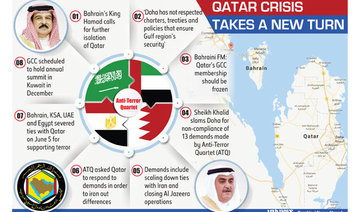
The condemnation by Al-Zayani coincides with the announcement made by Manama on Wednesday that visa restrictions would be imposed on Qatari nationals.
A statement from the official Bahrain News Agency (BNA) said Manama’s visa requirements for nationals and residents of Qatar will apply from Nov. 10. “The new measures aim to prevent harming the security and stability of Bahrain, particularly in light of the latest repercussions of the crisis with Qatar,” said the statement.
In the past, all citizens of the GCC were free to travel to any member state only by carrying their nationality card.
In a statement issued by the GCC General Secretariat late on Tuesday, Al-Zayani lambasted the Qatari media and said: “This is an unjust campaign that has gone beyond all customs, values and media professionalism by using a discourse that is unusual among Gulf nationals and that is full of abuses, insults and lack of respect.” He also denounced what he said were Qatari media attempts to suggest that his Bahraini nationality influenced his approach to the GCC conflict.
The GCC chief said: “Officials in the Qatari government and the Qatari media are fully aware that the solution of the crisis and the end of its repercussions are in the hands of the GCC leaders, who are the members of the supreme council, and no one else.”
The statement said that the job of the secretary-general is to “execute orders,” not resolve crises. “I am fully committed to shouldering the responsibilities, tasks and duties assigned by the Supreme Council to preserve the coherence of the GCC bloc, and its regional and international achievements,” Al-Zayani added.
“At the same time, I will remain a righteous son of the Kingdom of Bahrain, loyal to its leaders and attached to my patriotism,” reaffirmed Al-Zayani, while calling on the Qatari media “to stop resorting to media practices that harm, divide, do not contribute to bringing brothers closer and hinder the good mediation efforts undertaken by Kuwait’s Emir Sheikh Sabah Al-Ahmad, a leader known for his wisdom, loyalty and love for the GCC countries and people.”
Commenting on the intransigence of Qatar and the measures taken by Bahrain, Dr. Solaiman Al-Otaibi, a faculty member of the political science department at King Saud University, said: “Bahrain has taken the right measures to ensure security for itself, and for the region as a whole … There is a need to monitor the movements of Qatari nationals because of their complicity in acts of terror,” Al-Otaibi added.
“Qatar has been supporting extremism and terrorism, which prompted the Anti-Terror Quartet (ATQ) to isolate that Gulf state,” said Hanif Razdan, a local PR strategist. He called on Qatar to comply with “the demands of the ATQ for an early resolution to the worsening crisis before it gets too late.”


GCC chief blasts Qatar media over accusations and insults

GCC chief blasts Qatar media over accusations and insults


SDAIA president says Saudi Arabia is building an integrated AI ecosystem
RIYADH: Saudi Data and Artificial Intelligence Authority President Abdullah Al-Ghamdi says that Saudi Arabia is moving steadily to establish artificial intelligence as a trusted national capability, the Saudi Press Agency reported.
Guided by the objectives of Saudi Vision 2030, Al-Ghamdi said the goal is to use AI to help develop government services, enhance competitiveness, build human capacity and improve quality of life through a comprehensive strategy based on three main pillars that unlock the potential of this technology and achieve sustainable developmental impact.
“The first pillar focuses on building human capacity and enhancing readiness to engage with AI technologies,” he said.
The second pillar is building an integrated national AI ecosystem that drives expansion and innovation by developing advanced digital infrastructure that enables various sectors to adopt AI applications efficiently, consistently and with effective governance, Al-Ghamdi said.
The third pillar, he said, is governance that ensures responsible and measurable AI through a national framework aligned with international standards.
This came during Al-Ghamdi’s speech at a high-level ministerial session held on Thursday on the sidelines of the AI Impact Summit 2026 in New Delhi.
He is heading the Saudi delegation, and the session saw broad participation from heads of state, decision-makers and technology leaders from around the world.
Al-Ghamdi also had a meeting with Indian Prime Minister Narendra Modi on Thursday evening, discussed AI cooperation and expressed his gratitude for hosting the summit and for the hospitality extended to the participants.


