S. Sudan’s Kiir in Sudan to ease ‘tense’ relations

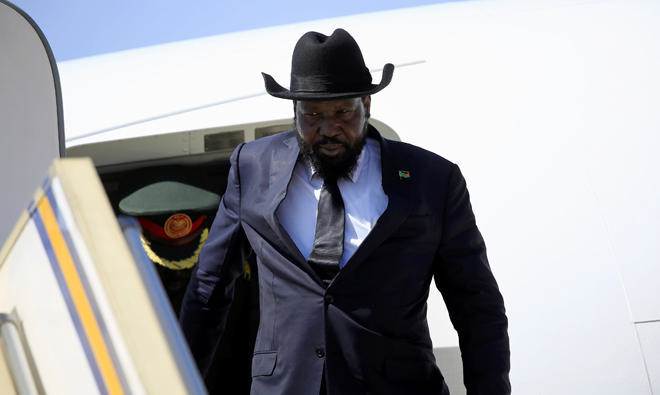
South Sudan's President Salva Kiir Mayardit arrives at Khartoum airport, Sudan on Wednesday, November 1, 2017. (Reuters)
Updated 01 November 2017
Follow

S. Sudan’s Kiir in Sudan to ease ‘tense’ relations

KHARTOUM: South Sudanese President Salva Kiir arrived Wednesday in Sudan for a two-day visit aimed at resolving border disputes and addressing mutual accusations of supporting rebels in each other’s territory.
It is Kiir’s third visit to Khartoum since the Christian majority south split from the Muslim north in 2011 after a 22-year civil war that killed hundreds of thousands.
Kiir was received by his Sudanese counterpart President Omar Al-Bashir at Khartoum airport, an AFP correspondent reported.
“This visit is aimed at normalizing the relations between the two countries which have been tense,” South Sudanese Information Minister Michael Makuei told reporters, adding the two leaders will decide on a roadmap to improve bilateral ties.
“The two countries should cooperate in the interests of their people as they are all one people in two countries.”
His Sudanese counterpart Ahmed Bilal said the visit aims to “establish security and stability in the two countries.”
Officials say Kiir will hold talks with Bashir and other senior Sudanese officials to thrash out several unresolved issues between the two countries.
Border rows, economic issues such as Juba’s payments for the use of an oil export pipeline through Sudan and building a buffer zone along the frontier are among the expected topics of discussions when the two leaders meet.
Officials will also attempt to address tensions over alleged support for insurgents.
Sudan has regularly accused its neighbor of aiding rebels in its war-torn Darfur, Blue Nile and South Kordofan regions.
Juba has often accused Khartoum of aiding Kiir’s opponent and former deputy Riek Machar in South Sudan’s ongoing civil war.
Tens of thousands of people have died in South Sudan and millions more have been driven from their homes since the war erupted in the world’s youngest country in December 2013.
More than 450,000 South Sudanese refugees have poured into Sudan since the war broke out, the UN says. Khartoum estimates they number 1.3 million.
Several senior South Sudanese officials have regularly visited Khartoum while Kiir himself previously visited in 2015.
A South Sudanese delegation of senior officials had already arrived in Khartoum a few days earlier for preliminary meetings ahead of Kiir’s arrival.


Ugandan opposition turns national flag into protest symbol

Updated 4 sec ago
Follow

Ugandan opposition turns national flag into protest symbol

KAMPALA: Hundreds screamed with excitement as Uganda’s opposition leader passed by a recent rally, with the crowd waving a sea of national flags — a dangerously politicized symbol in the run-up to this week’s election.
Analysts say it is almost a foregone conclusion that President Yoweri Museveni, 81, will win a seventh term in Thursday’s vote, given his near-total control over the state apparatus in the east African country.
But his opponent, 43-year-old Robert Kyagulanyi, better known as Bobi Wine, has framed the election as a protest vote and cannily turned the national flag into a symbol of resistance.
Police last month warned against using the flag “casually and inappropriately.”
Wine’s supporters have faced frequent intimidation by the security forces during the campaign, according to the United Nations Human Rights Office and other observers.
But the flag is “the only weapon we have,” said woodworker Conrad Olwenyi, 31, at a Wine rally this week.
“We cannot fight the security, because they have a gun. We only have the flag,” he said. But “if they shoot you when you have the flag, they are shooting the country.”

- ‘Reclaiming patriotism’ -

Uganda’s flag — created when the country achieved independence from Britain in 1962 — has stripes of black to represent Africa, yellow for its sunshine, and red to represent African brotherhood, with a grey crowned crane overlaid.
In the 2021 elections, Wine’s National Unity Platform (NUP) adopted red berets as a symbol, but the government ruled that was illegal since they were part of the military uniform, and used that ruling to justify raids on the party’s offices.
The flag is a clever alternative and a way of “reclaiming patriotism,” said Uganda expert Kristof Titeca.
“It’s kind of taken the government by surprise, and so that’s why they started this clampdown,” he told AFP.
Like many countries in east Africa, there are laws governing how the national flag may be used, though these were rarely enforced in Uganda in the past.
“It shows the panic,” prominent cartoonist Jimmy Spire Ssentongo told AFP.
“I don’t think they are threatened by misuse of the flag. They are threatened by the visibility of the support toward NUP,” said Ssentongo, adding that as Museveni ages and nears 40 years in power, “the space for freedom of expression also shrinks.”
“Everyone has a right to use the national flag, but it depends on in what context they’re using it for. I believe the opposition is politicizing it,” said Israel Kyarisiima, a national youth co-ordinator for Museveni’s National Resistance Movement party.
Security services have repeatedly been accused by Wine’s supporters of targeting those carrying the flag at rallies, with the leader urging followers in his Christmas address to “come to the defense of anyone assaulted for carrying the flag.”
And the threats from police have not stopped Wine’s supporters brandishing the flag at rallies.
“Now we’ve got something that can really show our unity as Ugandans, and they are trying to make it criminal,” said one attendee this week, Ruth Excellent Mirembe, 25, waving a flag.
Trying to stop its use is “oppression in the highest form,” she told AFP. “This represents us as Ugandans.”