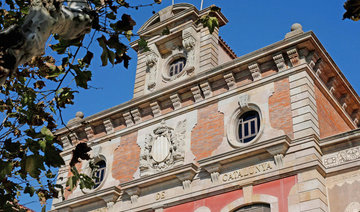
Rifts, recriminations among Catalonia’s separatists

Catalonia’s deposed, separatist leader Carles Puigdemont has accepted the “challenge” of Catalan elections on December 21 as called by Spain’s Prime Minister Mariano Rajoy. (AFP)
Updated 01 November 2017
Follow

Rifts, recriminations among Catalonia’s separatists

BARCELONA: Catalonia’s secessionist politicians have admitted that the region’s independence declaration failed and recriminations have started to fly.
Five days after the Catalan parliament proclaimed a break away from Spain, the new republic’s civil servants were working directly for the central government which imposed direct rule without finding any resistance, as had initially been feared.
Catalonia’s deposed, separatist leader Carles Puigdemont had traveled to Brussels where he told independence supporters to prepare for “a long stretch” and said it would be better to “slow down” the independence process rather than risk unrest.
He also accepted the “challenge” of Catalan elections on December 21 as called by Prime Minister Mariano Rajoy to “restore normality” after he imposed temporary direct rule on the semi-autonomous region in a bid to stop secession.
“The independence movement hasn’t slowed down, it’s stopped,” retorted a Spanish government source in Barcelona, who refused to be named.
Santi Vila, who was Puigdemont’s regional business minister until last week when he resigned after the Catalan leader decided against calling snap elections — an option some felt could have eased the crisis — accused his former colleagues Tuesday of naivety.
He said Catalonia hadn’t been ready to function as an independent republic.
“Where’s the control over the territory, the control of ports, airports, the management of transport?” he asked.
“We lacked the necessary political intelligence,” he admitted on Catalonia’s Rac1 radio, but denied having misled independence supporters.
“But it’s true that I have government colleagues who displayed a level of naivety that is surprising at their age.”
Vila put his name forward to lead his Catalan European Democratic Party (PDeCAT) — also Puigdemont’s party — into the elections.
PDeCAT is part of the separatist coalition that ruled Catalonia until the regional government was axed by Madrid on Friday, along with leftist nationalist ERC, whose leader Oriol Junqueras was vice president and the region’s economic czar.
After having encouraged Puigdemont to take the final step toward a unilateral declaration of independence, ERC said it would take part in the regional election.
“We’re champions of democracy, no democrat can compete with us,” Junqueras told Catalonia’s TV3 television Monday.
For its part, the small far-left CUP party, an ally of Puigdemont, asked for time Tuesday to “reflect on what happened, because we’ve seen the limits of institutional mechanisms.”
The independence movement sought EU support after scenes of brutal police repression during an outlawed independence referendum on October 1 and the detention of two high-profile separatist civil leaders suspected of sedition — in vain.
PDeCAT spokeswoman Marta Pascal summed up her impression of the current situation as “crikey, what happened here?,” pointing to the fact there had been no international recognition or that Catalonia’s regional police force were now following Madrid’s orders.
Over the past years, as it built up its independence drive, the Catalan government had sought the help of advisers to craft a new republic and make it a reality.
One such advisory grouping was the National Transition Advisory Council, which put together a “white paper” on independence.
In that paper, it had specifically warned that the success of a unilateral proclamation would depend on whether the new republic could effectively be governed.
Sandra Leon, a political analyst who teaches at England’s York University, said that far from focusing on a new republic, Catalan separatists were now looking ahead to the elections.
“Everyone is going to try and elaborate a tale of what happened in a way that will be most beneficial to them,” she said.
“There was a declaration of independence in which many people had placed their expectations and all of a sudden, days after it happened, there is no clear script.”
Former Catalan president Jose Montilla, a Socialist and rival of the nationalists, on Tuesday accused them of having lied.
They “have deceived people, they have messed with them, they sold them something they knew was a lie, wasn’t possible,” he told Catalan television.
“Why don’t they face the consequences? Where are the representatives of the Catalan republic now?,” he asked.


‘Extremely exciting’: the ice cores that could help save glaciers

Updated 5 sec ago
Follow

‘Extremely exciting’: the ice cores that could help save glaciers

  • Thousands of glaciers will vanish each year in the coming decades, leaving only a fraction standing by the end of the century, a study says
  • On the other hand, some glaciers have not only resisted melting, but even slightly grown, a phenomenon called the ‘Pamir-Karakoram anomaly’

SAPPORO: Dressed in an orange puffer jacket, Japanese scientist Yoshinori Iizuka stepped into a storage freezer to retrieve an ice core he hopes will help experts protect the world’s disappearing glaciers.

The fist-sized sample drilled from a mountaintop is part of an ambitious international effort to understand why glaciers in Tajikistan have resisted the rapid melting seen almost everywhere else.

“If we could learn the mechanism behind the increased volume of ice there, then we may be able to apply that to all the other glaciers around the world,” potentially even helping revive them, said Iizuka, a professor at Hokkaido University.

“That may be too ambitious a statement. But I hope our study will ultimately help people,” he said.

Thousands of glaciers will vanish each year in the coming decades, leaving only a fraction standing by the end of the century unless global warming is curbed, a study published in the journal Nature Climate Change showed Monday.

Earlier this year, AFP exclusively accompanied Iizuka and other scientists through harsh conditions to a site at an altitude of 5,810 meters (about 19,000 feet) on the Kon-Chukurbashi ice cap in the Pamir Mountains.

The area is the only mountainous region on the planet where glaciers have not only resisted melting, but even slightly grown, a phenomenon called the “Pamir-Karakoram anomaly.”

The team drilled two ice columns approximately 105 meters (345 feet) long out of the glacier.

One will be stored in an underground sanctuary in Antarctica belonging to the Ice Memory Foundation, which supported the Tajikistan expedition along with the Swiss Polar Institute.

The other was shipped to Iizuka’s facility, the Institute of Low Temperature Science at Hokkaido University in Sapporo, where the team is hunting clues on why precipitation in the region increased over the last century, and how the glacier has resisted melting.

Some link the anomaly to the area’s cold climate or even increased use of agricultural water in Pakistan that creates more vapor.

But the ice cores are the first opportunity to examine the anomaly scientifically.

‘ANCIENT ICE’

“Information from the past is crucial,” said Iizuka.

“By understanding the causes behind the continuous build-up of snow from the past to the present, we can clarify what will happen going forward and why the ice has grown.”

Since the samples arrived in November, his team has worked in freezing storage facilities to log the density, alignment of snow grains, and the structure of ice layers.

In December, when AFP visited, the scientists were kitted out like polar explorers to cut and shave ice samples in the comparatively balmy minus 20C of their lab.

The samples can tell stories about weather conditions going back decades, or even centuries.

A layer of clear ice indicates a warm period when the glacier melted and then refroze, while a low-density layer suggests packed snow, rather than ice, which can help estimate precipitation.

Brittle samples with cracks, meanwhile, indicate snowfall on half-melted layers that then refroze.

And other clues can reveal more information — volcanic materials like sulfate ions can serve as time markers, while water isotopes can reveal temperatures.

The scientists hope that the samples contain material dating back 10,000 years or more, though much of the glacier melted during a warm spell around 6,000 years ago.

Ancient ice would help scientists answer questions such as “what kind of snow was falling in this region 10,000 years ago? What was in it?” Iizuka said.

“We can study how many and what kinds of fine particles were suspended in the atmosphere during that ice age,” he added.

“I really hope there is ancient ice.”

SECRETS IN THE ICE

For now, the work proceeds slowly and carefully, with team members like graduate student Sora Yaginuma carefully slicing samples apart.

“An ice core is an extremely valuable sample and unique,” said Yaginuma.

“From that single ice core, we perform a variety of analyzes, both chemical and physical.”

The team hopes to publish its first findings next year and will be doing “lots of trial-and-error” work to reconstruct past climate conditions, Iizuka said.

The analysis in Hokkaido will uncover only some of what the ice has to share, and with the other samples preserved in Antarctica, there will be opportunities for more research.

For example, he said, scientists could look for clues about how mining in the region historically affected the area’s air quality, temperature and precipitation.

“We can learn how the Earth’s environment has changed in response to human activities,” Iizuka said.

With so many secrets yet to learn, the work is “extremely exciting,” he added.