

‘Extremely exciting’: the ice cores that could help save glaciers

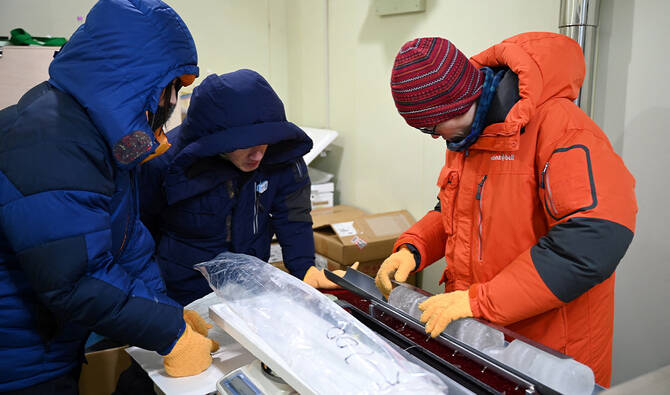
Researchers examine an ice core sample taken from a glacier in the Pamir mountain range in Tajikistan, at the Hokkaido University Institute of Low Temperature Science, in Sapporo, in northern Japan’s Hokkaido prefecture on December 9, 2025. (AFP)
Short Url
Updated 20 December 2025
Follow

‘Extremely exciting’: the ice cores that could help save glaciers

  • Thousands of glaciers will vanish each year in the coming decades, leaving only a fraction standing by the end of the century, a study says
  • On the other hand, some glaciers have not only resisted melting, but even slightly grown, a phenomenon called the ‘Pamir-Karakoram anomaly’

SAPPORO: Dressed in an orange puffer jacket, Japanese scientist Yoshinori Iizuka stepped into a storage freezer to retrieve an ice core he hopes will help experts protect the world’s disappearing glaciers.

The fist-sized sample drilled from a mountaintop is part of an ambitious international effort to understand why glaciers in Tajikistan have resisted the rapid melting seen almost everywhere else.

“If we could learn the mechanism behind the increased volume of ice there, then we may be able to apply that to all the other glaciers around the world,” potentially even helping revive them, said Iizuka, a professor at Hokkaido University.

“That may be too ambitious a statement. But I hope our study will ultimately help people,” he said.

Thousands of glaciers will vanish each year in the coming decades, leaving only a fraction standing by the end of the century unless global warming is curbed, a study published in the journal Nature Climate Change showed Monday.

Earlier this year, AFP exclusively accompanied Iizuka and other scientists through harsh conditions to a site at an altitude of 5,810 meters (about 19,000 feet) on the Kon-Chukurbashi ice cap in the Pamir Mountains.

The area is the only mountainous region on the planet where glaciers have not only resisted melting, but even slightly grown, a phenomenon called the “Pamir-Karakoram anomaly.”

The team drilled two ice columns approximately 105 meters (345 feet) long out of the glacier.

One will be stored in an underground sanctuary in Antarctica belonging to the Ice Memory Foundation, which supported the Tajikistan expedition along with the Swiss Polar Institute.

The other was shipped to Iizuka’s facility, the Institute of Low Temperature Science at Hokkaido University in Sapporo, where the team is hunting clues on why precipitation in the region increased over the last century, and how the glacier has resisted melting.

Some link the anomaly to the area’s cold climate or even increased use of agricultural water in Pakistan that creates more vapor.

But the ice cores are the first opportunity to examine the anomaly scientifically.

‘ANCIENT ICE’

“Information from the past is crucial,” said Iizuka.

“By understanding the causes behind the continuous build-up of snow from the past to the present, we can clarify what will happen going forward and why the ice has grown.”

Since the samples arrived in November, his team has worked in freezing storage facilities to log the density, alignment of snow grains, and the structure of ice layers.

In December, when AFP visited, the scientists were kitted out like polar explorers to cut and shave ice samples in the comparatively balmy minus 20C of their lab.

The samples can tell stories about weather conditions going back decades, or even centuries.

A layer of clear ice indicates a warm period when the glacier melted and then refroze, while a low-density layer suggests packed snow, rather than ice, which can help estimate precipitation.

Brittle samples with cracks, meanwhile, indicate snowfall on half-melted layers that then refroze.

And other clues can reveal more information — volcanic materials like sulfate ions can serve as time markers, while water isotopes can reveal temperatures.

The scientists hope that the samples contain material dating back 10,000 years or more, though much of the glacier melted during a warm spell around 6,000 years ago.

Ancient ice would help scientists answer questions such as “what kind of snow was falling in this region 10,000 years ago? What was in it?” Iizuka said.

“We can study how many and what kinds of fine particles were suspended in the atmosphere during that ice age,” he added.

“I really hope there is ancient ice.”

SECRETS IN THE ICE

For now, the work proceeds slowly and carefully, with team members like graduate student Sora Yaginuma carefully slicing samples apart.

“An ice core is an extremely valuable sample and unique,” said Yaginuma.

“From that single ice core, we perform a variety of analyzes, both chemical and physical.”

The team hopes to publish its first findings next year and will be doing “lots of trial-and-error” work to reconstruct past climate conditions, Iizuka said.

The analysis in Hokkaido will uncover only some of what the ice has to share, and with the other samples preserved in Antarctica, there will be opportunities for more research.

For example, he said, scientists could look for clues about how mining in the region historically affected the area’s air quality, temperature and precipitation.

“We can learn how the Earth’s environment has changed in response to human activities,” Iizuka said.

With so many secrets yet to learn, the work is “extremely exciting,” he added.


Mystery of CIA’s lost nuclear device haunts Himalayan villagers 60 years on

Updated 48 min 12 sec ago
Follow

Mystery of CIA’s lost nuclear device haunts Himalayan villagers 60 years on

  • Plutonium-fueled spy system was meant to monitor China’s nuclear activity after 1964 atomic tests
  • Porter who took part in Nanda Devi mission warned family of ‘danger buried in snow’

NEW DELHI: Porters who helped American intelligence officers carry a nuclear spy system up the precarious slopes of Nanda Devi, India’s second-highest peak, returned home with stories that sent shockwaves through nearby villages, leaving many in fear that still holds six decades later.

A CIA team, working with India’s Intelligence Bureau, planned to install the device in the remote part of the Himalayas to monitor China, but a blizzard forced them to abandon the system before reaching the summit.

When they returned, the device was gone.

The spy system contained a large quantity of highly radioactive plutonium-238 — roughly a third of the amount used in the atomic bomb dropped by the US on the Japanese city of Nagasaki in the closing stages of the Second World War.

“The workers and porters who went with the CIA team in 1965 would tell the story of the nuclear device, and the villagers have been living in fear ever since,” said Narendra Rana from the Lata village near Nanda Devi’s peak.

His father, Dhan Singh Rana, was one of the porters who carried the device during the CIA’s mission in 1965.

“He told me there was a danger buried in the snow,” Rana said. “The villagers fear that as long as the device is buried in the snow, they are safe, but if it bursts, it will contaminate the air and water, and no one will be safe after that.”

During the Sino-Indian tensions in the 1960s, India cooperated with the US in surveillance after China conducted its first nuclear tests in 1964. The Nanda Devi mission was part of this cooperation and was classified for years. It only came under public scrutiny in 1978, when the story was broken by Outsider magazine.

The article caused an uproar in India, with lawmakers demanding the location of the nuclear device be revealed and calling for political accountability. The same year, then Prime Minister Morarji Desai set up a committee to assess whether nuclear material in the area near Nanda Devi could pollute the Ganges River, which originates there.

The Ganges is one of the world’s most crucial freshwater sources, with about 655 million people in India, Nepal, and Bangladesh depending on it for their essential needs.

The committee, chaired by prominent scientists, submitted its report a few months later, dismissing any cause for concerns, and establishing that even in the worst-case scenario of the device’s rupture, the river’s water would not be contaminated.

But for the villagers, the fear that the shell containing radioactive plutonium could break apart never goes away, and peace may only come once it is found.

Many believe the device, trapped within the glacier’s shifting ice, may have moved downhill over time.

Rana’s father told him that the device felt hot when it was carried, and he believed it might have melted its way into the glacier, remaining buried deep inside.

An imposing mass of rock and ice, Nanda Devi at 7,816 m is the second-highest mountain in India after Kangchenjunga. 

When a glacier near the mountain burst in 2021, claiming over 200 lives, scientists explained that the disaster was due to global warming, but in nearby villages the incident was initially blamed on a nuclear explosion.

“They feared the device had burst. Those rescuing people were afraid they might die from radiation,” Rana said. “If any noise is heard, if any smoke appears in the sky, we start fearing a leak from the nuclear device.”

The latent fear surfaces whenever natural disasters strike or media coverage puts the missing device back in the spotlight. Most recently, a New York Times article on the CIA mission’s 60th anniversary reignited the unease.

“The apprehensions are genuine. After 1965, Americans came twice to search for the device. The villagers accompanied them, but it could not be found, which remains a concern for the local community,” said Atul Soti, an environmentalist in Joshimath, Uttarakhand, about 50 km from Nanda Devi.

“People are worried. They have repeatedly sought answers from the government, but no clear response has been provided so far. Periodically, the villagers voice their concerns, and they need a definitive government statement on this issue.”

Despite repeated queries whenever media attention arises, Indian officials have not released detailed updates since the Desai-appointed committee submitted its findings.

“The government should issue a white paper to address people’s concerns. The white paper will make it clear about the status of the device, and whether leakage from the device could pollute the Ganges River,” Soti told Arab News.

“The government should be clear. If the government is not reacting, then it further reinforces the fear.”