NEW DELHI: For the first time in 50 years, a church bell rang in India-administered Kashmir on Sunday.
Representatives of all faiths came to the Holy Family Catholic Church in the capital city of Srinagar for the inauguration of the new 150 kg bell.
The church, built in 1896, lost its old bell in an arson attack in 1967 prompted by the Arab-Israel war.
“This is a significant moment in the church’s history,” Rev. Roy Mathews told Arab News. “People of all faiths came to ring a bell which fell silent decades ago.”
Mathews said the moment emphasized “the composite culture and ethos of Kashmir, where pluralism is a way of life.”
Mathews hopes that this harmonious event is a positive omen for the Indian government’s newly appointed interlocutor for Jammu and Kashmir, Dineshwar Sharma, a former director of India’s Intelligence Bureau.
The reverend said he hopes Sharma can “help in bringing normalcy to the valley.”
Chief Minister of Jammu and Kashmir Mehbooba Mufti expressed similar hope: She tweeted that “Dialogue is a necessity of the hour and the only way to go forward.”
Her political opponent, Omar Abdullah of the National Conference party, was more reserved. He said that he will “keep an open mind and wait to see the results.”
The Indian government, under Prime Minister Narendra Modi, has been pushing hard for a military solution to dissent in Kashmir. So Sharma’s appointment came as a surprise to many.
“I intend to engage all stakeholders in talks in Kashmir, be it mainstream political parties or separatist leaders,” Sharma told Arab News the day after his appointment on Oct. 23.
However, his predecessor as interlocutor, M.M. Ansari, suggested Sharma was not the right man for the job.
“His past job profile as an intelligence guy raises the question of his suitability for such an important job,” Ansari told Arab News.
“The government is sending a confusing signal. (Sharma) does not have any background in conflict resolution and the appointment of a security officer gives a clear indication that the government is still looking at Kashmir through the prism of security,” he continued. “It is not treating Kashmir as a political problem.”
Srinagar-based political analyst, Professor Sheikh Showkat Hussain questioned the wisdom of appointing an interlocutor at all, considering the government’s aggressive approach to Kashmir.
“How he will engage separatists and secessionists for talks if you are not having an open mind?” Hussain asked. “Just a couple of days after Sharma’s appointment, Modi condemned Congress leader P. Chidambaram’s talk of autonomy for Kashmir. The valley’s mainstream parties stand for autonomy. So, if the interlocutor comes, what will he discuss if autonomy is ruled out?
“The appointment also came just before the visit of US Secretary of State (Rex) Tillerson. Perhaps the government wants to show America that they are doing something to resolve the issue in Kashmir,” Hussain continued.
“Not only this interlocutor, but all the earlier interlocutors have been for show.”
However, Altaf Thakur, spokesperson for the ruling Bharatiya Janata Party (BJP) in Kashmir, disagreed. “Prime Minister Modi is showing sincerity in addressing the issue in Kashmir and Sharma will engage all stakeholders in talks,” he told Arab News.
“Sharma is an old hand in Kashmir,” Thakur continued. “He understands the problem and he can focus on both the security and the political aspects of the problem.”


![]()
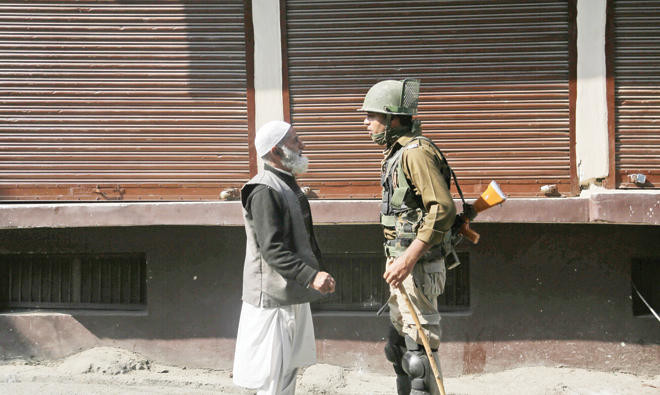
Kashmiris hopeful but wary of India’s new interlocutor
Kashmiris hopeful but wary of India’s new interlocutor

Latest updates


© 2026 SAUDI RESEARCH & PUBLISHING COMPANY, All Rights Reserved And subject to Terms of Use Agreement.