


Five Palestinians killed in Israel operation to blow up Gaza tunnel

An Israeli soldier in a tunnel used by militants. (AFP)
Updated 31 October 2017
Follow

Five Palestinians killed in Israel operation to blow up Gaza tunnel

GAZA CITY: Five Palestinians were killed and several others injured on Monday when Israel blew up a tunnel stretching from the Gaza Strip into its territory, the Health Ministry in the Hamas-run enclave said.
Health Ministry spokesman Ashraf Al-Qudra named three of those killed as Ahmed Abu Armanah, Omar Al-Faleet and Misbah Shubir.
Shubir was from Hamas’ armed wing, the Ezzedine Al-Qassam Brigades confirmed, while the others were believed to be from Islamic Jihad, an allied militant group.
Earlier Monday, Israel’s army “neutralized a terror tunnel leading into southern Israel,” military spokesman Jonathan Conricus told journalists.
“The tunnel was detonated from within Israel, close to the security fence. The (army) actions are in light of this grave and unacceptable violation of Israeli sovereignty.”
Conricus said thanks to groundbreaking technology this “active tunnel,” which was still being dug, was discovered and forces blew it up inside Israeli territory. He said military intelligence had been tracking it for some time.
Islamic Jihad said in a statement that the tunnels were “part of the policy of deterrence to defend the Palestinian people.”
It said the Israeli attack “targeting mujahedeen and civilians is a dangerous escalation,” adding that they would study potential responses.
Tunnels dug by Gaza’s rulers Hamas were a key issue in the last war with Israel in 2014, but discoveries of those stretching into the Jewish state have since been rare.
Israel has long claimed Hamas has been investing in new tunnels since the last war to attack Israel rather than helping its own people recover.
The military’s discovery followed word from the UN’s refugee agency that it had found what appeared to be a tunnel burrowed beneath one of the schools it operates in the Gaza Strip. Christopher Gunness, a spokesman for the UN Relief and Works Agency (UNRWA), said in a statement that the organization “robustly intervened with relevant parties to protest the violation.”
Israel’s military body responsible for governing Palestinian affairs noted UNRWA’s condemnation, adding that “Hamas is lying not only to the world but to the people of Gaza.”
US President Donald Trump’s special Mideast envoy Jason Greenblatt took to Twitter to rail against Hamas, which the US like most of the West considers a terrorist organization.
“Hamas uses the world’s generosity to shield terror. Palestinians in Gaza deserve so much better,” Greenblatt wrote.
Greenblatt also said that, in contrast, a rare meeting between top Israeli and Palestinian leaders in the West Bank yielded “meaningful steps” that strengthened economic ties between the two sides.

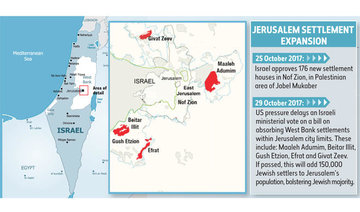
Israeli Finance Minister Moshe Kahlon met Sunday in Ramallah with Palestinian Prime Minister Rami Hamdallah to discuss potential financial projects, in a meeting that was also attended by top Israeli and Palestinian security officials. The meeting came just days after Israel approved construction of almost 200 new Jewish homes in an east Jerusalem neighborhood, part of a major settlement boom.
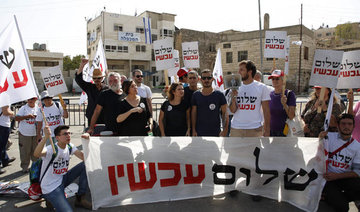
In a statement, the Palestinians said they protested Israel’s recent settlement expansion.
Greenblatt, however, reported “important progress” was made in the meeting and that there were “meaningful steps forward on key economic issues — revenues, customs, and investment — that help support the search for peace.”

Tunisia’s famed blue-and-white village threatened after record rains

Updated 31 January 2026
Follow

Tunisia’s famed blue-and-white village threatened after record rains

  • The one-time home of French philosopher Michel Foucault and writer Andre Gide, the village is protected under Tunisian preservation law, pending a UNESCO decision on its bid for World Heritage status

SIDI BOU SAID, Tunisia: Perched on a hill overlooking Carthage, Tunisia’s famed blue-and-white village of Sidi Bou Said now faces the threat of landslides, after record rainfall tore through parts of its slopes.
Last week, Tunisia saw its heaviest downpour in more than 70 years. The storm killed at least five people, with others still missing.
Narrow streets of this village north of Tunis — famed for its pink bougainvillea and studded wooden doors — were cut off by fallen trees, rocks and thick clay. Even more worryingly for residents, parts of the hillside have broken loose.
“The situation is delicate” and “requires urgent intervention,” Mounir Riabi, the regional director of civil defense in Tunis, recently told AFP.
“Some homes are threatened by imminent danger,” he said.
Authorities have banned heavy vehicles from driving into the village and ordered some businesses and institutions to close, such as the Ennejma Ezzahra museum.

- Scared -

Fifty-year-old Maya, who did not give her full name, said she was forced to leave her century-old family villa after the storm.
“Everything happened very fast,” she recalled. “I was with my mother and, suddenly, extremely violent torrents poured down.”
“I saw a mass of mud rushing toward the house, then the electricity cut off. I was really scared.”
Her Moorish-style villa sustained significant damage.
One worker on site, Said Ben Farhat, said waterlogged earth sliding from the hillside destroyed part of a kitchen wall.
“Another rainstorm and it will be a catastrophe,” he said.
Shop owners said the ban on heavy vehicles was another blow to their businesses, as they usually rely on tourist buses to bring in traffic.
When President Kais Saied visited the village on Wednesday, vendors were heard shouting: “We want to work.”
One trader, Mohamed Fedi, told AFP afterwards there were “no more customers.”
“We have closed shop,” he said, adding that the shops provide a livelihood to some 200 families.

- Highly unstable -

Beyond its famous architecture, the village also bears historical and spiritual significance.
The village was named after a 12th-century Sufi saint, Abu Said Al-Baji, who had established a religious center there. His shrine still sits atop the hill.
The one-time home of French philosopher Michel Foucault and writer Andre Gide, the village is protected under Tunisian preservation law, pending a UNESCO decision on its bid for World Heritage status.
Experts say solutions to help preserve Sidi Bou Said could include restricting new development, building more retaining walls and improving drainage to prevent runoff from accumulating.
Chokri Yaich, a geologist speaking to Tunisian radio Mosaique FM, said climate change has made protecting the hill increasingly urgent, warning of more storms like last week’s.
The hill’s clay-rich soil loses up to two thirds of its cohesion when saturated with water, making it highly unstable, Yaich explained.
He also pointed to marine erosion and the growing weight of urbanization, saying that construction had increased by about 40 percent over the past three decades.
For now, authorities have yet to announce a protection plan, leaving home and shop owners anxious, as the weather remains unpredictable.