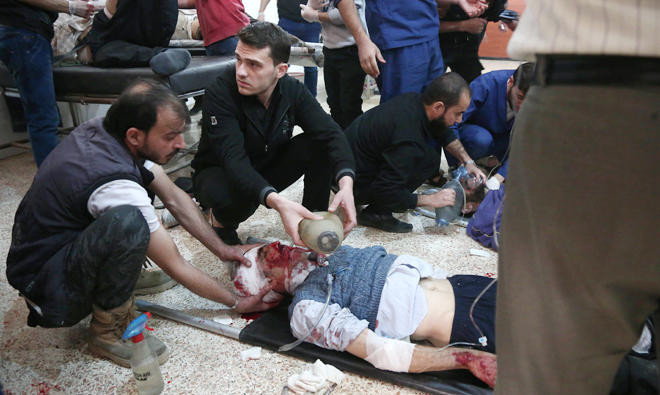
BEIRUT/AMMAN: At least 11 civilians were killed and a school day violently interrupted amid intensive Syrian regime shelling of an opposition-held enclave north of the capital Damascus Sunday, sending panicked kindergarten children scurrying for shelter, opposition activists reported.
The Britain-based Syrian Observatory for Human Rights and the Eastern Ghouta Media Center said those killed in the Saqba and Hamouriyah districts include two women, one child and a media activist. The Ghouta Media center said the media activist worked for the local Al-Jisr TV.
In a video posted by the Ghouta Media Center, kindergarten children were seen running in the streets of Kfar Batna, another village in the area that was shelled. Panicked children were scattered in the small rural streets of the village, some in tears while others called out for their parents. Rescuers struggled to escort the children out of the area covered in a cloud of dust following the explosions.
The first-responders group in the Damascus suburbs, the Syrian Civil Defense, also known as the White Helmets, reported that two shells fell in a school in the center of the village, injuring several. Baraa Abdurrahman, a resident of Kfar Batna, said the shells fell in a street that has a couple of schools. He added that six were injured.
Eastern Ghouta, north of Damascus, is part of a de-escalation zone declared earlier this year in Syria. But violence amid a tight regime siege has persisted in the area, which has faced intense government shelling for four years.
Images of starving children and adults emerged from the Ghouta suburbs, one of the hubs of the 2011 uprising against President Bashar Assad’s rule, prompting UN officials to say the area is facing a humanitarian crisis.
In a related development, the regime forces, supported by Russian jets and Iranian-backed militias, escalated bombing of areas of Deir Ezzor still held by Daesh.
Former residents and the Syrian Observatory for Human Rights said there were heavy aerial strikes on eastern Syria’s largest city as troops pushed toward the Hay Al-Umal area, which overlooks some of the remaining militant-held neighborhoods where an estimated 1,500 civilians are trapped.
“The situation is catastrophic, there are families under the rubble and others who fled have no shelter,” said Sheikh Awad Al-Hajr, a tribal leader, referring to the plight of those remaining inside the city and in cities, towns and farms in the fertile strip along the Euphrates bordering Iraq.
Fighting and relentless airstrikes in Deir Ezzor province, the last stronghold of Daesh, have prompted tens of thousands of civilians to flee, former residents and aid workers say.
Earlier on Sunday, the Observatory said heavy clashes between regime’s forces and Daesh in Deir Ezzor city have killed at least 73 fighters in the last 24 hours
The monitor said the fierce fighting on Saturday killed at least 50 Daesh fighters, as well as 23 Syrian soldiers and pro-regime militiamen.
Observatory director Rami Abdel Rahman said regime forces had captured two new neighborhoods and the municipal stadium.


![]()
Syrian regime shelling kills 11, hits school
Syrian regime shelling kills 11, hits school


Latest updates


© 2026 SAUDI RESEARCH & PUBLISHING COMPANY, All Rights Reserved And subject to Terms of Use Agreement.