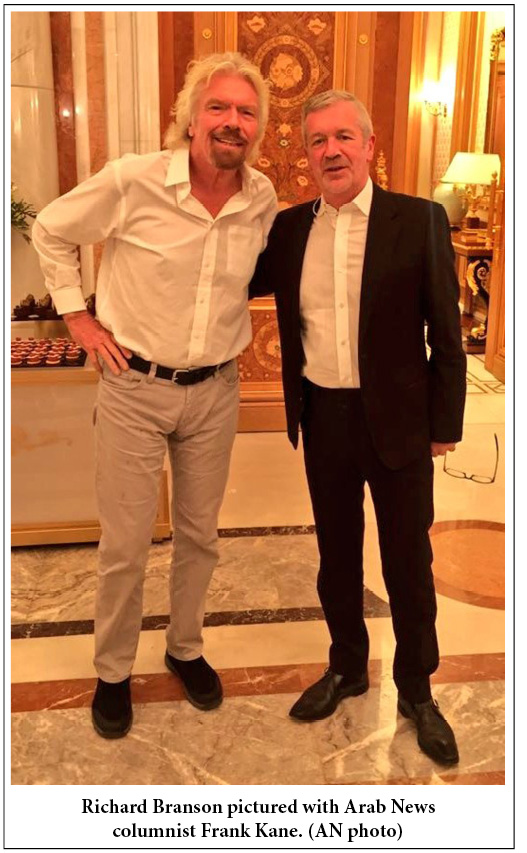
RIYADH: Richard Branson looks slightly out of place in the Louis Quinze splendor of the Green Room at the King Abdul Aziz International Conference Center in Riyadh.
His habitual open-neck shirt and jeans do not quite fit with the rococo glamor of the room, and are also in distinct contrast with the formal collar-and-tie uniform of most male participants at the Future Investment Initiative conference.
But that is the style 67-year-old Branson has made his own, and it has served him well as a branding feature in a half-century career that has succeeded by challenging traditional orthodoxies and marketing unashamedly to youth and youthful aspirations via his Virgin organization.
That philosophy is what has brought him to Saudi Arabia at a time of great change in the Kingdom, with a young Crown Prince Mohammed bin Salman leading a quiet revolution on behalf of the new generation of Saudi citizens.
“This is the most exciting time to be in, and come from, Saudi Arabia. There is such potential. Around 65 percent of the country is under 30, more than 50 percent are women. If (the crown prince) continues the way he is going, it is going to be a beautiful place,” he said.
Specifically, Branson was at the glittering Future Investment Initiative (FII) conference — billed as the “Saudi Davos,” in reference to the Swiss gathering of business leaders where he is also a regular star attendee — to sign a $1 billion deal with the Kingdom’s Public Investment Fund (PIF), advance his plans for the Red Sea Resort tourism project, and unveil a plan to increase Internet access in the region.
He was also there to give public backing from one of the best known names in the business world to the transformation underway in the Kingdom, and is fully aware of its historical significance. He has done his Middle East history homework.
“It’s nearly 40 years since 1979, and now there is an opportunity for the country to leave behind the problems that all seemed to stem from that year — the rise of violent religious extremism and intolerance that has caused so many problems in the Kingdom and in the world,” he said.
He explains that was the year of the Iranian revolution, the attack on the Grand Mosque in Makkah and the Soviet invasion of Afghanistan, which heralded an era of violent extremism and foreign intervention in the Middle East, the effects of which are still being felt today.
“There was a concern that Saudi Arabia would go the same way as Iran, which allowed the extremists to take full control. Now, a brave crown prince with the backing of his equally brave father are bringing it back to what it was before 1979 — an Islamic country, certainly, but one of tolerance, moderation and modernity,” he said.
He believes that change is already noticeable in the Kingdom. “I came to a big conference here last year, and the audience was almost entirely male. Now, at the FII, there are as many women as men, and they are walking around openly and mixing freely. There has been real change in just a short space of time,” he said.
“I’ve visited the Kingdom a lot recently, and I’ve talked to a lot of young people here, men and women. They are delighted at the prospect of being able to see a film together, or go to a concert, or spend their holidays at home rather than have to travel overseas. It’s a wonderful thing to see their hopes and ambitions for the future,” he said.
As a man well used to challenging the accepted orthodoxies, he recognizes that there will be challenges. “Of course, there are still some very conservative people, mainly older people, so it takes a young person to take the country forward and give the next generation what they want. I think a lot of the extreme right wing religious people will step down or be moved aside gradually,” he added.
He thinks the next step should be a loosening of the Kingdom’s guardianship laws that restrict women’s ability to travel and conduct business affairs freely.
“The next challenge is to change the rules that make women have to ask permission from men to be able to travel and move around freely. It’s about equality. Why should women have to ask men for permission to travel? Men should ask permission too. I know that I have to ask my wife permission when I travel, I cannot just head off and leave everything with her. It’s just normality.”
He tells how his wife Joan makes him sign a document each time he goes off on another daredevil adventure — solo ballooning, or round-the-world sailing — giving her possession of their Caribbean Island, Necker, in the event that he might not return.
The conversation turns to resorts, on which he regards himself as something of an authority.
“The projects here — Neom, the Red Sea, and the entertainment parks — are all very exciting. I was asked if I’d be a director on the Red Sea Resort, which is an amazing place. I visited some of the islands and it was breathtakingly beautiful, islands and coastline.”
Apart from Necker, he also has a home in the Maldives and has developed resorts on other island destinations. There are 50 islands in the Red Sea project, and he will advise on how to develop them in a tasteful way, in keeping with the Kingdom’s cultures and traditions.
“I have some experience with islands, so the plan is to develop the resort as a destination for high quality tourism, but to leave it still beautiful when it’s developed — the aim is to keep it virgin, untouched and pristine, but to be able to offer facilities that will allow people to enjoy it,” he said.
There is an ongoing discussion in the Kingdom about what kind of regime will run the resort, with some suggestions of semi-autonomous status and a more relaxed approach to traditional standards of dress and entertainment.
“That’s still being worked on, but I’d like to think it will be more like Dubai, not in all respects of course but in some ways. Maybe bikinis will be allowed, or maybe it will be developed as a detox area.
“Let’s wait and see,” he teased.
It is still early days in the project, and Virgin’s input so far — apart from the valuable endorsement of the Branson brand — is advisory. But it could go further.
“The idea is to develop them as four star to ultra luxury destinations, so no cheap beach-type holiday packages. But we’re looking at putting Virgin hotels there so that would be a significant investment by the group,” he said.
He is also considering the possibility of launching Virgin flights to the Kingdom. “Maybe one day. I’ll be traveling here a lot so it might be better to have the airline fly here as well,” he said.
The Virgin company began as a music label, but has since become a portfolio of brands all aimed at fast-growing markets with a youthful consumer profile, like air travel, tourism, telecommunications, online banking and retailing.
But his latest all-consuming preoccupation is with space travel. The $1 billion deal with PIF will ensure Saudi funding for the project to create the world’s first “spaceline” that will enable passengers to fly into space on a commercial basis. It is an ambitious project and has suffered setbacks along the way. “People use the phrase ‘it’s not rocket science’ about something that’s easy, but with space travel it literally is rocket science,” he joked.
Connectivity is one of the basic themes of the Virgin brand, and while in Saudi Arabia he also announced plans to expand the reach of the One Web communications satellite system, in which Virgin is an investor along with Japan’s SoftBank, to bring improved Internet connectivity across the region.
“It will help connect thousands of people in even the remotest parts of Saudi Arabia,” he said.
There is also a hint that Virgin will get involved in plans by some Gulf counties to develop “hyperloop” transportation systems which can cut train traveling times to a fraction of their current duration. “I think hyperloop is the future,” he said, promising more details soon.
There is no doubt that he sees the Middle East, and Saudi Arabia in particular, as a prime destination for future Virgin projects. “We are happy and keen to invest in the new Saudi Arabia. I’ve got to know (the crown prince) quite well in the past few months and I want to help him in a more positive way,” he said.
Does he think the crown prince is pushing ahead too fast with the transformation of Saudi society, culture and economy?
“Well, as a general rule it’s better to walk before you can run, but I never really went along with that. If you want to succeed you should have an idea and a plan to implement it, and just do it. He is doing that, and his heart is in the right place,” he said, before heading off to address a packed audience of men and women at the final day of the Riyadh conference.
As usual, Richard Branson gets the last word.


![]()

Richard Branson urges Saudi Arabia to ‘just do it’
Richard Branson urges Saudi Arabia to ‘just do it’


Latest updates


Recommended


© 2026 SAUDI RESEARCH & PUBLISHING COMPANY, All Rights Reserved And subject to Terms of Use Agreement.