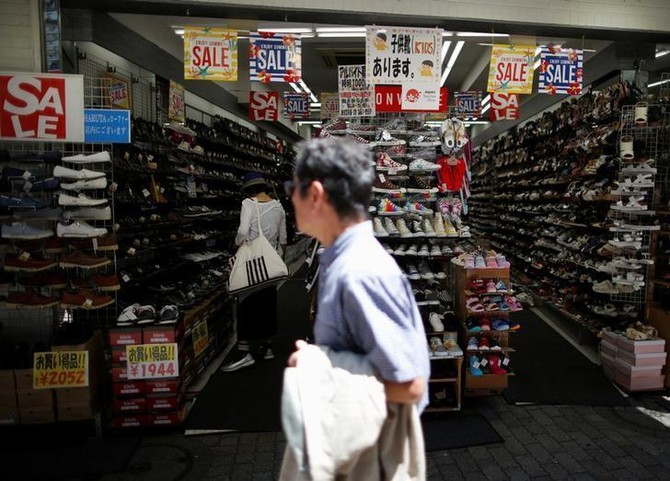
Japan consumer prices rise for 9th straight month

Japan’s economy expanded at an annualized 2.5 percent in the second quarter as consumer and corporate spending picked up. (Reuters)
Updated 27 October 2017
Follow

Japan consumer prices rise for 9th straight month

TOKYO: Japan’s core consumer prices marked a ninth straight month of annual gains in September but failed to accelerate from the previous month, underscoring the central bank’s huge task as it struggles to meet an ever-elusive 2 percent inflation target.
Most of September’s scant inflation was driven by continued rises in energy costs, which were partly offset by falling cellphone bills — another sign that companies still baulk at raising prices for fear of stalling a fragile recovery in private consumption.
Still, the Bank of Japan is set to largely maintain its current inflation forecasts at a policy meeting next week, blaming stagnant inflation on factors such as corporate efforts to boost productivity.
The nationwide core consumer price index, which includes oil products but excludes volatile fresh food prices, rose 0.7 percent in September from a year earlier, matching August but lower than a median market forecast of 0.8 percent.
“Private consumption was probably weak in July-September and gains in household income may have slowed due to weak summer bonus payments,” said Takeshi Minami, chief economist at Norinchukin Research Institute.
“There’s still quite some distance from the BOJ’s 2 percent target, so monetary policy will be steady for the time being.”
A 7.6 percent rise in energy prices made up most of the consumer price growth, a sign inflation was still driven by temporary factors rather than sustained strength in demand.
Stripping away the effect of fresh food and energy, consumer prices rose 0.2 percent in September from a year ago, data from the internal affairs ministry showed.
Core consumer prices in Tokyo, available a month before the nationwide data, were up 0.6 percent in October from a year earlier, against a median forecast for a 0.5 percent rise. It was the fastest annual pace since March 2015, a potential source of comfort for the BOJ.
Japan’s economy expanded at an annualized 2.5 percent in the second quarter as consumer and corporate spending picked up, with steady growth likely to be sustained in coming quarters.
Japan is experiencing near full employment, and wholesale prices rose in September at the fastest annual rate in almost nine years as raw material costs surged.


Closing Bell: Saudi main market closes the week in red at 10,526 

Updated 14 sec ago
Follow

Closing Bell: Saudi main market closes the week in red at 10,526 

RIYADH: Saudi equities ended Thursday’s session modestly lower, with the Tadawul All Share Index slipping 14.63 points, or 0.14 percent, to close at 10,526.09.    

The MSCI Tadawul 30 Index also declined 3.66 points, or 0.26 percent, to 1,389.66. In contrast, the parallel market outperformed, as Nomu jumped 237.72 points, or 1.02 percent, to close at 23,430.93.  

Market breadth on the main market remained tilted to the downside, with 156 stocks ending lower against 99 gainers.    

Trading activity eased further, with volumes reaching 80.46 million shares and total traded value amounting to SR1.66 billion ($442 million).    

On the movers’ board, Saudi Industrial Export Co. led the gainers, rising 6.6 percent to SR2.10, followed by Consolidated Grunenfelder Saady Holding Co., which advanced 6.43 percent to SR9.60.    

Raoom Trading Co. climbed 4.36 percent to SR61.05, while Astra Industrial Group gained 4.35 percent to close at SR139. Riyadh Cables Group Co. added 3.77 percent to end the session at SR135.00.    

On the downside, Methanol Chemicals Co. topped the losers’ list, falling 5.96 percent to SR7.41.  

Flynas Co. retreated 5.43 percent to SR61.00, while Leejam Sports Co. dropped 5 percent to close at SR100.80.    

Alramz Real Estate Co. slipped 4.64 percent to SR55.50, and Almasane Alkobra Mining Co. declined 4.55 percent to SR84.00.  

On the announcement front, ACWA Power said it has completed the financial close for the Ras Mohaisen First Water Desalination Co., a reverse osmosis desalination project with a capacity of up to 300,000 cubic meters per day, alongside associated potable water storage facilities totaling 600,000 cubic meters in Saudi Arabia’s Western Province.    

The project was financed through a consortium of local and international banks, with total funding of SR2.07 billion and a tenor of up to 29.5 years, while ACWA Power holds an effective 45 percent equity stake.  

Shares of ACWA Power ended the session at SR185.90, up SR0.2, or 0.11 percent.     

Meanwhile, Consolidated Grunenfelder Saady Holding Co. announced the sign-off of a customized solutions project with Saudi Aramco Nabors Drilling Co., valued at SR166.0 million excluding VAT.    

The 24-month contract covers the sale and maintenance of field camp facilities, with the financial impact expected to begin from the first quarter of 2026.