JERUSALEM: A bill that critics say would amount to de facto annexation of Israeli settlements surrounding Jerusalem is expected to go before ministers on Sunday, drawing harsh criticism from Palestinians and those hoping to salvage the two-state solution.
The bill would absorb major Israeli settlements currently in the occupied West Bank into Jerusalem by enlarging the city limits.
Its opponents argue that it is a step toward full unilateral annexation of the West Bank settlements affected — a move that would be sure to spark international outrage.
For the vast majority of the international community, the status of Israel’s settlements, built on land the Palestinians see as part of their future state, are to be decided in peace negotiations.
Approval by a ministerial committee on Sunday would fast-track the bill’s progress through Parliament.
“This coming Sunday I shall take part in Jewish history,” Intelligence Minister Yisrael Katz posted on Facebook Wednesday.
“The ‘Greater Jerusalem bill,’ which I initiated, will come up for a vote in the ministerial committee on legislation,” he said.
Senior Palestinian official Hanan Ashrawi said the plan could kill hopes for an independent Palestinian state.
Ashrawi, a member of the Palestine Liberation Organization’s executive committee, said late Wednesday that “such efforts represent the end of the two-state solution.”
“Israel is in the business of prolonging the military occupation and not ending it, legalizing the presence of extremist Jewish settlers on Palestinian soil, and completing the total isolation and annexation of Palestinian Jerusalem,” she wrote.
Israel occupied the West Bank, including east Jerusalem, in the Six-Day War of 1967. It later annexed east Jerusalem in a move never recognized by the international community.
It sees the entire city as its indivisible capital, while the Palestinians want the eastern sector as the capital of their future state.
Prominent members of Netanyahu’s coalition openly oppose the idea of a Palestinian state and advocate annexing most of the West Bank.
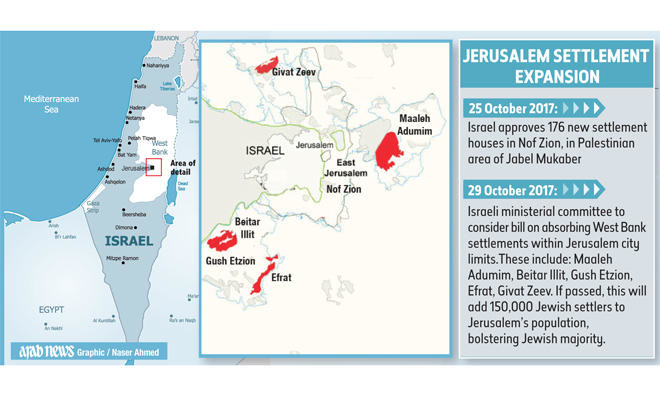
The major settlement of Maaleh Adumim, east of Jerusalem, would be among the areas absorbed into the enlarged city limits under the draft legislation, according to an explanatory note by its sponsors.
The settlements mentioned however would not be fully annexed to Israel — at least not at first — although Netanyahu pledged on a recent visit to Maaleh Adumim that it would at some part become part of the Jewish state.
“We shall build here thousands of housing units” and add industrial zones, Netanyahu said during his visit to the settlement of 37,000 people. “This place will be a part of the state of Israel.”
Maaleh Adumim’s municipal boundaries include a contentious area known as E1 adjacent to the settlement.
E1 and Maaleh Adumim form an Israeli buffer east of Jerusalem that the Palestinians say would divide the city from the West Bank and badly hurt the possibility of a contiguous Palestinian state.
Also incorporated under the new bill would be the ultra-Orthodox Jewish settlement of Beitar Illit, southwest of Jerusalem, the Gush Etzion settlement bloc to the south and Efrat and Givat Zeev settlements.
“The settlements joined to Jerusalem will maintain certain municipal autonomy, since they will be considered sub-municipalities of Jerusalem,” the draft bill says.
Katz said the bill would add an additional 150,000 people to Jerusalem’s population, strengthening its Jewish majority.
Haaretz newspaper on Thursday said the wording meant the settlements would be annexed to the city of Jerusalem rather than to the state of Israel.
But settlement watchdog Peace Now said any difference was purely cosmetic.
“The meaning of the bill is a de-facto annexation of these territories to Israel, even if it would be possible to argue that this will not constitute de-jure annexation,” it said in a statement.
Daniel Seidemann, head of the Terrestrial Jerusalem group, which monitors Israel’s settlements and its treatment of Palestinians in east Jerusalem, said that Netanyahu had backed a similar plan in 1998 but was forced to abandon it by international condemnation.
Now, with a supportive US President Donald Trump, Netanyahu apparently feels more confident, Seidemann told AFP on Thursday.
Netanyahu heads what is seen as the most right-wing government in Israel’s history, and settlement advocates wield significant power in his coalition.
“This is part of an overall attempt to implement policies that are tantamount to de facto annexation and it’s also an indication that Netanyahu thinks he can get away with anything,” Seidemann said.


Israel ‘annexation’ bill draws fresh concern for two-state solution
Israel ‘annexation’ bill draws fresh concern for two-state solution


Israel says it launched pre-emptive attacks against Iran
- An Israeli defense official said the operation had been planned for months in coordination with Washington
Israel said it launched a pre-emptive attack against Iran on Saturday, pushing the Middle East into a renewed military confrontation and further dimming hopes for a diplomatic solution to Tehran’s long-running nuclear dispute with the West.
The New York Times, citing a US official, reported that US strikes on Iran were underway. A source said that Iran’s supreme leader, Ayatollah Ali Khamenei, was not in Tehran and had been transferred to a secure location.
An apparent strike in Iran’s capital Saturday happened near the offices of Khamenei. State television acknowledged an explosion in the area of the offices.
Israeli media reported attempts to assassinate Iranian President Masoud Pezeshkian during the attacks, and have not ruled out Khamenei being targeted.

Several missiles have struck University Street and the Jomhouri area in Tehran, while explosion likely occurred in the northern Seyyed Khandan area of Tehran, state media reported. Thick smoke was also rising from the vicinity of Pasteur Street in downtown Tehran, ISNA said.
The attack, coming after Israel and Iran engaged in a 12-day air war in June, follows repeated US-Israeli warnings that they would strike again if Iran pressed ahead with its nuclear and ballistic missile programs.
“The State of Israel launched a pre-emptive attack against Iran to remove threats to the State of Israel,” Defense Minister Israel Katz said.
An Israeli defense official said the operation had been planned for months in coordination with Washington, and that the launch date was decided weeks ago.
The US military declined to immediately comment on the attack.
Explosions were heard in Tehran on Saturday, Iranian media reported, and sirens sounded across Israel around 08:15 local time in what the military said was a proactive alert to prepare the public for the possibility of an incoming missile strike.

The Israeli military announced the closure of schools and workplaces, with exceptions for essential sectors, and a ban on public airspace. Israel closed its airspace to civilian flights, and the airports authority asked the public not to go to any of the country’s airports.
The country’s airspace will reopen and flights to and from Israel to resume ‘as soon as the security situation allows,’ the airport authority said.
Iran’s airspace has been closed, Tasnim news agency reported.
The US and Iran renewed negotiations in February in a bid to resolve the decades-long dispute through diplomacy and avert the threat of a military confrontation that could destabilize the region.
Israel, however, insisted that any US deal with Iran must include the dismantling of Tehran’s nuclear infrastructure, not just stopping the enrichment process, and lobbied Washington to include restrictions on Iran’s missile program in the talks.
Iran said it was prepared to discuss curbs on its nuclear program in exchange for lifting sanctions but ruled out linking the issue to missiles.
Tehran also said it would defend itself against any attack.
It warned neighboring countries hosting US troops that it would retaliate against American bases if Washington struck Iran.
In June, the US joined an Israeli military campaign against Iranian nuclear installations, in the most direct American military action ever against the Islamic Republic.
Tehran retaliated then by launching missiles toward the US Al Udeid air base in Qatar, the largest in the Middle East.
Western powers have warned that Iran’s ballistic missile project threatens regional stability and could deliver nuclear weapons if developed. Tehran denies seeking atomic bombs.


