BEIRUT: As US-allied fighters hurtle down the eastern bank of the Euphrates River, a showdown could ensue between the US and Russia, whose allies are racing to take over the same strategic oil-rich territory from Daesh.
While the two sides will likely avoid a direct confrontation, the capture of Raqqa by the US-backed forces, followed by their swift seizure of Syria’s largest oil field from Daesh, has irked Damascus, which needs the oil to boost its flagging economy.
As the rival international coalitions compete to defeat the militants and snap up oil and gas fields, the Russian military has issued a stream of angry statements, accusing the US of colluding with the Daesh and other extremist groups in a bid to stymie the government’s advances.
Both the US and Russia have embedded special forces with their respective partners and are supporting their advances with aggressive airstrikes. They have so far avoided any significant confrontations by maintaining talks and a hotline intended to prevent midair and ground incidents.
US Army Col. Ryan Dillon, spokesman for the US-led anti-Daesh coalition, said contacts with Russia were continuing to avoid friction on the ground around Syria’s Al-Omar oil field, which was seized by the Kurdish-led Syrian Democratic Forces (SDF) on Sunday. But he indicated the coalition was prepared for any possibility.
“We are prepared to defend our partners if they are attacked, whether by ISIS (Daesh) fighters or by anyone else. We certainly don’t want to come to that and we will continue to de-conflict with our Russian partners,” he told the AP on Tuesday. He suggested the SDF would continue to march south into the town of Boukamal on the Iraqi border after consolidating their gains, fueling concerns of conflict between the two groups and their superpower sponsors.
The stakes are high and the two sides have exchanged accusations of firing on one another in the past.
As Daesh sheds its hold on territory, Iranian- and Russia-backed Syrian government forces have been gaining ground on the western bank of the Euphrates River, while the US-backed SDF is advancing on the eastern bank and has already seized a major natural gas field and other smaller oil fields in addition to Al-Omar.
The Al-Omar field, which before the war produced around 9,000 barrels per day (bpd), is a major prize for both sides, particularly the Syrian regime whose coffers have been decimated by the country’s war, now in its seventh year.
The regime and the Kurds have maintained a complicated relationship throughout Syria’s war, mostly refraining from fighting one another while some rebels have accused the Kurds of being secretly aligned with the Syrian president. But US support in the fight against Daesh has emboldened Syria’s Kurds, who now control nearly 25 percent of Syrian territory and have expanded into non-Kurdish, Arab-dominated areas, unsettling Damascus.
Their capture of Raqqa, the former heart of Daesh’s so-called caliphate, was a highly prestigious win and has further raised their profile. Syrian state-run media ignored reports about the US-backed force’s capture of Raqqa for days, and it is not clear how regime troops will respond to their seizure of the Al-Omar field.
Both sides have upped the rhetoric, and have started talking about a possible confrontation.
Some have suggested the SDF now has enough cards to bargain with the Syrian regime in future negotiations.
“I do expect the Assad regime will pressure the SDF to relinquish control of the oil field in return for some form of financial or energy support from the regime,” said Jennifer Cafarella, lead researcher at the Washington-based Institute for the Study of War. She said Russia, Iran, and Assad were likely preparing to cut a strategic deal with the main Kurdish militia for the future governance of eastern Syria.
“Russia and Assad could actually demand limits on the US presence in eastern Syria as a condition of a deal,” she said.
Hassan Hassan, a Syria expert who co-authored a book about Daesh, said he did not think there would be a showdown.
“We assume the SDF will continue to control the oil field and surrounding areas if Russia sticks to the de-confliction understanding with Washington, which stipulates that they avoid attacking the other side in a certain area once the other side expels Daesh from it,” he said.
“The regime would have wanted to control the oilfields, but the SDF checkmated it,” he added.


![]()
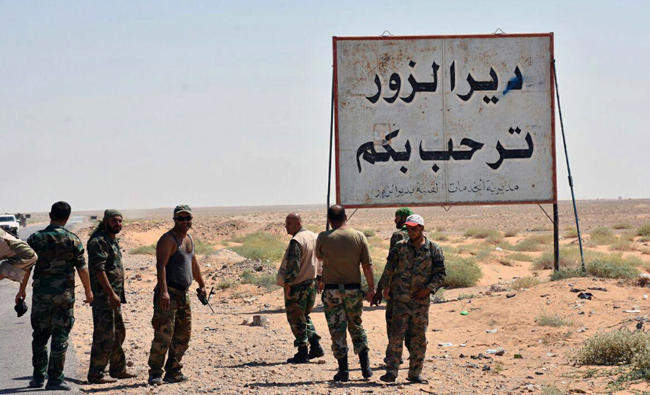
Potential US-Russia showdown in Syria over Daesh-held territory
Potential US-Russia showdown in Syria over Daesh-held territory


Latest updates


© 2026 SAUDI RESEARCH & PUBLISHING COMPANY, All Rights Reserved And subject to Terms of Use Agreement.