MOSCOW: Russia has fired cruise missiles from the Mediterranean Sea on Daesh positions in Syria, the Defense Ministry said on Friday, Moscow’s latest show of strength in the conflict wracking the Mideast country.
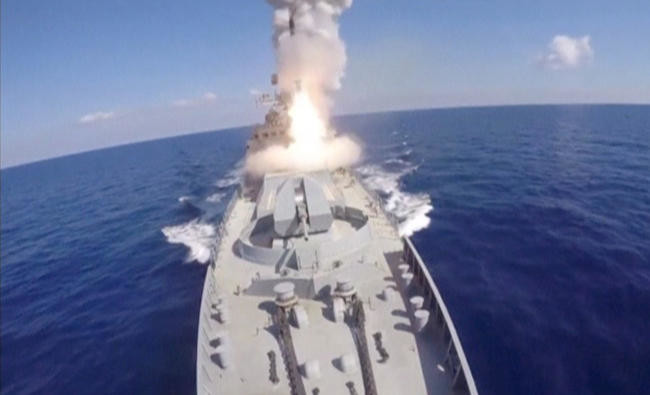
The ministry said in a statement that two frigates and a submarine launched six cruise missiles on Daesh installations in Syria’s Hama province, destroying command centers and ammunition depots. It did not say when the missiles were launched.
Moscow has fired missiles from the Mediterranean at militants’ positions in Syria before, including launches from a submarine and a frigate in May at targets in the area of the ancient city of Palmyra.
It said that the Turkish and Israeli military “were informed in a timely manner of the missile launches through communication channels,” but it did not mention the US.
Russia has suspended its communication channel with the US on military operations in Syria after a US jet shot down a Syrian warplane on Sunday, with Moscow accusing Washington of failing to issue a warning.
The ministry said that Russia’s Admiral Essen and Admiral Grigorovich warships and the Krasnodar submarine fired six Kalibr missiles at command centers and weapons stores in Syria’s Hama region.
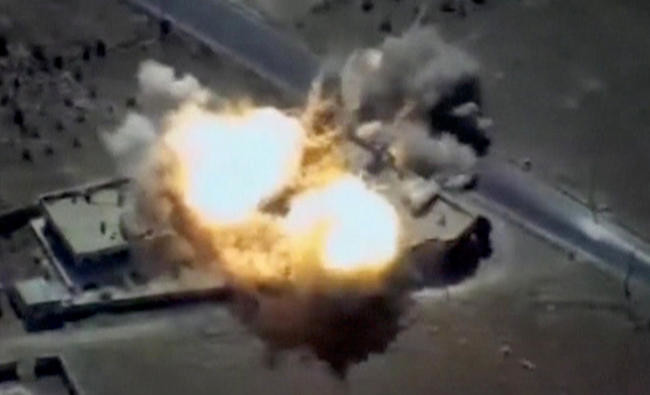
“As a result of the surprise mass missile strike, command points were destroyed and also large stores of weapons and ammunition of the Daesh terrorists in the area of Aqirbat in the Hama province,” it said.
The ministry added that Russian planes then carried out aerial strikes that “destroyed the remainder of the Daesh fighters and their facilities.”
The ministry released video footage of missiles being fired from underwater by the submarine and from the ships as well as aerial footage of the missiles striking two-story buildings in what appeared to be semi-desert areas.
The most recent such strikes from ships and submarines were announced by the ministry on May 31, aimed at targets around Palmyra.
Russia is one of the strongest backers of Syrian President Bashar Assad’s regime and has been carrying out airstrikes in the country since September 2015.
Separately on Friday, a senior Russian lawmaker said Moscow is “nearly 100 percent” sure that the top Daesh leader was killed in a Russian airstrike last month.
The Defense Ministry first made the claim last week, saying that Abu Bakr Al-Baghdadi’s death in the May 28 strike on the outskirts of the Syrian city of Raqqa was still “being verified through various channels.”
Viktor Ozerov, head of the defense and security committee at the upper chamber of the Russian Parliament, told the Interfax news agency on Friday that Russia’s intelligence about Al-Baghdadi’s death is “nearly 100 percent” certain.
“Russia would not want to be on the list of the countries that have said before that he was killed and then Al-Baghdadi would resurrect,” Ozerov added.
The whereabouts of the shadowy Al-Baghdadi, with a $25 million US bounty on his head, have not been known. His last public appearance was almost three years ago in the Iraqi city of Mosul, at the 12th-century Al-Nuri Mosque from where he declared a “caliphate” in the territory that Daesh had seized in Iraq and Syria in July 2014.
That mosque, along with its famous leaning minaret, was destroyed on Wednesday night, blown up by Daesh militants as their control of Mosul increasingly is slipping away. The mosque would have been a symbolic prize for Iraqi forces and the US-led coalition in the fight for Iraq’s second-largest city.
The ministry said Friday that Daesh fighters have been moving forces into Hama province this week under cover of night and using large buildings there as command points and weapons stores.
It said the fighters were trying to move out from Raqqa towards Palmyra.


![]()
![]()
Noose tightens: Russia fires missiles at Daesh from Mediterranean
Noose tightens: Russia fires missiles at Daesh from Mediterranean


Latest updates


© 2026 SAUDI RESEARCH & PUBLISHING COMPANY, All Rights Reserved And subject to Terms of Use Agreement.