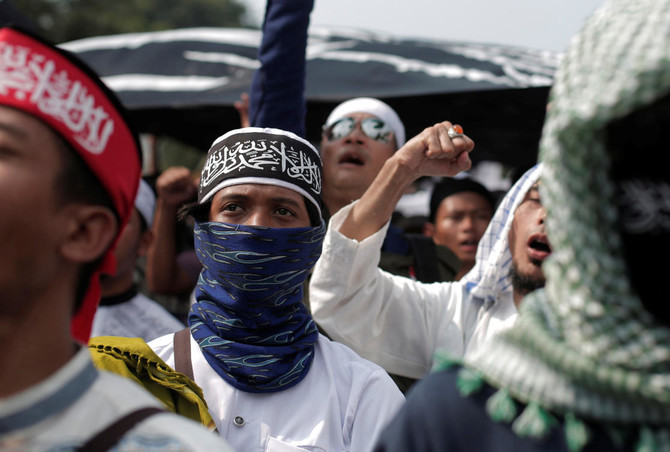
JAKARTA: Around 1,000 Indonesians, led by hard-line Islamist groups, protested outside parliament on Tuesday as lawmakers approved a presidential decree banning any civil organizations deemed to go against the country’s secular state ideology.
Tuesday’s approval puts into law a policy President Joko Widodo set in a decree in July. The policy was aimed at containing hard-line groups who have cast a shadow over the long-standing reputation for religious tolerance in the world’s largest Muslim-majority nation.
“We have seen mass organizations that are against the Pancasila (state ideology) and have created social conflict,” said Arya Bima, a lawmaker in favor of the policy. “This law doesn’t impede freedom of organization or assembly, it strengthens it.”
In late 2016 and early this year, groups such as Hizb-ut Tahrir Indonesia (HTI) and the Islamic Defenders Front (FPI), which call for Islamic law to be imposed in Indonesia, led mass street rallies attacking Jakarta’s governor, a Christian, whom they accused of insulting Islam.
Basuki TjaHajja Purnama, who in April lost an election to get a new term, was jailed one month later after being convicted of blasphemy, in a court ruling widely criticized in Indonesia and overseas as unjust.
The presidential decree Widodo signed in July ordered the disbanding of all organizations deemed to be in conflict with the secular state ideology. HTI, which seeks to establish an Islamic caliphate, was the first organization to be disbanded under the policy.
Pancasila or ‘five principles’ is Indonesia’s state ideology, which includes belief in god, the unity of the country, social justice and democracy, and which enshrines religious diversity in an officially secular system.
Under the new law, anyone who “embraces, develops of spreads ideology that is in conflict with the (state ideology) Pancasila” can face imprisonment of six months to life, according to a copy of the draft law reviewed by Reuters.
Rights activists and civil organizations have decried the move, saying it harks back to the era of authoritarian ruler Suharto, who demanded loyalty to Pancasila and took repressive measures against some opponents.
Opposition lawmaker Al Muzamil Yusuf said the new law could “violate democratic rights and remove checks and balances on the government.”
During the protest outside parliament on Tuesday, around 5,200 police and military personnel stood guard around the complex in central Jakarta.
A hashtag supporting Widodo’s policy was a top trending topic on Indonesian Twitter.
“This policy is not about (Widodo) or any political party, it’s about safeguarding the unity of the country,” said user @Senopati


![]()

Indonesia passes law to ban organizations deemed against its ideology
Indonesia passes law to ban organizations deemed against its ideology
Trump to remove Vietnam from restricted tech list: Hanoi
HANOI: US President Donald Trump told Vietnam’s top leader To Lam he would “instruct the relevant agencies” to remove the country from a list restricted from accessing advanced US technologies, Vietnam’s government announced Saturday.
The two leaders met in person for the first time at the White House on Friday, after Lam attended the inaugural meeting of Trump’s “Board of Peace” in Washington.
“Donald Trump said he would instruct the relevant agencies to soon remove Vietnam from the strategic export control list,” Hanoi’s Government News website said.
The two countries were locked in protracted trade negotiations when the US Supreme Court ruled many of Trump’s sweeping tariffs were illegal.
Three Vietnamese airlines announced nearly $37 billion in purchases this week, in a series of contracts signed with US aerospace companies.
Fledgling airline Sun PhuQuoc Airways placed an order for 40 of Boeing’s 787 Dreamliners, a long-haul aircraft, with an estimated total value of $22.5 billion, while national carrier Vietnam Airlines placed an $8.1 billion order for around 50 Boeing 737-8 aircraft.
When Trump announced his “Liberation Day” tariffs in April, Vietnam had the third-largest trade surplus with the US of any country after China and Mexico, and was targeted with one of the highest rates in Trump’s tariff blitz.
But in July, Hanoi secured a minimum 20 percent tariff with Washington, down from more than 40 percent, in return for opening its market to US products including cars.
Trump signed off on a global 10-percent tariff on Friday on all countries hours after the Supreme Court ruled many of his levies on imports were illegal.
The two leaders met in person for the first time at the White House on Friday, after Lam attended the inaugural meeting of Trump’s “Board of Peace” in Washington.
“Donald Trump said he would instruct the relevant agencies to soon remove Vietnam from the strategic export control list,” Hanoi’s Government News website said.
The two countries were locked in protracted trade negotiations when the US Supreme Court ruled many of Trump’s sweeping tariffs were illegal.
Three Vietnamese airlines announced nearly $37 billion in purchases this week, in a series of contracts signed with US aerospace companies.
Fledgling airline Sun PhuQuoc Airways placed an order for 40 of Boeing’s 787 Dreamliners, a long-haul aircraft, with an estimated total value of $22.5 billion, while national carrier Vietnam Airlines placed an $8.1 billion order for around 50 Boeing 737-8 aircraft.
When Trump announced his “Liberation Day” tariffs in April, Vietnam had the third-largest trade surplus with the US of any country after China and Mexico, and was targeted with one of the highest rates in Trump’s tariff blitz.
But in July, Hanoi secured a minimum 20 percent tariff with Washington, down from more than 40 percent, in return for opening its market to US products including cars.
Trump signed off on a global 10-percent tariff on Friday on all countries hours after the Supreme Court ruled many of his levies on imports were illegal.
Latest updates


Recommended


© 2026 SAUDI RESEARCH & PUBLISHING COMPANY, All Rights Reserved And subject to Terms of Use Agreement.