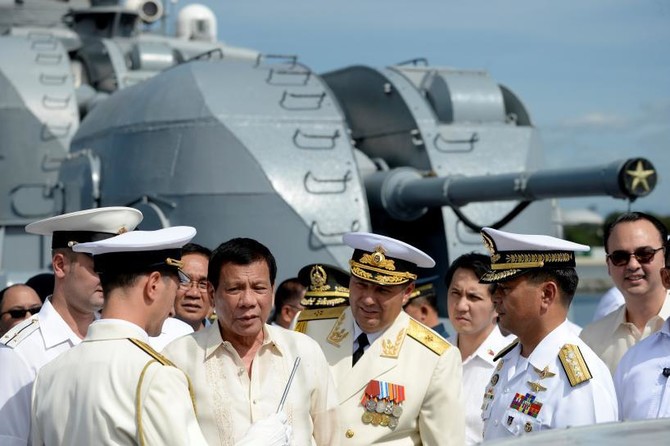
MANILA: Russia handed over army trucks and thousands of assault rifles to Philippine President Rodrigo Duterte on Wednesday as the two nations celebrated their growing military ties.
Duterte accepted the weaponry during a visit to a Russian naval ship docked in Manila, the latest move to embrace Russia and China while distancing the Philippines from its longtime ally and mutual defense partner, the US.
Following a tour of the mammoth anti-submarine warship Admiral Panteleyev, Duterte personally handled some of the 5,000 donated Kalashnikov rifles along with ammunition and 20 trucks to the poorly-equipped Philippine military.
Russian Defense Minister Sergei Shoigu hailed the closer relations as he signed two agreements with his Filipino counterpart, Delfin Lorenzana.
“The Philippines is considered to be (a) key and prospective partner in Southeast Asia and Asian-Pacific rim in general,” the Russian defense ministry quoted him as saying in a statement, adding it was the first time a defense minister from Moscow had visited the Philippines.
For decades the Southeast Asian nation has been one of Washington’s most staunch regional military allies.
But the firebrand Duterte, 72, has loosened that 70-year alliance.
Infuriated by American criticism of a controversial drug war which has claimed thousands of lives, Duterte has instead reached out to Russia and China.
The military on Monday finally declared an end to a five-month battle in the southern city of Marawi where troops struggled to flush out militants loyal to the Daesh group in the nation’s longest urban warfare.
Australian and US military helped provide crucial reconnaissance and targeting during that fight.
But Duterte has made it clear he favors being less dependent on the US.
During a visit to Beijing last year he said he had “realigned” himself toward Beijing and Moscow.
Shoigu and Lorenzana on Tuesday signed an agreement at the sidelines of a security forum north of Manila that covered defense cooperation in weapons research and exchange of experts, according to statements from their ministries.
The Philippines also signed a contract to purchase rocket propelled grenade launchers, the Russian ministry said without stating how many weapons would be acquired or how much the deal was worth.
China has also donated thousands of assault and sniper rifles to the Philippines in a similar gesture of friendship.

Philippines’ Duterte receives Russian assault rifles
Mali, Burkina say restricting entry for US nationals in reciprocal move
ABIDJAN: Mali and Burkina Faso have announced travel restrictions on American nationals in a tit-for-tat move after the US included both African countries on a no-entry list.
In statements issued separately by both countries’ foreign ministries and seen Wednesday by AFP, they said they were imposing “equivalent measures” on US citizens, after President Donald Trump expanded a travel ban to nearly 40 countries this month, based solely on nationality.
That list included Syrian citizens, as well as Palestinian Authority passport holders, and nationals of some of Africa’s poorest countries including also Niger, Sierra Leone and South Sudan.
The White House said it was banning foreigners who “intend to threaten” Americans.
Burkina Faso’s foreign ministry said in the statement that it was applying “equivalent visa measures” on Americans, while Mali said it was, “with immediate effect,” applying “the same conditions and requirements on American nationals that the American authorities have imposed on Malian citizens entering the United States.”
It voiced its “regret” that the United States had made “such an important decision without the slightest prior consultation.”
The two sub-Saharan countries, both run by military juntas, are members of a confederation that also includes Niger.
Niger has not officially announced any counter-measures to the US travel ban, but the country’s news agency, citing a diplomatic source, said last week that such measures had been decided.
In his December 17 announcement, Trump also imposed partial travel restrictions on citizens of other African countries including the most populous, Nigeria, as well as Ivory Coast and Senegal, which qualified for the football World Cup to be played next year in the United States as well as Canada and Mexico.
In statements issued separately by both countries’ foreign ministries and seen Wednesday by AFP, they said they were imposing “equivalent measures” on US citizens, after President Donald Trump expanded a travel ban to nearly 40 countries this month, based solely on nationality.
That list included Syrian citizens, as well as Palestinian Authority passport holders, and nationals of some of Africa’s poorest countries including also Niger, Sierra Leone and South Sudan.
The White House said it was banning foreigners who “intend to threaten” Americans.
Burkina Faso’s foreign ministry said in the statement that it was applying “equivalent visa measures” on Americans, while Mali said it was, “with immediate effect,” applying “the same conditions and requirements on American nationals that the American authorities have imposed on Malian citizens entering the United States.”
It voiced its “regret” that the United States had made “such an important decision without the slightest prior consultation.”
The two sub-Saharan countries, both run by military juntas, are members of a confederation that also includes Niger.
Niger has not officially announced any counter-measures to the US travel ban, but the country’s news agency, citing a diplomatic source, said last week that such measures had been decided.
In his December 17 announcement, Trump also imposed partial travel restrictions on citizens of other African countries including the most populous, Nigeria, as well as Ivory Coast and Senegal, which qualified for the football World Cup to be played next year in the United States as well as Canada and Mexico.
© 2025 SAUDI RESEARCH & PUBLISHING COMPANY, All Rights Reserved And subject to Terms of Use Agreement.