Philippines’ Duterte warns of ‘revolutionary government’

President Rodrigo Duterte said he would resort to a revolutionary government, as opposed to martial law that would require congressional approval. (AFP)
Updated 14 October 2017
Follow

Philippines’ Duterte warns of ‘revolutionary government’

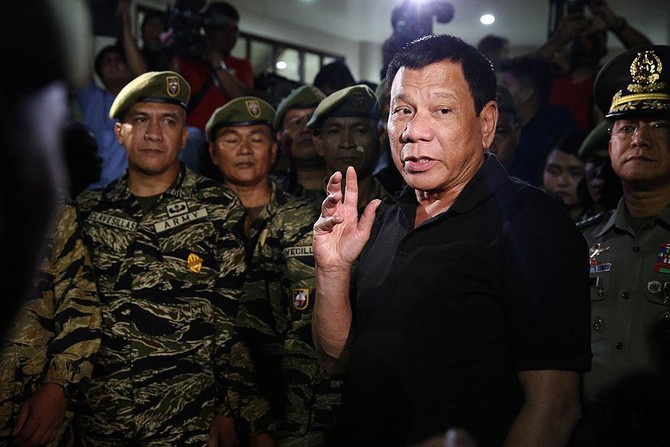
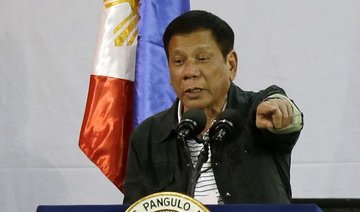
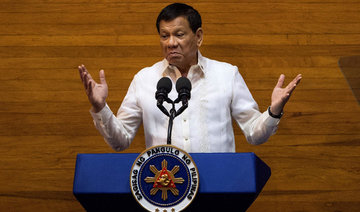
MANILA: Philippine President Rodrigo Duterte has warned he is prepared to establish a “revolutionary government” to fend off alleged efforts to oust him, fueling fears of a looming dictatorship.
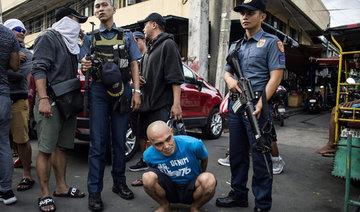
He issued the warning on state television late Friday as he railed against the press, European lawmakers and other critics of his drug war that has left thousands dead and led rights groups to warn of a crime against humanity.
Duterte said he would resort to a revolutionary government, as opposed to martial law that would require congressional approval, if communists and other opponents tried to destabilize his rule.
“If your destabilization is taking place and there is chaos already, I will not hesitate to declare a revolutionary government until the end of my term and I will arrest all of you and we can go to a full scale war against the reds,” Duterte said, in reference to communist rebels who have waged a nearly 50-year insurgency.
Duterte cited the precedent set by Corazon Aquino, who established a revolutionary government soon after leading a “People Power” uprising in 1986 that ended the dictatorship of Ferdinand Marcos.
Aquino sacked all elected officials, abolished Congress and tore up the 1973 constitution in favor of a provisional charter.
She handpicked a commission to write a new constitution, which was ratified by plebiscite in 1987 and paved the way for elections. She is revered by many Filipinos who continue to see her as a heroine of democracy.
Under the post-Aquino constitution, presidents are limited to a single term of six years.
Duterte’s critics fear the 72-year-old, who has repeatedly threatened to impose martial law, is intent on dragging the country back into dictatorship and allow himself more freedom in prosecuting his drug war.
Duterte was elected last year largely on an incendiary law-and-order platform in which he promised to eradicate illegal drugs in society by killing 100,000 people.
Since he took office 15 months ago, police have reported killing 3,850 people in anti-drug operations while thousands of others have been murdered in unexplained circumstances.
Many Filipinos continue to support Duterte, seeing the charismatic politician as a savior fighting corruption and crime.
But opposition has started to build, with the influential Catholic Church and leftist groups taking a prominent role in speaking out against his drug war.
Rare street protests broke out last month after police involved in the drug war killed two teenagers in controversial circumstances.
The Philippine military, which backed Marcos until the last days of his dictatorship, did not respond to AFP’s request for comment on Duterte’s warning.


Bangladesh takes ‘balanced approach’ with Pakistan as talks of defense deal emerge

Updated 4 sec ago
Follow

Bangladesh takes ‘balanced approach’ with Pakistan as talks of defense deal emerge

  • Air force chiefs of Pakistan and Bangladesh discussed potential defense pact last week
  • Dhaka says plan to procure fighter jets still in early stages, discussions ongoing with several countries

DHAKA: Bangladesh appears to be moving with caution as Dhaka and Islamabad forge closer ties and explore a potential defense deal, experts said on Friday.

Following decades of acrimonious ties, relations between Bangladesh and Pakistan have been growing since a student-led uprising ousted former Prime Minister Sheikh Hasina in 2024.

Talks on a potential defense deal covering the sale of Pakistan’s JF-17 fighter jets to Dhaka emerged after Bangladesh’s Air Chief Marshal Hasan Mahmood Khan visit to Rawalpindi last week, where he met with his Pakistani counterpart Air Chief Marshal Zaheer Ahmed Baber Sidhu and Field Marshal Syed Asim Munir, Pakistan’s chief of defense forces.

Bangladesh’s military media wing, the Inter-Services Public Relations, said the procurement of fighter jets for the Bangladesh Air Force is “in the very rudimentary level,” and currently “under an evaluation process.”

ISPR Director Lt. Col. Sami Ud Dowla Chowdhury told Arab News: “The evaluation process will determine which country’s offer proves befitting for us. The air chief’s visit to Pakistan is part of the evaluation process … Earlier, he visited China, Italy (too).

“Discussions are underway with different countries. Nothing concrete has come yet.”

Talks between the high-ranking military officials are the latest development in Bangladesh-Pakistan ties, which have included the resumption of direct trade for the first time since the 1971 war and the expected launch of a regular route from Dhaka to Karachi at the end of this month, following over a decade of suspension.

Though efforts to expand relations can be seen from both sides, the current interim government of Bangladesh led by economist and Nobel Prize laureate Muhammad Yunus has been “showing some kind of pragmatism,” said Prof. Delwar Hossain of Dhaka University’s international relations department.

“Bangladesh is stepping very cautiously in comparison with the advancement from the Pakistan side. Bangladesh is trying to make a balanced approach,” he told Arab News.

“The present government is always saying that the development of a relationship with Pakistan doesn’t necessarily mean that Bangladesh is moving towards a particular camp. Rather, Bangladesh is interested in having a balanced relationship with all the great powers.”

Trade and economy are “naturally” more preferable areas of cooperation for Dhaka, Hossain said, adding that “we need more time to determine” how far military cooperation will be expanded.

Ishfaq Ilahi Choudhury, a defense expert and retired air officer of the Bangladesh Air Force, said that Bangladesh is “very much in need of advanced aircraft” because its military has not procured new fighter jets in at least two decades.

“Air frigate fighters are badly needed for the Bangladesh Air Force. We had some F-7 produced by China, but they stopped producing these fighters nowadays. Here, Pakistan can be a source for our fighter jets, but it involves … geopolitics,” he told Arab News, alluding to how Dhaka’s defense ties with Pakistan may be perceived by its archrival neighbor India.

Pakistan’s JF-17 fighter jets, a multi-role combat aircraft jointly developed with China, have drawn international interest following their success last May, when Pakistani and Indian forces engaged in their worst fighting since 1999.

Islamabad said it shot down several Indian fighter jets during the aerial combat, a claim Indian officials later acknowledged after initially denying any losses, but without specifying the number of jets downed.

“Our friendship with Pakistan shouldn’t (come) at the cost of our friendship with India,” Choudhury said.

“With this (potential) defense purchase deal with Pakistan, we have to remain very cautious so that it proves sustainable in the long term.”