CLARK FREEPORT ZONE, Philippines: Australia on Tuesday announced the expansion of its security support to the Philippines, which will involve training in urban counter-terrorism, to fight the rise and spread of Islamist militancy in the region.
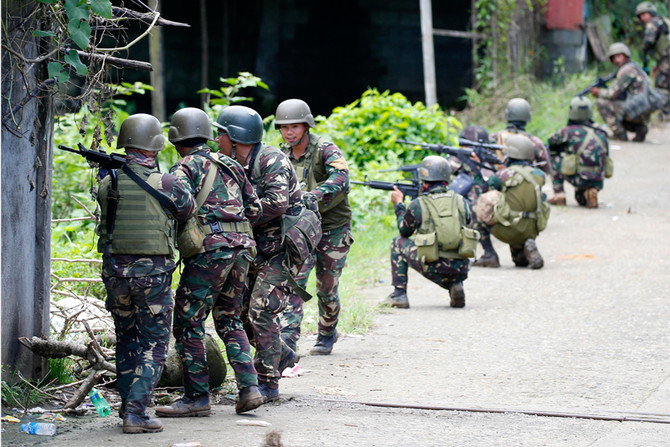
The announcement follows the end of the 154-day battle for Marawi city which stunned the Philippine’s military inexperienced in urban combat, and fueled concerns Islamic State loyalists wanted to use the southern island of Mindanao as a base for Southeast Asia activity.
The battle for Marawi ended on Monday. Philippines authorities said 920 militants, 165 troops and police and at least 45 civilians were killed in the conflict, which displaced more than 300,000 people.
Australia, along with the United States, Singapore and China, provided weaponry and technical support, including surveillance aircraft.
“All nations must learn from the recent Marawi conflict and the Philippines’ experience,” said Australian Defense Minister Marise Payne, adding Canberra and Manila will host a post-conflict seminar to learn from the five-month Marawi conflict.
About 80 soldiers from Australia’s mobile training team will be deployed in local bases in the Philippines to train army and marine units in urban counter-terrorism warfare, said Payne on the sidelines of an ASEAN Defense Ministers Meeting in Clark, a former US air force base.
“The practical training the Australian Defense Forces (ADF) will provide will ensure the Philippines defense force is better able to counter the brutal tactics being employed by terrorists,” Payne told a news conference.
“The spread of Daesh-inspired (Islamic State) terrorism is a direct threat to Australia and its interests and we are committed to working with our partners and allies to ensuring Daesh cannot establish a geographic foothold in the region.”
Payne said Australia was concerned with Islamic State fighters returning from Iraq and Syria to home countries in Southeast Asia and was working closely with Indonesia, Malaysia, Philippines and Singapore to monitor militant movements.
Philippine Defense Secretary Delfin Lorenzana said in the same briefing the government had been provided by Kurdish intelligence, through Manila’s embassy in Baghdad, with a list of Indonesians, Malaysians and a few Filipinos who might return home.
Lorenzana said the Philippines and Australia are now reviewing the deployment of surveillance planes, which flew four times a week over Marawi since late June.
Apart from urban warfare training, Australia will also enhance provide intelligence, surveillance and reconnaissance capability, share information and intelligence and strengthen maritime security engagement and bilateral maritime patrols.
An increasing number of Australian warships are expected to make visits to Manila. Canberra is also emerging to be the top source of education and training for local troops.


Australia expands security assistance to Philippines to combat Islamist militants
Australia expands security assistance to Philippines to combat Islamist militants

Pakistan Embassy denies role in Kabul visa black market as Afghans turn to agents
- Arab News investigation earlier found how Afghans resort to tour agents, pay up to $1,800 to obtain Pakistani visas
- Any additional money charged by travel agents is ‘outside the purview’ of the embassy, spokesperson says
KABUL: The Pakistani Embassy in Kabul has rejected reports of knowledge of a black market for Pakistani visas, emphasizing its unwavering commitment to a fair and accessible visa system for Afghans.
An Arab News investigation published last month found Afghans resorting to tour agents and paying exorbitant prices to obtain Pakistani travel documents, with desperate applicants paying between $1,300 and $1,800 for visas that officially cost more than 50 times less.
In a rebuttal shared with Arab News, the Embassy of Pakistan in Kabul said it “has no official agents, intermediaries, or affiliated travel companies authorized to collect money” from visa applicants.
“The embassy’s official visa fee is published transparently and must be paid directly via credit card. We are aware that many applicants lack credit cards and often rely on local agents for assistance with the online payment,” Sayed Khizar Ali, the embassy’s press counsellor, said in a statement to Arab News.
“Our commitment to a transparent, fair, and accessible visa system for our Afghan brothers remains unwavering.”
Multiple travel agencies in Kabul and Nangarhar that earlier confirmed to Arab News that Pakistani visas are traded on the black market have maintained their statements.
“How can it be outside their control when we send applications and they come back approved within three days?” one manager of a travel agency who declined to be named told Arab News this week.
“The embassy stamps the visas. They know where they come from.”
He said his agency has been processing dozens of visas weekly since October, after tensions between Afghanistan and Pakistan rose following a week of deadly clashes at their shared border.
“The travel agencies that are registered with them, we are the only way. If you don’t go through us, you won’t get a visa,” he said.
Despite the embassy’s denial that it does not work through travel agents, public advertisements by several tour agents offering services for “guaranteed” medical and tourist visas can be seen both online and on their storefronts. Though prices are negotiated privately, many openly promise quick turnarounds of just a few days.
The Afghan Ministry of Interior and Ministry of Foreign Affairs did not respond to requests for comment, despite repeated attempts by Arab News.
Pakistan’s visa fee for Afghan nationals is approximately $25, paid through a fully digital online system. But applicants who attempt to follow this channel told Arab News the process often ends in silent rejection after months of waiting.
Asma, an Afghan national who has been trying to join her fiance in Switzerland, had to go through tour agents to obtain her and her father’s Pakistan visas.
“I applied online through the official channel. That was four months ago. I never heard anything back. No response, no explanation — just complete silence,” Asma told Arab News earlier.
The cost to obtain the travel documents was double for her, as her father also had to apply in order to accompany her due to Afghanistan’s strict travel rules for unmarried women.
“We heard from neighbors that some agencies in Kabul could get it done faster … We went there,” she said, adding that they received their visas on WhatsApp three days later — not through official channels but through a cousin’s contact.
One agency employee who agreed to speak anonymously earlier described a system organized around waiting lists and contacts at the Pakistani Embassy and consulates in Kabul, Nangarhar, Kandahar and Mazar-e-Sharif.
“We have lists. Each list works like seats on a plane. When one list is full, we start filling the next. Every day, a list goes out — meaning visas are issued daily,” he said.
“These days, no visa costs less than $1,300 and none exceed $1,800. This rate has been stable for over a month.”
However, the Embassy of Pakistan in Kabul maintained that these reports are “unfounded and most unfortunate.
“Any additional money these private agents may charge applicants is an illegal and unofficial practice that occurs entirely outside the purview and control of the embassy.”


